
Guest Spotlight: Reflections from Gene L. Dodaro, the 8th Comptroller General of the United States and Head of GAO
Note for our readers: Today’s WatchBlog post is a guest spotlight written by the 8th Comptroller General and head of GAO Gene L. Dodaro. Mr. Dodaro arrived at GAO in the 1970s and is the first U.S. Comptroller General to come up through the agency’s ranks. His 15-year term ended on December 29.
We also recorded an interview with Mr. Dodaro in December. You can listen to that podcast episode here.
By Gene L. Dodaro, Comptroller General of the United States and head of GAO (2010-2025)—
I have had the honor to serve as U.S. Comptroller General and head of GAO for the past 15 years, plus over 2 years as acting head. But I got my start at the agency in 1973.
A lot has changed in the 50-plus years since then. Many of the challenges facing our country have changed. Technology has changed. The issues we audit here at GAO and how we audit them have changed. And GAO has needed to continually adapt in response to meet the evolving needs of the Congress and the nation.
In this WatchBlog post, I want to highlight how, over the past 50-plus years, GAO has evolved to better serve the Congress and the American people.
Image
GAO has changed to meet the moment and congressional interests
When I first arrived at GAO, we were focused on specific financial management issues, but the federal government did not yet prepare financial statements according to generally accepted accounting principles nor were they independently audited. GAO was also focused on evolving its burgeoning reviews of government programs and performance.
Thanks to congressional action, federal departments and agencies now annually perform individual audits of financial statements, and GAO audits the consolidated financial statements of the U.S. Government. We also continued to evolve and broaden our performance auditing work to virtually all aspects of government programs and operations in response to congressional interest. This includes emerging issues that could affect everything from national defense to public health. Here’s how we made this shift.
First, we’re more in sync with Congress. When I first came to GAO, less than a third of what we did was in direct response to a congressional request. Today, more than 95% of our work is in response to either mandates and legislation or requests from chairs and ranking members of committees and subcomittees. Congressional priorities and GAO’s strategic plan for serving the Congress and the nation result in a shared agenda. As a result, we are more in sync with Congress’ interests.
Importantly, parties come in and out of power over time. And GAO must work with and treat them both evenhandedly and consistently over time. We treat committee chairs (who are in the majority) and ranking members (who are in the minority) the same. Both have access to GAO resources. We developed congressional protocols that guide how we will interact with the Congress.
It’s vital that all parties trust GAO’s work as fact-based and nonpartisan. Members of Congress get information from a lot of different places. But GAO is the place they can come to where they know there is no agenda. We call balls and strikes based on facts and our independent, professional judgement. That’s it.
Second, we're very attuned to emerging issues. When I came to GAO, we barely had computers. Today, science and technology advancements are changing everything. Health care, transportation, even auditing: you name it, science and technology is changing it. And while these advancements have improved Americans’ lives, they have also raised concerns about personal privacy and civil liberties, as well as mental health.
GAO must have the know-how to audit these emerging advancements. And so, GAO has evolved its capabilities commensurate with this evolution in science and technology. The Congress also acknowledges how vital these efforts are and has provided us with the resources we need to audit everything from generative AI and quantum computing to hypersonic weapons and modernization of the nuclear weapons complex. In 2019, in conjunction with congressional interest, we launched a new team within GAO—our Science, Technology Assessment, and Analytics team—to expand our work in these areas. This effort included hiring staff with the right skills and expertise in a wider range of scientific and technology fields. We have engineers, chemists, biologists, physical scientists, and other technical experts. And it’s given us the ability to help the Congress better understand these advancements, as well as monitor their impacts on and risks to Americans.
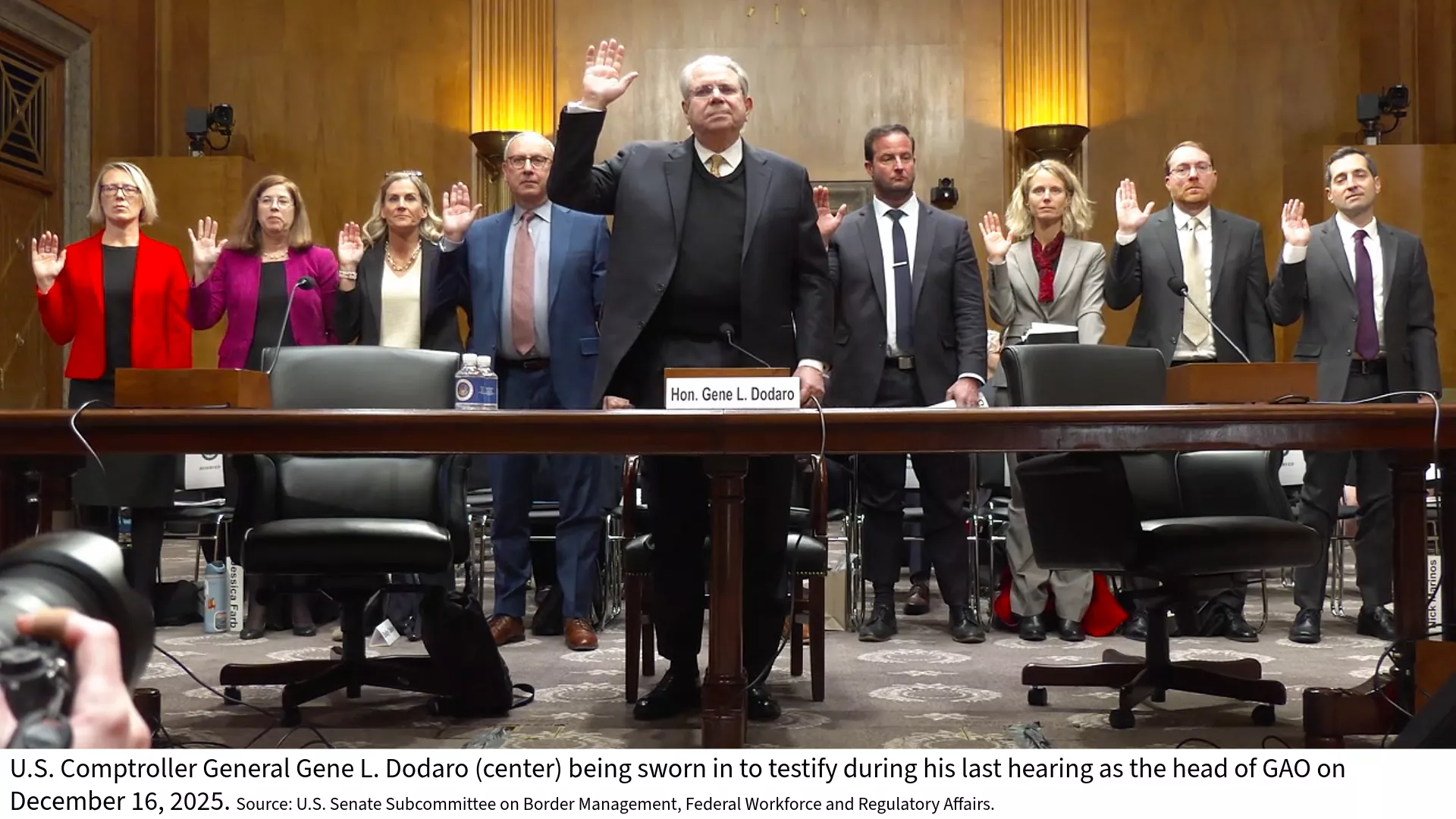
In my last testimony before the Senate on December 16, I also highlighted some of the continuing challenges that need immediate attention. These include issues that appear on GAO’s High Risk List, as well as the perils of our nation’s fiscal health. Watch my opening statement to senators below.
Third, we are auditing more in real time. Knowing how money was spent or how a program operated last year is useful. But so is auditing the federal response to an emergency in real time.
Some improvements to the federal response can’t wait for a crisis to end. For example, during the 2007-2009 financial crisis, GAO was brought in to do real-time auditing. We had to be on the ground auditing within days of the legislation being passed to stabilize financial markets, as well as stimulate the economy in response to the Great Recession. The goal was to have GAO there to maximize legislative objectives and minimize any fraud. These objectives were to unfreeze the credit markets and get our financial system and economy back on track as fast as possible. We learned a lot at GAO from this experience and, as a result, were ready to handle real-time audits during the COVID-19 pandemic.
GAO had a big role during the pandemic. We tracked $4.6 trillion that was allocated to respond to this public health and economic crisis. We issued 200 reports and made hundreds of recommendations to improve the federal response in real time, as well as suggested actions to better prepare for responding to future emergencies.
Accomplishments any comptroller general would be proud of
During my time as the head of GAO, our work has saved taxpayers more than $1.2 trillion and resulted in tens of thousands of improvements to how federal programs work. These accomplishments are a culmination of significant contributions from an exceptional workforce—one that values excellence in public service above all else.
The list of accomplishments is too lengthy for one blog post. But there are four categories of accomplishments I want to highlight.
First, GAO is now a reliable partner for the Congress during changing times and national emergencies. Our world is moving faster. Issues are evolving more quickly. It’s important that the Congress have current information about emergent issues so that it can make well-informed, timely decisions to address them. GAO has been there and will be there to provide that support and be a reliable source of real-time information, especially when Congress has to take extraordinary emergency measures.
Second, GAO is helping agencies prevent fraud. GAO is well known for its work on identifying and preventing fraud. Accountability is our middle name after all. But we don’t just find fraud. We have also established frameworks, guidance, and other tools to help federal agencies stop fraud before it begins.
GAO crafted a framework for preventing fraud, provided its first ever government-wide estimate of annual losses from federal spending due to fraud, and made recommendations to OMB and Treasury to measure fraud in high risk programs.
Third, GAO provided early and continuing focus on improving computer security and information technology management.
GAO’s work and recommendations have resulted in:
- Designating computer security as a government-wide high risk area since 1997 and critical infrastructure protection since 2003.
- Significant legislation and hundreds of actions to focus on strengthening computer security in the federal government and protecting critical infrastructure across the country.
- The establishment of chief information officers in the federal government to oversee the use and security of federal IT systems.
- Several laws to modernize or reform federal IT, such as the 1996 Clinger-Cohen Act and the Federal Information Technology Acquisition Reform Act of 2014 (better known by its acronym, FITARA).
- The establishment of laws to improve transparency of data collected. This includes the 2014 Data Act and the Taxpayer Right to Know provisions, which provide more transparency of federal spending to the taxpayer.
Fourth, I couldn’t be more proud of GAO’s workforce. The workforce we’ve built and retained over my term is full of hardworking, talented, dedicated public servants. GAO is a small agency with a big job of auditing the entire federal government. Our people provide Congress with the information needed to address pressing issues facing our nation. They have saved taxpayers hundreds of billions of dollars and improved the programs meant to serve Americans and keep them safe.
To the GAO team—past and present—I extend my deepest thanks for your extraordinary service. Your talents and dedication ensure that GAO’s mission remains strong for the Congress and the American people.
As I said at the top of this blog post, a lot has changed in the 50-plus years since I started at GAO. But during all my time here, one thing has remained consistent. No matter which party is in power, GAO remains steadfast in its commitment to provide the Congress with professional, objective, fact-based, nonpartisan work that aims to improve the federal government for the country and the American people.
- GAO’s fact-based, nonpartisan information helps Congress and federal agencies improve government. The WatchBlog lets us contextualize GAO’s work a little more for the public. Check out more of our posts at GAO.gov/blog.
- Got a question or comment? Email us at blog@gao.gov.
GAO Contacts
Image




GAO's mission is to provide Congress with fact-based, nonpartisan information that can help improve federal government performance and ensure accountability for the benefit of the American people. GAO launched its WatchBlog in January, 2014, as part of its continuing effort to reach its audiences—Congress and the American people—where they are currently looking for information.
The blog format allows GAO to provide a little more context about its work than it can offer on its other social media platforms. Posts will tie GAO work to current events and the news; show how GAO’s work is affecting agencies or legislation; highlight reports, testimonies, and issue areas where GAO does work; and provide information about GAO itself, among other things.
Please send any feedback on GAO's WatchBlog to blog@gao.gov.