
Does Nuclear Waste Cleanup Really have a 'Not in My Backyard' Problem?
The U.S. government has spent decades cleaning up nuclear waste left behind from the atomic bomb production and energy development that began in the 1940s. The Department of Energy (DOE), which manages this effort, estimates that it could take another 75 years to clean up its remaining 15 contaminated nuclear sites. And it could cost taxpayers an additional $641 to $840 billion.
One of the challenges with cleaning up this waste is differences of opinion between DOE and states. Some states are wary of the federal government’s cleanup efforts and about what happens to the land when it is finally done.
Today’s WatchBlog post looks at our two new reports on this issue.
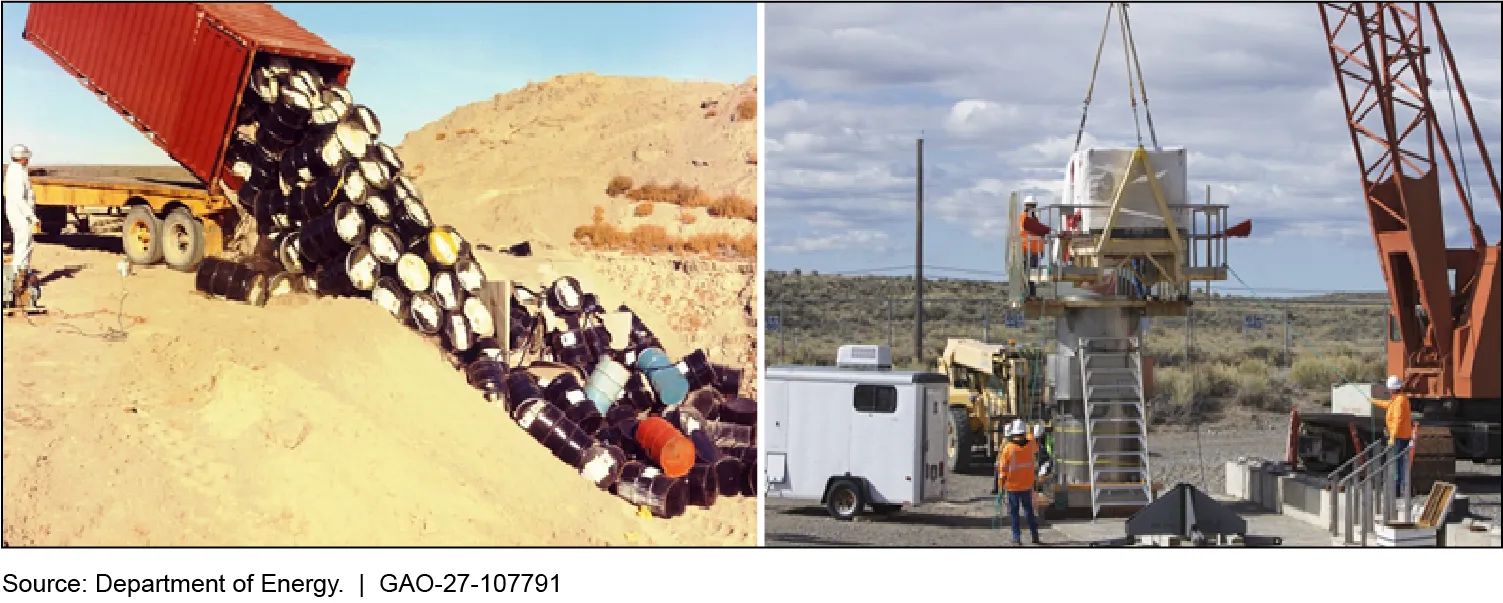
Cleanup at the Idaho National Laboratory (Left: Disposal in 1960s. Right: Cleanup of Same Area in 2020s)
Image
The fight over who regulates federal nuclear cleanup in states
Much of DOE’s nuclear waste is a mix of radiological and hazardous materials—both dangerous with the potential to cause cancer.
There’s no single law governing how nuclear waste should be cleaned up. Instead, there’s a complex set of federal and state laws, regulations, and cleanup agreements. DOE is largely responsible for regulating the radiological components of this waste. The Environmental Protection Agency (EPA) and certain states are responsible for regulating the hazardous components.
In some cases, this has caused friction between DOE and the states. And a congressionally directed review in 2015 found that the complex legal and regulatory framework was delaying DOE’s cleanup efforts and resulting in substantially higher cleanup costs at some sites.
As an example, let’s look at the Hanford Site in Washington State—one of the largest and most expensive environmental cleanup projects in the world. At Hanford, DOE is trying to address 54 million gallons of radioactive and hazardous waste stored in 155 large underground tanks. DOE and Washington State disagree on how certain regulations apply to this mix of radioactive and hazardous waste.
This matters because the mix determines who regulates it and how the waste must be treated. The disagreement over how certain regulations apply has slowed the cleanup and resulted in treatment approaches that may be more expensive than necessary. The result may be costing taxpayers billions of dollars. Other states like Utah and Texas have commercial disposal facilities that can accept waste physically similar to most of Hanford’s without requiring this costly treatment approach.
As another example, let’s look at the Waste Isolation Pilot Plant in New Mexico—the nation’s only deep geologic repository for the disposal of certain nuclear waste. New Mexico issued a permit for DOE to operate the facility. This permit explicitly prohibits the disposal of a certain type of radioactive waste present at specific sites, even if DOE determines that the waste otherwise meets the criteria for disposal at the site.
This matters because it makes it unclear who gets to decide which type of radioactive waste is appropriate for disposal at the site. This issue has prevented certain waste from being disposed of, which slows cleanup and costs taxpayer dollars.
Cleanup efforts fall short of future land use plans
What happens to land when it is finally cleaned up? DOE has been working with local communities since the 1990s on just that. This too is a negotiation of sorts.
DOE gets input from communities, states, Tribes, and local groups on how land might be used in the future. Then DOE and state regulators decide on the level of cleanup that should be completed to allow for a specific expected future land use—like residential. The decision ultimately impacts how that land may be used in the future. Lower levels of cleanup might mean land can only be used for industrial purposes. Higher levels, and it could be safe for residential development.
The decision on level of cleanup is affected by all kinds of factors, such as the extent of contamination, laws and regulations, and costs.
In a new report, we looked at future land use plans for six cleanup sites. Four of them are being cleaned up to meet the levels needed for industrial use, as DOE originally planned. At the remaining two sites, DOE is cleaning up some areas to allow for residential use, even though it had originally planned for and now anticipates industrial use at those sites. This means DOE may be spending more to clean up these sites than makes sense for the communities.
At the same time, DOE has transferred or leased a small amount of land to the community or private sector at five of the six sites. And DOE recently announced a new initiative for energy development and nuclear fuel activities at these sites.
Some community stakeholders we spoke with continue to express interest in having more land transferred to them and generally supported industrial use. They said this could promote economic growth, jobs, and new tax revenue for their communities.
To learn more about DOE’s nuclear cleanup efforts and our work on them, check out our latest report.
- GAO’s fact-based, nonpartisan information helps Congress and federal agencies improve government. The WatchBlog lets us contextualize GAO’s work a little more for the public. Check out more of our posts at GAO.gov/blog.
- Got a comment, question? Email us at blog@gao.gov.
GAO Contacts
Image



Related Products
GAO's mission is to provide Congress with fact-based, nonpartisan information that can help improve federal government performance and ensure accountability for the benefit of the American people. GAO launched its WatchBlog in January, 2014, as part of its continuing effort to reach its audiences—Congress and the American people—where they are currently looking for information.
The blog format allows GAO to provide a little more context about its work than it can offer on its other social media platforms. Posts will tie GAO work to current events and the news; show how GAO’s work is affecting agencies or legislation; highlight reports, testimonies, and issue areas where GAO does work; and provide information about GAO itself, among other things.
Please send any feedback on GAO's WatchBlog to blog@gao.gov.