
Could Blind Spots in Larger Vehicles Be Putting Pedestrians and Cyclists at Greater Risk?
Thousands of pedestrians and cyclists are killed on U.S. roadways each year. Bad weather, excessive speed, and poor decisions can result in fatalities. But could the growing number of large vehicles on roads play a role as well?
Commercial trucks, pickups, and SUVs tend to be bigger and may have larger blind spots (or zones) that limit drivers’ ability to see nearby pedestrians and cyclists.
Today’s WatchBlog post looks at our new report on the relationship between driver visibility in larger vehicles and an increase in pedestrian and cyclist fatalities across the nation.
Pedestrian and cyclist fatalities have increased, especially in crashes involving larger vehicles
The statistics are rather grim. About 9,200 pedestrians and cyclists died in traffic crashes in 2024 alone—an increase of about 65% since 2010.The greatest increase in pedestrian and cyclist fatalities came from crashes involving larger vehicles between 2010-2024.
A wide range of things could be contributing to this rise in pedestrian and cyclist fatalities. For example, a few years ago, we reported that driver and pedestrian behavior, roadway design, and limited visibility at night can affect fatalities.
More recently, in our new report, we looked at the types of vehicles involved in pedestrian and cyclist crashes.
Here’s what we found. Vehicles on U.S. roadways have been getting larger over time—even smaller cars like sedans are growing in size. And studies show that larger vehicles (and certain automobile designs) can create blind zones that limit driver visibility.
Examples of Increase in Vehicle Size, 1996 to 2026
Image
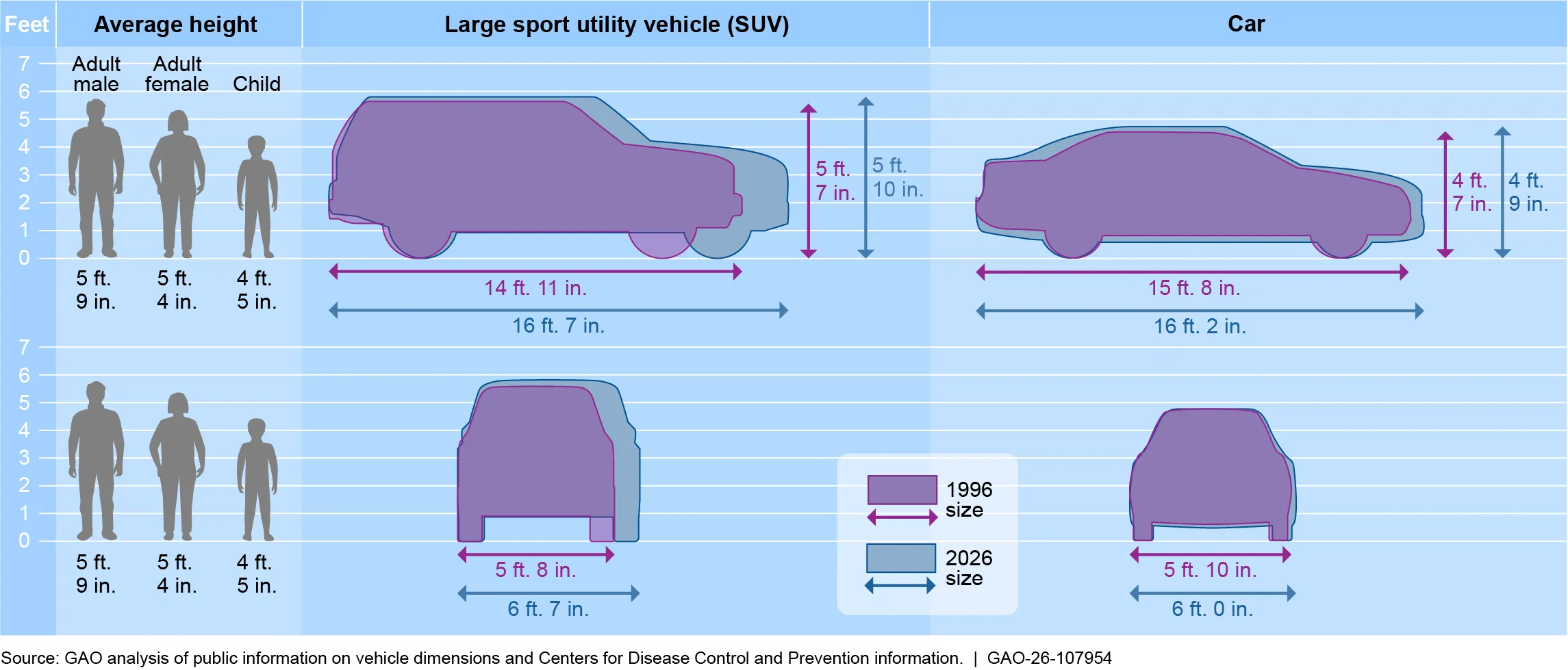
Blind zones include the areas in front of, beside, or behind the vehicle that are obstructed from the driver’s direct view. These zones tend to be bigger on SUVs and trucks. Safety features like large windows, mirrors, and cameras can help drivers see around the vehicle. But even these features don’t allow a driver to see everything.
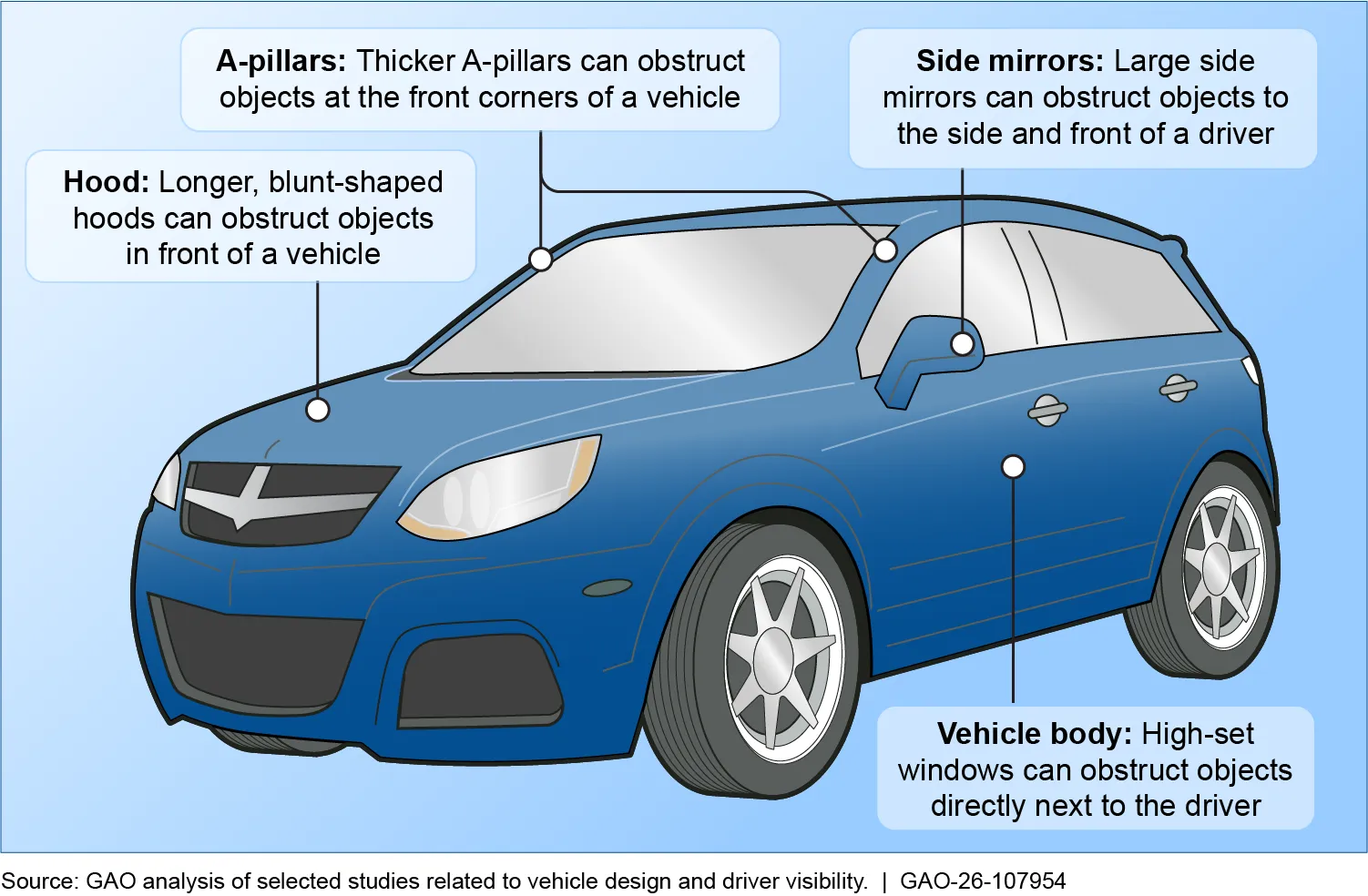
Vehicle design can also affect driver visibility. For example, a driver who is higher off the ground may not be able to see shorter pedestrians, like children, close to their vehicle.
The shape of the hood and large side mirrors can also obstruct a driver’s view. In one study we reviewed, blunt-shaped front ends like those on many trucks and SUVs were associated with a higher risk of pedestrian fatalities in a crash.
Other studies showed that when larger vehicles are turning, a driver’s ability to see nearby pedestrians and cyclists can be compromised as well. Our own analysis found similar results. For example, we found that SUVs, vans, and especially heavy-duty trucks posed a greater risk to pedestrians when turning than cars. Similarly, drivers turning right may have difficulty seeing cyclists in their blind zone, resulting in more severe cyclist injuries in a crash.
Safety features and the need to improve them
New cars come with safety features such as backup cameras. And all cars are equipped with side and rearview mirrors.
But some of the same safety features meant to protect those inside a vehicle may actually be putting people outside of it at risk. For example, federal safety standards call for stronger roofs to protect drivers and passengers during a rollover crash. Many automakers have responded by installing thicker A-pillars, especially in larger vehicles. But these bigger supports can also obstruct a driver’s visibility and create larger blind zones at the front and sides of the automobile.
Vehicle Design Features and Their Potential Relationship to Driver Visibility
Image
New technologies and standards might help address some of these and other concerns.
Safety technologies. Some vehicle manufacturers have developed technologies to help increase drivers’ awareness of nearby pedestrians and cyclists. For example, side bicyclist alerts warn a driver when a cyclist is in their side blind zone.
Pedestrian automatic emergency braking can detect and apply the brakes before a crash with a pedestrian. Other technologies—not specifically intended to detect pedestrians and cyclists—make drivers aware of obstacles and other vehicles around them. For example, lane assist systems alert the driver if they unintentionally depart from their lane. Camera monitor systems can also show drivers the sides of their vehicles, decreasing blind zones.
Safety standards. Some European countries have already begun implementing driver visibility standards. For example, some commercial truck operators in London must install additional safety equipment to meet minimum driver visibility standards.
For its part, the U.S. Department of Transportation (DOT) has begun to research and collect data on the relationship between driver visibility and risks to pedestrians and cyclists. But DOT has not determined a method to measure driver visibility. Having a better grasp on visibility issues would allow DOT to address the risks pedestrians and cyclists face and help meet DOT’s goal of reducing roadway fatalities.
Learn more about ongoing efforts to better protect pedestrians and cyclists in our full report.
- GAO’s fact-based, nonpartisan information helps Congress and federal agencies improve government. The WatchBlog lets us contextualize GAO’s work a little more for the public. Check out more of our posts at GAO.gov/blog.
- Got a comment, question? Email us at blog@gao.gov.
GAO Contacts
Image



Related Products

GAO's mission is to provide Congress with fact-based, nonpartisan information that can help improve federal government performance and ensure accountability for the benefit of the American people. GAO launched its WatchBlog in January, 2014, as part of its continuing effort to reach its audiences—Congress and the American people—where they are currently looking for information.
The blog format allows GAO to provide a little more context about its work than it can offer on its other social media platforms. Posts will tie GAO work to current events and the news; show how GAO’s work is affecting agencies or legislation; highlight reports, testimonies, and issue areas where GAO does work; and provide information about GAO itself, among other things.
Please send any feedback on GAO's WatchBlog to blog@gao.gov.