
Congress Curbs Institutional Investors’ Ownership of Single-family Homes. We Looked At this Trend
Last month, Congress overwhelmingly passed the 21st Century ROAD to Housing Act—legislation aiming to increase the supply and affordability of housing. It includes a restriction on institutional investors’ purchases of certain single-family homes. We recently looked at trends involving institutional investors’ buy-up of homes—including how they affected some cities.
Today’s WatchBlog post looks at our report on these trends.
Image
What’s the trend that led to concerns over institutional investors?
You may remember that back in 2007-2009 a large number of homes were in foreclosure. This was caused by the subprime mortgage meltdown. As foreclosure numbers increased, home values in a lot of communities tanked. But while prices were lower, fewer people were able to buy homes because of their financial situation.
Enter—the institutional investor. Large institutional investors (companies that own many homes) with money to spend leveraged their access to capital to purchase swaths of foreclosed homes.
After purchasing homes, institutional investors converted them into rental properties. At the time (the 2010s), this “buy-up” helped meet the growing demand for rental housing among those who couldn’t afford to buy. Lots of families needed more rental options.
But the housing market looks very different today. Today, there are concerns that such investment could mean higher rents, higher home prices, and lower homeownership rates.
Where are institutional investors still growing?
Nationally, institutional investors own about 3% of single-family homes. But some regions have a much heavier presence of institutional investors. This is particularly true in Sunbelt cities—such as Atlanta, Jacksonville, or Charlotte. These areas were also, in many cases, hit hard with foreclosures after the financial crisis.
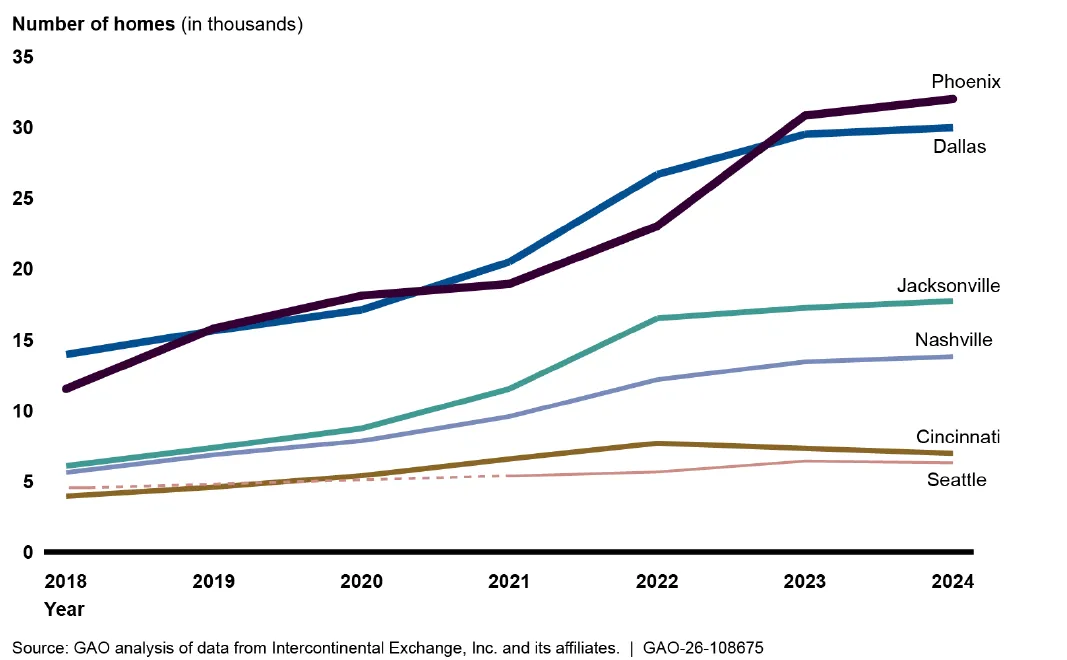
And in recent years the number of single-family rental homes owned by institutional investors has increased in some metro areas. This trend has leveled off recently. But between 2018 and 2024, we found that:
- Phoenix and Dallas recorded the largest increases, each adding at least 16,000 institutional investor-owned homes (an increase of about 177% and 114%, respectively).
- Jacksonville and Nashville each added at least 8,000 institutional investor-owned homes (an increase of more than 145% in each metro area).
- Cincinnati and Seattle saw smaller increases by 2024, adding about 3,000 investor-owned homes in Cincinnati and less than 2,000 in Seattle (an increase of about 76% and 40%, respectively).
The Number of Single-Family Homes Owned by Institutional Investors in Six Selected Cities, 2018-2024
Image
This growth raised concerns among members of Congress. Learn more about these trends by reading our full report. You can also read more by checking out our previous blog post on this topic.
- GAO’s fact-based, nonpartisan information helps Congress and federal agencies improve government. The WatchBlog lets us contextualize GAO’s work a little more for the public. Check out more of our posts at GAO.gov/blog.
- Got a question or comment? Email us at blog@gao.gov.
GAO Contacts
Image




Related Products

GAO's mission is to provide Congress with fact-based, nonpartisan information that can help improve federal government performance and ensure accountability for the benefit of the American people. GAO launched its WatchBlog in January, 2014, as part of its continuing effort to reach its audiences—Congress and the American people—where they are currently looking for information.
The blog format allows GAO to provide a little more context about its work than it can offer on its other social media platforms. Posts will tie GAO work to current events and the news; show how GAO’s work is affecting agencies or legislation; highlight reports, testimonies, and issue areas where GAO does work; and provide information about GAO itself, among other things.
Please send any feedback on GAO's WatchBlog to blog@gao.gov.