
When Commuters Become Teleworkers: City Planning in the Era of Remote Work
Empty buses and trains. Car-free streets during rush hour. Bustling business districts turned to ghost towns. Telework during COVID-19 brought sudden changes to many metropolitan areas. Even though many people have returned to their offices, cities are still reckoning with this shift in their communities.
Today’s WatchBlog post looks at our new report on how cities are adapting to the telework era.
Image
How is telework affecting cities today?
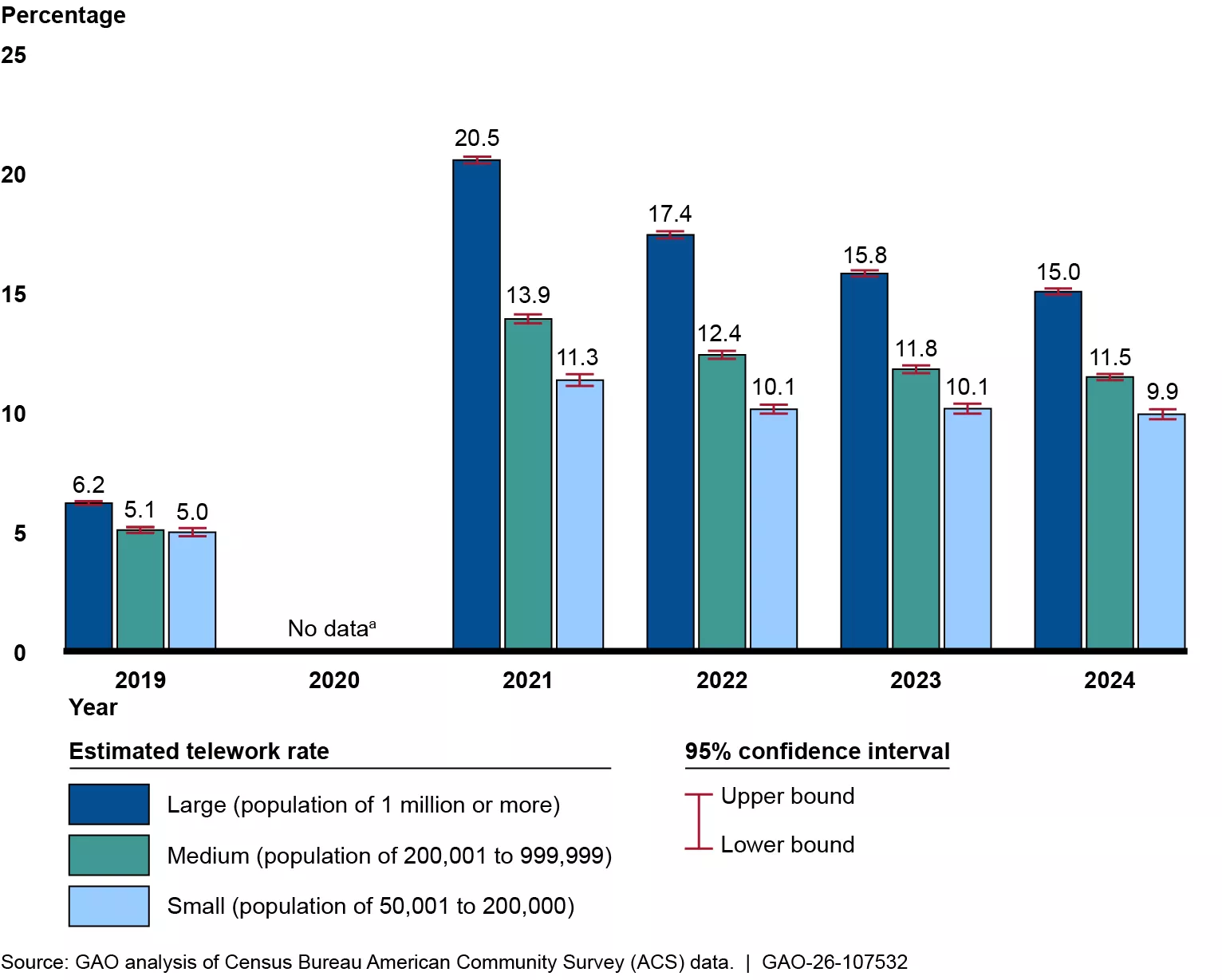
The estimated number of workers who primarily telework more than doubled between 2019 and 2024, from less than 6% to over 13%. This transition has changed cities in many ways, including:
Traffic. There are still fewer cars on the roads during rush hours, as workers continue to take advantage of workplace flexibilities, such as arriving and departing during off-peak hours. At the same time, for many communities, non-commuter traffic remained the same or increased between 2019 and 2024.
Transit. Public buses and trains have long served as a key means for people to get from place to place in a city. Urban areas saw ridership on public transit decrease by about 20% on average from 2019-2024, leading fare revenues to decline as well.
Real Estate. And we probably all know someone (maybe even you!) who moved out of the city to that suburban life during the pandemic. That’s a trend we see in the demand for housing. The demand for both housing and commercial real estate has shifted away from central business districts. Housing prices outside of central business districts have seen increases as teleworkers migrate. Prices have dropped for all types of commercial properties—like offices, retail locations, and hotels—with office properties seeing the largest decline.
Not all metropolitan areas have experienced these changes equally. Large communities, with a population of more than 1 million people, have seen significantly larger increases in telework than medium and small communities. As a result, large cities have felt the impact more. For example, 78% of large communities reported a decline in transit ridership from 2019-2024, while 41% of small communities reported declines.
Estimated Average Percentage of Workers Who Primarily Teleworked by Community Size, 2019–2024
Image
City planning that factors in telework
Addressing these changes is no small task. Across the nation, Metropolitan Planning Organizations are working to understand how these changes will affect their communities. They provide a forum where local government, transit agencies, and the public collaborate to address local transportation needs. This includes developing long- and short-term transportation plans, distributing federal funds for local projects, reducing traffic congestion, and more.
We asked all 410 Metropolitan Planning Organizations in the U.S. about how they are responding to the changes telework has brought. We heard back from about 350. Many told us that they or other community organizations like transit agencies are taking action to respond to changes, including trying to better understand current and future transportation needs. Some are taking actions like:
Conducting public transit and household travel surveys
Adjusting transit fares and schedules
Improving transit service
Changing roadway use
Repurposing unused commercial spaces
Many of these actions were designed to bring back or attract new transit riders. But few transit agencies have seen ridership rebound. If transit agencies cannot increase ridership and revenue, some may have to make tough decisions that could limit transit access for Americans.
To help these efforts, the U.S. Department of Transportation was supposed to complete a study that would provide guidance and best practices for transportation planning. This study was due in 2023. But the department has yet to complete it—leaving Metropolitan Planning Organizations struggling to know how best to plan for changes they are experiencing and forecast new travel behaviors. We recommended that the department establish a clear plan and timeline to complete the study.
To learn more about trends in telework and how cities are adjusting to address these changes, check out our new report.
- GAO’s fact-based, nonpartisan information helps Congress and federal agencies improve government. The WatchBlog lets us contextualize GAO’s work a little more for the public. Check out more of our posts at GAO.gov/blog.
- Got a comment, question? Email us at blog@gao.gov.
GAO Contacts
Image



Related Products

GAO's mission is to provide Congress with fact-based, nonpartisan information that can help improve federal government performance and ensure accountability for the benefit of the American people. GAO launched its WatchBlog in January, 2014, as part of its continuing effort to reach its audiences—Congress and the American people—where they are currently looking for information.
The blog format allows GAO to provide a little more context about its work than it can offer on its other social media platforms. Posts will tie GAO work to current events and the news; show how GAO’s work is affecting agencies or legislation; highlight reports, testimonies, and issue areas where GAO does work; and provide information about GAO itself, among other things.
Please send any feedback on GAO's WatchBlog to blog@gao.gov.