
Can DOD’s Ambitious New Missile-Threat Tracking System Deliver?
Note: This blog post was updated on February 23 to clarify information on the contractor’s role and estimated cost increases.
The future of U.S. missile-threat detection and tracking involves a new, large-scale constellation of satellites planned for low Earth orbit. This system promises to help the U.S. better track launches and movement of potential enemy missiles. But the ambitious plans to deliver these capabilities are already behind schedule and over initial cost estimates.
Today’s WatchBlog post looks at our new report on the status of this new missile warning and tracking system and the challenges that have slowed its progress.
Image

What is the new missile tracking system and why is it needed?
Up until recently, it was easier to track missile threats. Most missiles are launched using powerful rocket boosters, which can be spotted using infrared sensors in space. And it was also easier to predict where these missiles were headed. But in recent years, the Department of Defense (DOD) has identified emerging missile threats that make tracking and warning against potential missile attacks difficult. This includes hypersonic missile capabilities being used by Russia and China.
In response, the DOD began developing a new system that could detect missiles—a large constellation of low-orbiting satellites.
Earth Orbits with Missile Warning Satellites
Image
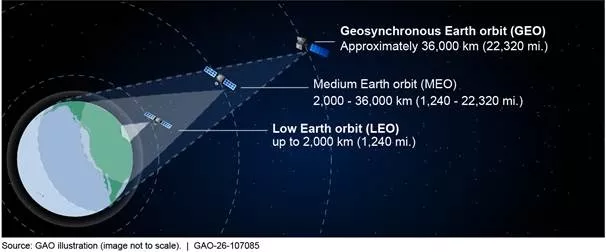
How does it work? Using satellites to identify and track missiles isn’t new. The United States has used satellites for this purpose for about 50 years. DOD currently relies on a small number of high-cost satellites and equipment operating approximately 22,000 miles above Earth (shown in the graphic above as geosynchronous orbit, or GEO).
Under the new missile warning system, at least 300-500 satellites would be used in low Earth orbit (LEO) to complement existing systems. These satellites are intended to make communications faster and more secure. And in a few years, DOD plans to add another group of satellites to these capabilities from medium Earth orbit (MEO).
Having satellites in low orbit could improve missile tracking, especially as new threats emerge. It would also give DOD better flexibility to update technology and adjust the constellation configuration if needed. Additionally, these satellites are less expensive to make and launch.
What’s the status of DOD’s efforts? The department’s goal is to deliver this capability as soon as possible. A round of satellites was launched in 2023 to test the feasibility of the system. The first satellites to deliver some operational capability began launching in September 2025. These satellites will need to be replaced roughly 5 years after launch.
The constellation is expected to cost $35 billion through FY 2029. But in our new report, we found challenges to DOD’s efforts that could increase these costs and potentially delay the fielding of needed capabilities.
DOD already faces technology challenges and other risks that could delay efforts
DOD is facing technical and supply chain challenges that are impeding its ability to meet deadlines and cost estimates for this new missile warning system. For example, we found that the department is relying on contractor assessments of some of the technology it plans to use. This approach sometimes fails to account for modifications and additional testing required to perform missile warning. This is adding to cost and schedule because it overestimates the readiness of technology for some critical elements it plans to use. This includes the spacecraft that houses the equipment that can improve satellites’ tracking ability.
Conducting technology readiness assessments of new elements would help DOD develop more realistic timelines for delivering its new missile warning system. It would also allow DOD to better understand the risks it faces of delivering a system that doesn’t meet, or is out of sync with, operational needs.
Similarly, we found that DOD’s costs are already exceeding initial estimates. For example, the ground contractor’s estimates to manage the first round of operational satellite deployments had grown to nearly $445 million, a 37% increase. The third round of deployments added another $491 million to costs. DOD has not developed and maintained reliable cost estimates, which are needed to support its decision making on this project.
Given the extraordinary importance of the missile warning mission, it’s imperative for DOD to find ways to address these and other challenges. Learn more about this new missile warning system and its challenges by reading our full report.
- GAO’s fact-based, nonpartisan information helps Congress and federal agencies improve government. The WatchBlog lets us contextualize GAO’s work a little more for the public. Check out more of our posts at GAO.gov/blog.
- Got a question or comment? Email us at blog@gao.gov.
GAO Contacts
Image



Related Products

GAO's mission is to provide Congress with fact-based, nonpartisan information that can help improve federal government performance and ensure accountability for the benefit of the American people. GAO launched its WatchBlog in January, 2014, as part of its continuing effort to reach its audiences—Congress and the American people—where they are currently looking for information.
The blog format allows GAO to provide a little more context about its work than it can offer on its other social media platforms. Posts will tie GAO work to current events and the news; show how GAO’s work is affecting agencies or legislation; highlight reports, testimonies, and issue areas where GAO does work; and provide information about GAO itself, among other things.
Please send any feedback on GAO's WatchBlog to blog@gao.gov.