
Missile Warning Satellites: Space Development Agency Should Be More Realistic and Transparent About Risks to Capability Delivery [Reissued with revisions on Feb. 2, 2026]
Fast Facts
DOD is developing a new system—a large constellation of satellites—to detect and track missile threats. But its current efforts risk not delivering needed capabilities as quickly as planned.
DOD is overestimating the readiness of some parts critical to this system, such as the spacecraft. This has resulted in unplanned work—adding time to contractors’ schedules.
DOD relies on contractors’ schedules to track the progress of its overall efforts. A system-wide schedule would help DOD understand how changes affect satellite launches and its ability to deliver capabilities that meet users’ needs.
We recommended that DOD address these issues and more.

Revised 02/02/2026 to replace the word “mission” with “missile” in both instances in Recommendation 3 on page 47.
Highlights
What GAO Found
The Space Development Agency (SDA) is developing space- and ground-based systems to detect and track potential missile threats in low Earth orbit. SDA aims to rapidly deliver capability and frequently update technology by delivering multiple satellites in phases, which it calls tranches, planned for contract award every 2 years. Each tranche needs to be replaced roughly 5 years after launch.
However, SDA is at risk of being unable to deliver capability as quickly as planned. For example, SDA is overestimating the technology readiness of some critical elements it plans to use. This includes the spacecraft, which must be modified for the mission. As a result, contractors have performed additional unplanned work, which has added to already delayed schedules.
Earth Orbits with Missile Warning Satellites
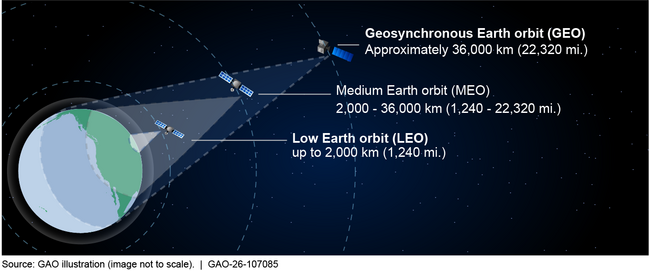
Additionally, SDA’s requirements process is not transparent to users. For example, SDA is not sufficiently collaborating with combatant commands, which report having insufficient insight into how SDA defines requirements and when, or whether, SDA will deliver planned capabilities. Consequently, SDA is at risk of delivering satellites that do not meet warfighter needs.
SDA reports achieving early milestones, but these achievements do not reflect schedule risks. SDA has continued to award new tranche contracts every 2 years irrespective of satellite performance. SDA relies on contractor schedules for each tranche but has not developed an overall or architecture-level schedule. Using an architecture-level schedule to monitor schedule risks would better position SDA and stakeholders to understand earlier how schedule changes affect SDA’s progress in delivering capabilities.
In addition, the Department of Defense (DOD) does not know the life-cycle cost to deliver missile warning and tracking capabilities because it has not created a reliable cost estimate. SDA required limited cost data from contractors for tranches 1 and 2. Requiring more complete and frequent cost data moving forward would enable DOD to develop reliable cost estimates for future tranches.
Why GAO Did This Study
DOD is developing large constellations of satellites for missions that include missile warning and tracking. SDA’s effort—known as the Proliferated Warfighter Space Architecture—plans to have at least 300-500 satellites in low Earth orbit. This constellation is expected to cost nearly $35 billion through fiscal year 2029. Given the design life of the satellites, each one must be replaced about every 5 years.
A Senate report contains a provision for GAO to assess DOD’s efforts to develop these capabilities. GAO’s report (1) describes SDA’s efforts to develop and deliver missile warning and tracking capabilities; (2) identifies risks SDA faces delivering these planned capabilities; (3) assesses aspects of SDA’s requirements process; and (4) evaluates the extent to which SDA is meeting schedule milestones and cost estimates.
GAO reviewed relevant program, DOD, and contractor documents; assessed SDA’s schedule and cost estimates against best practices; conducted site visits to a ground operations center, the Boulder Ground Innovation Facility, which analyzes satellite data, and seven contractor sites; and interviewed SDA and DOD officials and three combatant commands.
Reissued with revisions on Feb. 2, 2026
Revised 02/02/2026 to replace the word “mission” with “missile” in both instances in Recommendation 3 on page 47.Recommendations
GAO is making six recommendations, including that SDA should assess the technology readiness of new critical technologies; collaborate with warfighters on requirements and deferred capabilities; develop an architecture-level schedule and a reliable, data-informed cost estimate; and include requirements for cost data in new contract awards. DOD concurred with five of the recommendations and partially concurred with one recommendation.
Recommendations for Executive Action
| Agency Affected | Recommendation | Status |
|---|---|---|
| Department of the Air Force | The Secretary of the Air Force should ensure that the Space Development Agency conducts and documents a tailored technology readiness assessment for new critical technology elements inserted in each future tranche, starting with tranche 3. (Recommendation 1) |
When we confirm what actions the agency has taken in response to this recommendation, we will provide updated information.
|
| Department of the Air Force | The Secretary of the Air Force should ensure that the Space Development Agency is following the process reflected in the Warfighter Council charter to collaboratively, with warfighter participants, identify, define, and prioritize requirements, and present regular opportunities for interactive feedback and warfighter response. (Recommendation 2) |
When we confirm what actions the agency has taken in response to this recommendation, we will provide updated information.
|
| Department of the Air Force | The Secretary of the Air Force should ensure that the Space Development Agency develops a prioritized backlog to maintain traceability between overall missile warning and missile tracking requirements and tranche development efforts. (Recommendation 3) |
When we confirm what actions the agency has taken in response to this recommendation, we will provide updated information.
|
| Department of the Air Force | The Secretary of the Air Force should ensure that the Space Development Agency develops and maintains an architecture-level networked schedule for Proliferated Warfighter Space Architecture that reflects both government and contractor activities. (Recommendation 4) |
When we confirm what actions the agency has taken in response to this recommendation, we will provide updated information.
|
| Department of the Air Force | The Secretary of the Air Force should ensure that the Space Development Agency requires contractors to provide Cost and Software Data Reporting in awarded contracts. (Recommendation 5) |
When we confirm what actions the agency has taken in response to this recommendation, we will provide updated information.
|
| Department of the Air Force | The Secretary of the Air Force should ensure that the Space Development Agency develops and establishes reliable, data-driven cost estimates and a process for regularly updating these estimates that supports cost-informed decision-making beginning with tranche 3. (Recommendation 6) |
When we confirm what actions the agency has taken in response to this recommendation, we will provide updated information.
|