
$186 Billion Was Lost to Improper Payments Last Year. How Can We Prevent Them In the Future?
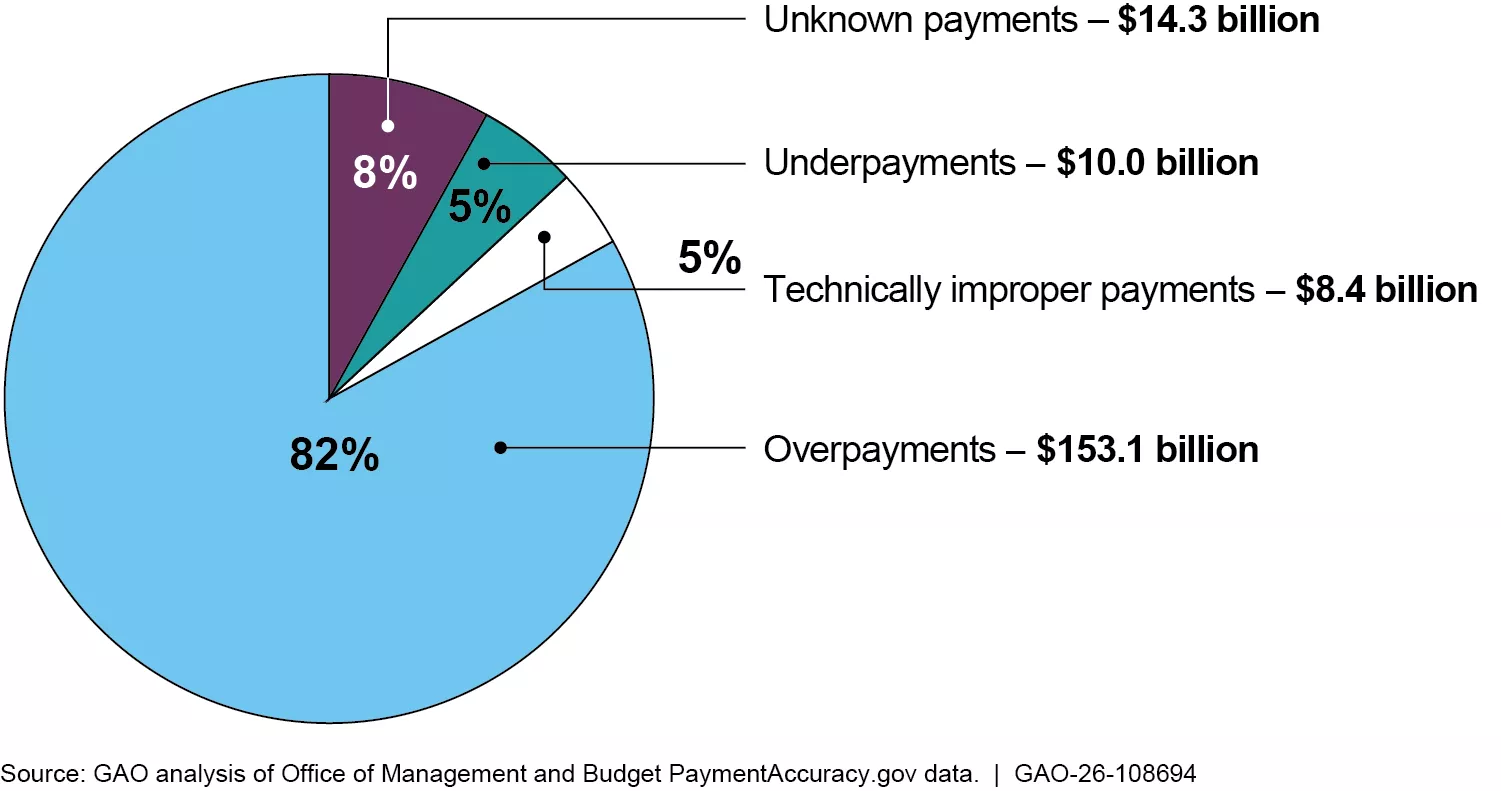
The federal government reported an estimated $186 billion in improper payments for FY 2025—an increase of about $24 billion from the prior year. The majority of these payments were errors that resulted from overpayments, such as paying someone who was ineligible for federal assistance.
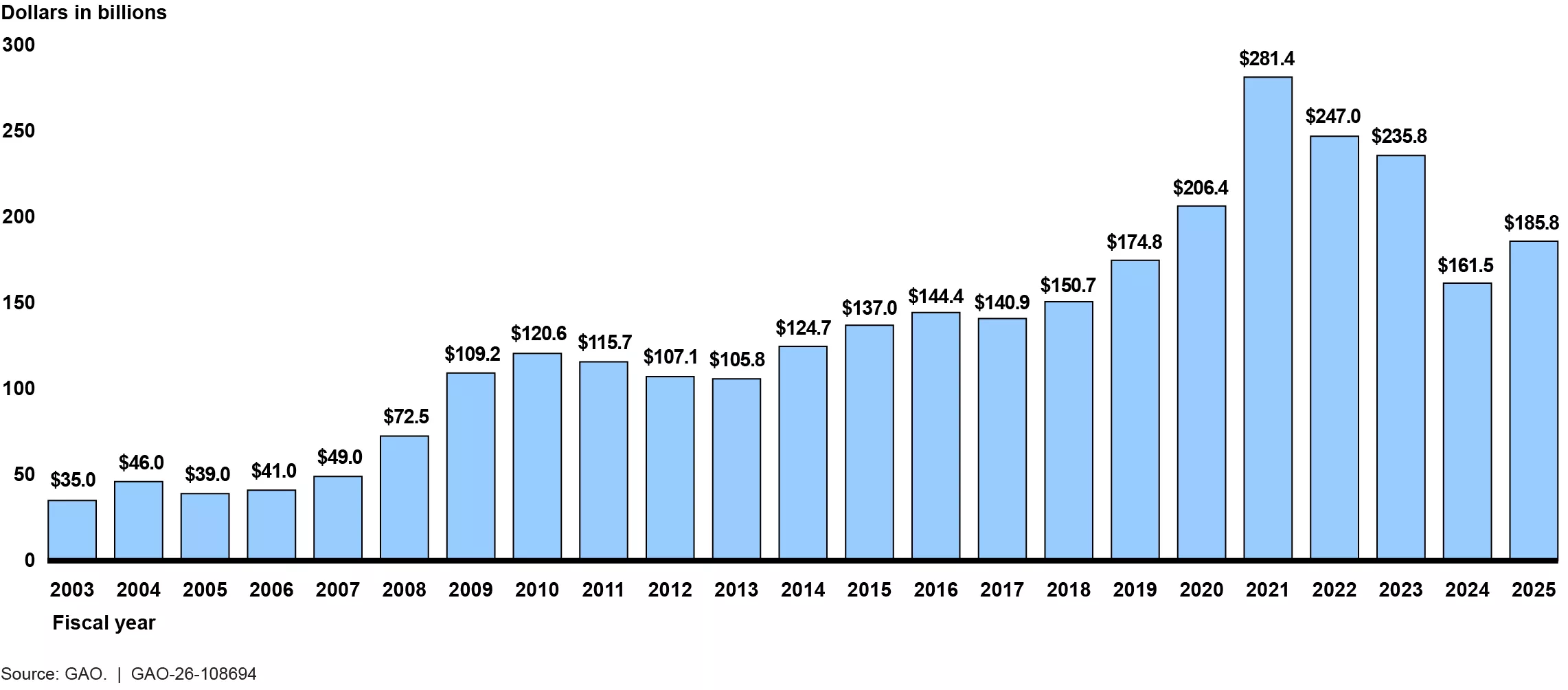
Although improper payments make up a small amount of overall government spending, they are a longstanding, significant problem. As much as $3 trillion has been lost to these payment errors since FY 2003. And it is important to address their underlying causes.
Today’s WatchBlog post looks at our two new reports about what causes improper payments, where did they occur most often, and what agencies are doing to prevent them.
Federal Agencies’ FY 2025 Estimated Improper Payments by Type
Image
Improper payments increased in FY 2025—here’s why
Improper payments are up this year, but the increase was partly due to better reporting by agencies. For example, some programs that did not report in FY 2024 did so in FY 2025. The increase can also be attributed to eligibility redeterminations and provider screening under Medicaid as COVID-era expanded coverage was phased out. That change represented about $153 billion of the estimated overpayments in FY 2025.
And while improper payments increased last year, they are down when compared to the last 5 years or so. Payment errors are in line with their pre-COVID pandemic levels.
Total Reported Improper Payment Estimates, Fiscal Years 2003-2025
Image
Where did improper payments occur the most in FY 2025? We look across some 15 agencies and 64 programs for improper payments. About 73% of reported errors occurred within five program areas—Medicare, Medicaid, the Earned Income Tax Credit, the Supplemental Nutrition Assistance Program (SNAP, sometimes known as food stamps), and the Small Business Administration's Shuttered Venue Operators Grant program.
Programs Reporting the Largest Percentage of Improper Payments, FY 2025
Image
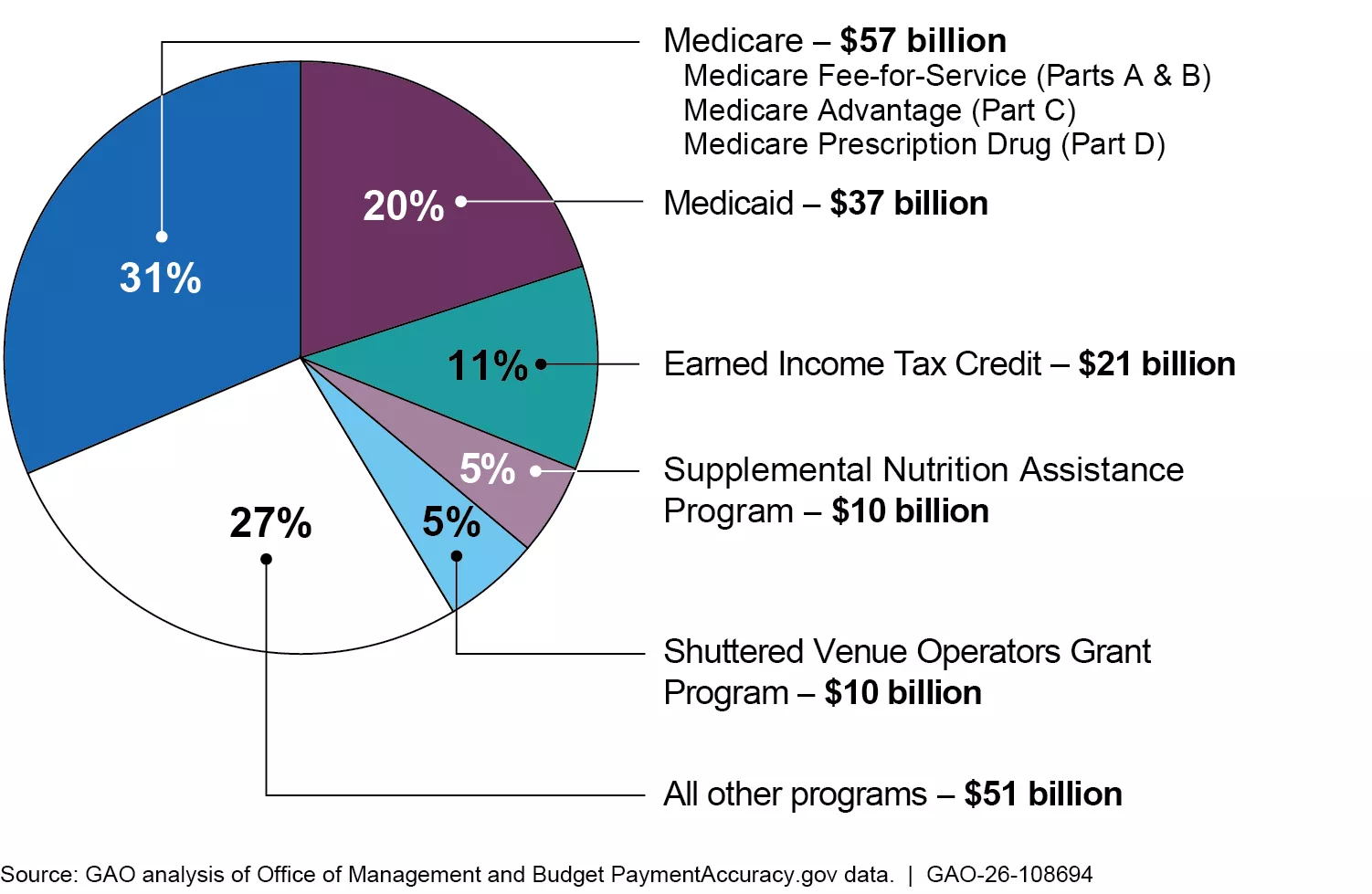
Of the 64 programs we looked at,
- 8 reported improper payments of $5 billion or more
- 19 reported these payments occurring at a rate of at least 10%
- 6 programs reported a rate of improper payments exceeding 25%
Some improper payments go unreported. This isn’t the totality of improper payments activity. It’s likely some payment errors go undetected or are not reported.
The government-wide estimate doesn’t include some programs that were determined to be susceptible to significant payment errors. For example, the $186 billion estimate doesn’t include potential improper payments made under the Temporary Assistance for Needy Families (TANF). About $16.5 billion was spent under TANF in FY 2025. But the Department of Health and Human Services (HHS) did not report improper payments under TANF as it does with others programs it runs, like Medicare and Medicaid. Part of the reason is that HHS does not have the authority to require states to report the data it needs to estimate improper payments. But we think it should. And we have asked Congress to consider taking action that would give HHS that authority.
What should agencies be doing to prevent improper payments?
Understanding the causes of improper payments is key to preventing them. As part of the effort to stop payment errors, federal agencies must publicly report on them. These reports should include:
- A review of all programs and activities to identify those that may be at significant risks of improper payments
- An estimate of payment errors for those programs and activities
- Corrective actions and targets for reducing improper payments
For agencies that don’t comply with certain improper payment requirements, such as appropriately reducing improper payments to less than 10%, follow-up reporting to Congress, OMB, and GAO is needed. Agencies with higher rates of improper payments for multiple years in a row have not always completed this additional reporting.
Noncompliant Agencies with Improper Payment Rates Greater than 10% for Consecutive Fiscal Years
Image
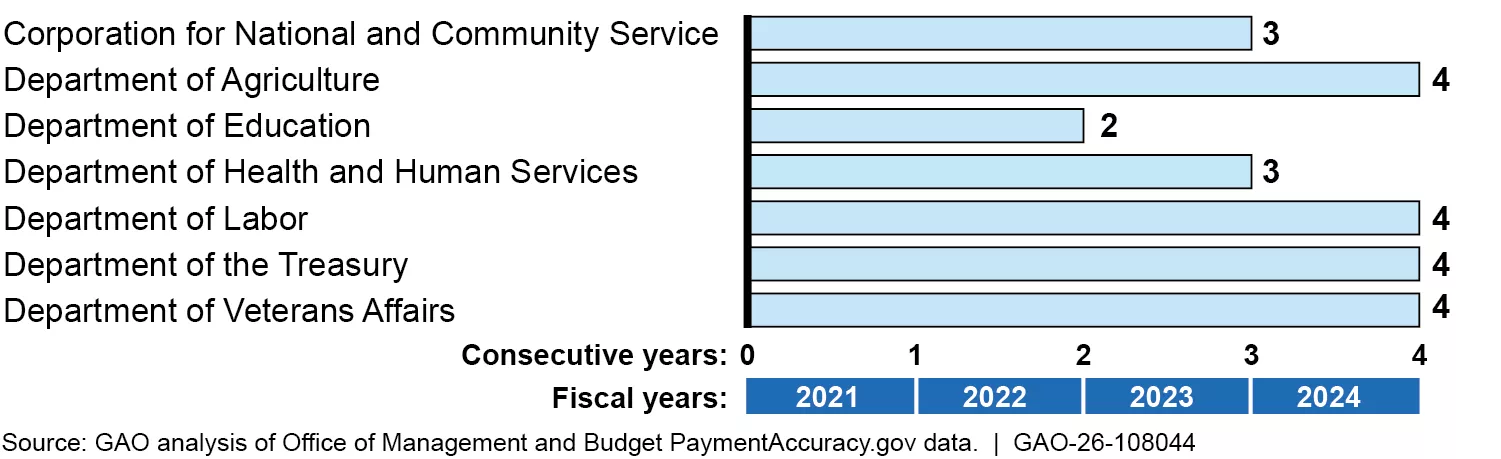
Why didn’t they report? We asked and officials at each agency told us the same thing. They said they meet the Office of Management and Budget’s (OMB’s) reporting requirements by posting information on PaymentAccuracy.gov. This website is run by OMB. It is meant to provide the public, policymakers, and oversight entities information about federal agencies’ progress in preventing and recovering payment errors. But the website doesn’t meet all of the reporting requirements discussed above. For example, it does not meet the requirement of reporting to Congress. This is important because Congress needs this information to assess agencies’ efforts to address improper payments and hold them accountable when they don’t.
What happens when agencies do not comply with these requirements? It depends on how many years they don’t comply. But generally, agencies must submit additional program information and take other actions to bring their efforts into compliance and reduce improper payments. The longer agencies go without submitting this information, the less visibility Congress has in understanding risks and helping support efforts to reduce improper payments.
To make sure Congress has the information it needs, we recommended a number of actions, including that OMB clarify its guidance to agencies on how to report annual information. We also recommended agencies improve their procedures for properly reporting.
Learn more about this issue and our recommendations by checking out our full report.
We also recently sat down with our experts to discuss how GAO helps federal agencies prevent improper payments and fraud. Watch that interview below.
- GAO’s fact-based, nonpartisan information helps Congress and federal agencies improve government. The WatchBlog lets us contextualize GAO’s work a little more for the public. Check out more of our posts at GAO.gov/blog.
- Got a comment, question? Email us at blog@gao.gov.
GAO Contacts
Image

Image



Related Products
GAO's mission is to provide Congress with fact-based, nonpartisan information that can help improve federal government performance and ensure accountability for the benefit of the American people. GAO launched its WatchBlog in January, 2014, as part of its continuing effort to reach its audiences—Congress and the American people—where they are currently looking for information.
The blog format allows GAO to provide a little more context about its work than it can offer on its other social media platforms. Posts will tie GAO work to current events and the news; show how GAO’s work is affecting agencies or legislation; highlight reports, testimonies, and issue areas where GAO does work; and provide information about GAO itself, among other things.
Please send any feedback on GAO's WatchBlog to blog@gao.gov.