
How is Social Security Death Data Helping to Prevent Federal Payment Errors?
The federal government makes all kinds of payments each day, everything from Social Security benefits to payments for weapon systems. But sometimes errors occur, including payments to dead people.
A pilot program has helped to reduce how often these errors occur. And it was so successful that the president recently signed a law to make it permanent—an action that GAO recommended. While the program helped reduce payment errors, it comes with financial costs that should be addressed.
Today’s WatchBlog post looks at our new report on the success of this effort and its costs.
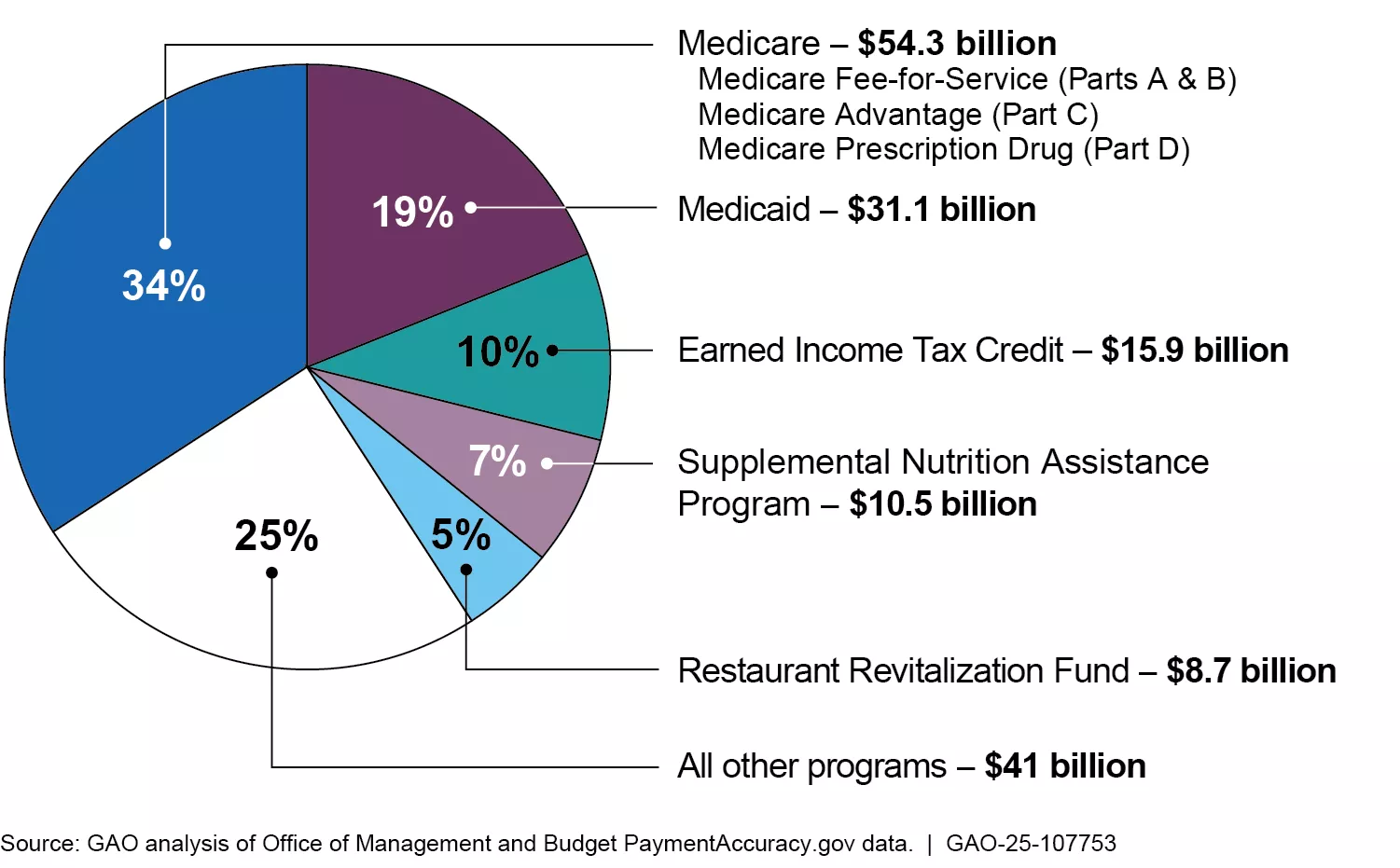
Programs Reporting the Largest Percentage of Government-wide Improper Payments Estimates for FY 2024
Image
How Social Security Death Data bolstered Treasury’s Do Not Pay system
Improper payments are a longstanding, widespread, and significant problem for the federal government. During the last 2 decades or so, these payment errors have cost taxpayers an estimated $2.8 trillion.
Why do so many payment errors occur? One key challenge is verifying the eligibility of recipients before issuing payments. This doesn’t mean the federal agencies or the states that administer programs aren’t checking eligibility. But it’s difficult because eligibility can change over time. For example, someone may age out of a program, or their income could change. And some people could no longer be eligible because of issues like delinquent child support or being late on nontax debt payments.
The “Do Not Pay” system is a key resource for checking eligibility. It allows agencies to verify recipients against a variety of databases prior to making payments. But until recently, the Do Not Pay system didn’t have access to another important data set—the full version of the Social Security Administration’s (SSA’s) Death Master File. The Death Master File is a comprehensive database that would help prevent payments to dead people.
Death data. This is where the pilot program came in and was so successful. Under the 3-year pilot, Congress gave SSA temporary authority to share the full version of its Death Master File with the Department of the Treasury’s Do Not Pay system. Prior to the pilot, SSA could only share a more limited set of death data with Treasury.
This doesn’t mean that federal agencies weren’t checking or couldn’t check to see if payments were being made to people who had died. But having access to SSA’s Death Master File through the Do Not Pay system greatly improved agencies' ability to check. SSA’s full Death Master File is more comprehensive than other sources of death information.
How successful was the pilot? In April 2025, Treasury reported that the pilot had identified and prevented or recovered $113.5 million in payment errors during its first year alone. Treasury also projects that the data-sharing partnership will result in more than $337 million saved during the 3-year pilot. As a result, Congress has approved making the pilot permanent.
While SSA’s death data is critical for preventing payment errors, the costs to obtain it have increased dramatically in recent years.
SSA’s death data costs have increased
Over the next 4 years, SSA estimates that it will spend more than $100 million to obtain death data.
You might be thinking—why does it cost the federal government money to obtain death data? In this case, the answer is in the source for the data. While SSA holds death data, this information is actually collected and owned by states. SSA must pay states to use the data. A few years ago, in 2023, SSA paid states $8.8 million total for this data. But then, under new contracts with states, this cost jumped to $23.8 million—a price tag that is expected to keep increasing.
SSA's Actual and Estimated Future Costs for State Death Records, 2023-2028
Image
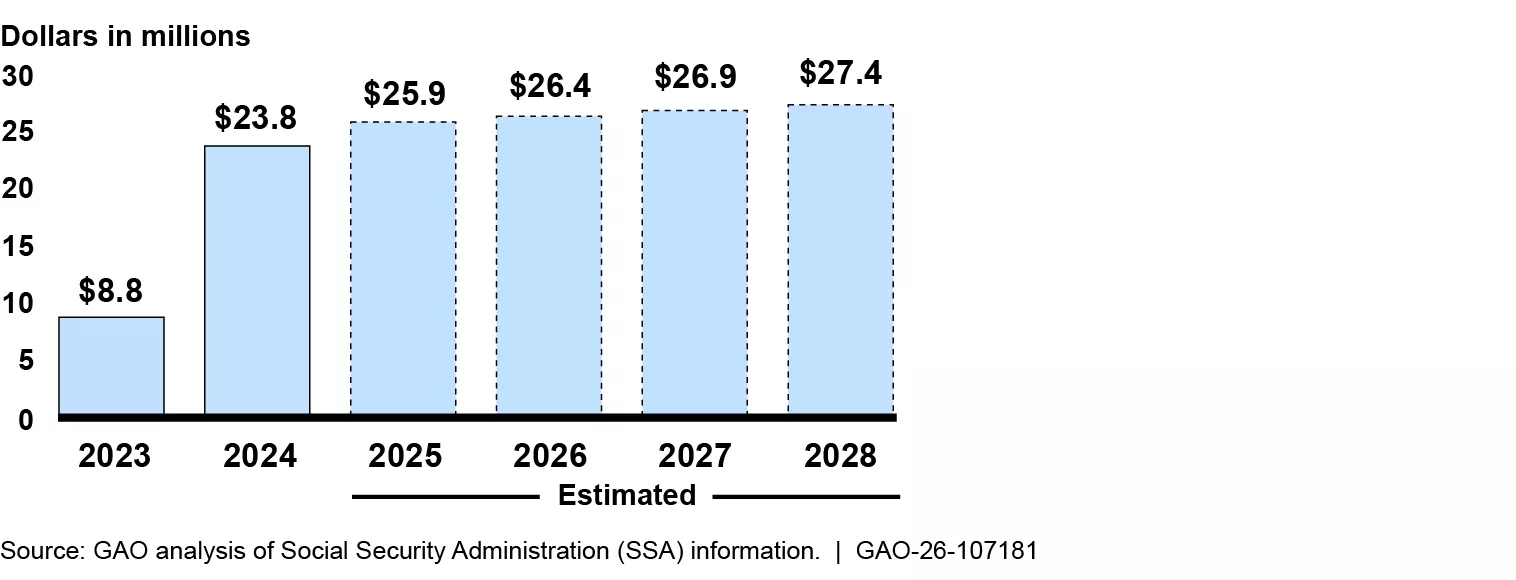
What caused the price to increase so dramatically? By law, SSA is supposed to compensate states for the costs they incur while collecting and maintaining the data, as well as a fee for transmitting data for SSA’s use. SSA recently renegotiated with states and will pay more for access to this data. SSA officials say the higher payments are meant to better encompass all of the costs that states incur. But we found that SSA didn’t collect the information from states that is needed to know what their costs are. As a result, SSA might be paying states more than it needs to.
As the death data sharing program moves from pilot to permanent, it’s important that SSA understand all the costs associated with obtaining this important data. We made recommendations to help SSA achieve this.
Learn more about our work on improper payments and death data by checking out our full report.
- GAO’s fact-based, nonpartisan information helps Congress and federal agencies improve government. The WatchBlog lets us contextualize GAO’s work a little more for the public. Check out more of our posts at GAO.gov/blog.
- Got a comment, question? Email us at blog@gao.gov.
GAO Contacts
Image



Related Products

GAO's mission is to provide Congress with fact-based, nonpartisan information that can help improve federal government performance and ensure accountability for the benefit of the American people. GAO launched its WatchBlog in January, 2014, as part of its continuing effort to reach its audiences—Congress and the American people—where they are currently looking for information.
The blog format allows GAO to provide a little more context about its work than it can offer on its other social media platforms. Posts will tie GAO work to current events and the news; show how GAO’s work is affecting agencies or legislation; highlight reports, testimonies, and issue areas where GAO does work; and provide information about GAO itself, among other things.
Please send any feedback on GAO's WatchBlog to blog@gao.gov.