
The 150-Year-Old Law Governing Animal Transport—Is It Time for an Update?
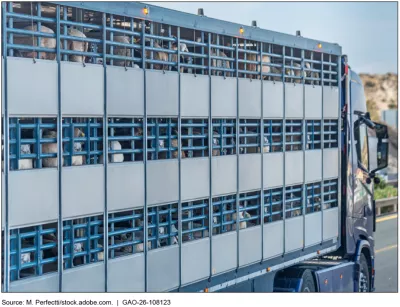
Cattle, goats, horses, sheep, pigs—hundreds of millions of livestock are transported by truck around the country each year. As these animals are travelling, they may experience overcrowding, extreme temperatures, lack of water, and other harsh conditions that can lead to injury or death.
The law governing the humane treatment of these animals was established in 1873. It generally prohibits animals from being confined for more than 28 hours during interstate transport without unloading for food, water, and rest. Much has changed in the 150 years since this law was established—including the arrival of the automobile—which replaced trains as the main method of transporting livestock.
Today’s WatchBlog post looks at our new report on whether this 19th century law has withstood the test of time and how it could be adapted to our modern world.
A Truck Transporting Sheep on a U.S. Highway
Image
Enforcing a 19th century law on humane treatment today
The 28-hour law has not changed much since it was first enacted in 1873. However, what has changed is how federal agencies enforce it.
How does enforcement work? USDA food safety inspectors monitor animals that arrive at slaughter facilities. They then investigate potential violations and report them to the Department of Justice (DOJ) for prosecution. But USDA oversight is ad hoc. Inspectors do not monitor every arrival to slaughterhouses, nor do they monitor livestock transported to other locations, like feedlots. As a result, they may miss violations.
In addition to limited oversight, there may be gaps in enforcement of violations. While the U.S. attorney general is responsible for prosecuting violations, the law does not say who should notify DOJ of potential violations. USDA has only referred one case to DOJ over the last 13 years. And officials from both agencies decided not to pursue action in that case.
Even if the DOJ had pursued action, the civil penalties may be an insufficient deterrent of inhumane treatment of animals during transport. Penalties for breaking the law range from $206 to $1,055 per shipment. DOJ officials said that these penalties are too low to incentivize the use of limited department resources for a costly civil case.
What could help improve enforcement? We think Congress should consider updating the 28-hour law to give USDA greater authority to monitor livestock transport. This could help catch more violations. We also recommended Congress consider raising civil penalties and granting agencies the ability to take administrative actions against violators to help incentivize compliance. This could include issuing warning letters or fines.
What else could improve conditions for humane animal transportation?
We also looked at whether the 28-hour law is actually meeting its original purpose of protecting animals against cruelty. We identified additional ways to prevent cruelty to livestock in transport.
Conditions. Addressing environmental and vehicle conditions like temperature, sanitation, and adequate ventilation to make sure animals are safe during transportation. Equally important is making sure they are fit for travel—meaning they aren’t traveling sick, injured, pregnant, or too young.
Driver preparedness. Training drivers to safely and humanely load, handle, and monitor animals in transport. Additionally, ensuring that drivers adequately plan routes and prepare for any emergencies that could arise, such as accidents, road closures, or bad weather.
Both the government and industry have made efforts to address some of these areas. For example:
- USDA has issued guidance for the international movement of animals under a separate law. It ensures vehicle sanitation, safe driving conditions, and humane treatment.
- Livestock industry groups told us they train, certify, and audit association members to ensure compliance with best practices for the safe handling and welfare of livestock. A veterinary group has also issued a policy to support humane animal transport.
- Other countries, such as Canada and Mexico, and the European Union require transporters to ensure the fitness of animals to travel before transport. They are also required to address other areas, such as driver preparedness and condition of vehicles.
We think Congress should consider updating the 28-hour law to improve enforcement and address issues, such as those above, that could help prevent cruelty to animals during interstate transport.
Learn more about the 28-hour law and how it could be modernized to better protect livestock in our new report.
- GAO’s fact-based, nonpartisan information helps Congress and federal agencies improve government. The WatchBlog lets us contextualize GAO’s work a little more for the public. Check out more of our posts at GAO.gov/blog.
- Got a comment, question? Email us at blog@gao.gov.
GAO Contacts
Image



Related Products

GAO's mission is to provide Congress with fact-based, nonpartisan information that can help improve federal government performance and ensure accountability for the benefit of the American people. GAO launched its WatchBlog in January, 2014, as part of its continuing effort to reach its audiences—Congress and the American people—where they are currently looking for information.
The blog format allows GAO to provide a little more context about its work than it can offer on its other social media platforms. Posts will tie GAO work to current events and the news; show how GAO’s work is affecting agencies or legislation; highlight reports, testimonies, and issue areas where GAO does work; and provide information about GAO itself, among other things.
Please send any feedback on GAO's WatchBlog to blog@gao.gov.