
Animal Transport: Congress Should Consider Modernizing the Law to Better Protect Livestock
Fast Facts
Each year, trucks transport hundreds of millions of livestock. If not managed properly, these trips can lead to animal illness, injury, or even death.
Federal law prohibits transporting livestock for more than 28 consecutive hours without breaks to protect the animals' health and welfare.
Our Q&A report noted that the law doesn't:
Address other important factors, such as animals' fitness to travel
Empower federal agencies to monitor compliance with the law
Set meaningful penalties for violations
As a result, it's unclear whether the law is effectively preventing cruelty.
We recommended Congress consider addressing this.
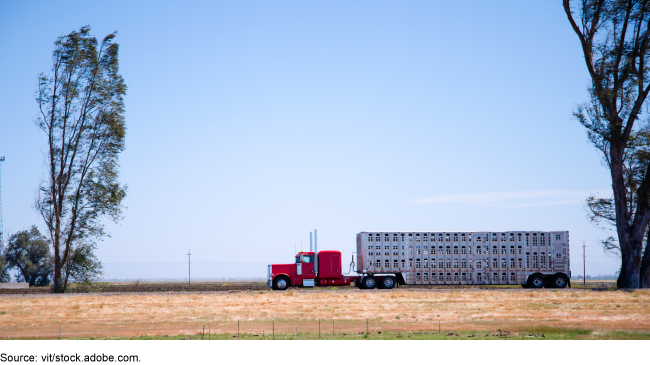
A large livestock-carrying truck on a country road.
Highlights
What GAO Found
Transport of livestock animals can extend over thousands of miles. If not managed properly, this can lead to injury, illness, or death. The Twenty-Eight Hour law is the primary federal law addressing the interstate transport of livestock animals. Historically, the law’s purpose has been to prevent cruelty to animals during transport by limiting the duration of confinement to 28 hours without humanely unloading them for feed, water, and rest. However, the law does not address other factors GAO identified that could help prevent such cruelty, including the animals’ fitness for transport and unsanitary vehicles and equipment. Industry and other stakeholders have noted that addressing these factors provides multiple economic, safety, and health benefits, such as preventing the spread of disease.
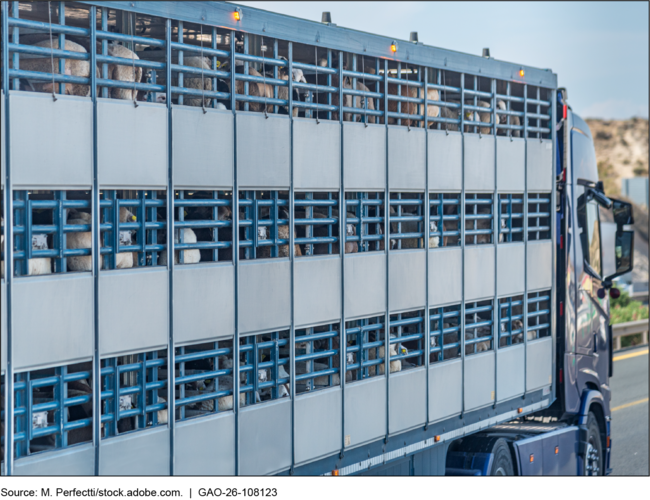
Truck Transporting Sheep on a U.S. Highway
The U.S. Department of Agriculture (USDA) has taken limited action to monitor interstate transport of livestock animals for potential violations because, according to officials, they do not have regulatory authority. The Department of Transportation (DOT) has not taken any such action because it does not have a role in or authority for ensuring welfare of livestock animals during transport, according to DOT officials. From 2013 through 2025, USDA referred one case involving a potential violation of the Twenty-Eight Hour law to the Department of Justice (DOJ) for enforcement, but no enforcement action was taken in that case. In general, the penalties and enforcement mechanisms are inadequate to incentivize enforcement, according to DOJ officials and other stakeholders GAO interviewed.
By amending the law or passing new legislation to (1) address factors beyond the duration of travel, (2) authorize federal agencies to monitor transport of livestock animals, and (3) enhance the penalties and authorize administrative enforcement actions, Congress would improve federal agencies’ ability to prevent cruelty to livestock animals during interstate transport. Congress would also be better positioned to hold agencies accountable for ensuring compliance.
Why GAO Did This Study
Hundreds of millions of livestock animals, such as cattle, goats, horses, mules, pigs, and sheep, are transported each year for various purposes, primarily by truck. Some of these trips may span many hours.
GAO was asked to assess federal agencies’ efforts to oversee the interstate transport of livestock animals. This report reviews the extent to which the Twenty-Eight Hour law addresses factors that could help prevent cruelty to livestock animals, and federal agency actions to monitor compliance with and enforce the law.
GAO reviewed relevant federal laws, regulations, and guidance; conducted site visits to two USDA-approved Feed, Water, and Rest stations; analyzed USDA data on potential violations of the law and assessed the reliability of these data; obtained and analyzed documents, when provided, and views from officials at USDA, DOJ, and DOT, and 17 nonfederal stakeholders, including industry and animal health and welfare groups.
Recommendations
GAO recommends that Congress consider amending the law or passing new legislation to address factors that could help prevent cruelty to livestock animals during transport, such as those GAO identified; authorize federal agencies to monitor interstate transport of livestock animals and specify their roles and responsibilities; and enhance the penalties and authorize federal agencies to take administrative enforcement actions.
GAO provided a draft of this report to DOJ, DOT, and USDA. DOJ and DOT provided technical comments, which GAO incorporated, as appropriate. USDA did not provide comments on the report.
Matter for Congressional Consideration
| Matter | Status | Comments |
|---|---|---|
| Congress should consider amending the Twenty-Eight Hour law or passing new legislation to address factors that could help prevent cruelty to livestock animals during interstate transport, such as those we identified. (Matter for Consideration 1) | When we confirm what actions the agency has taken in response to this recommendation, we will provide updated information. | |
| Congress should consider amending the Twenty-Eight Hour law to authorize federal agencies to monitor interstate transport of livestock animals and specify their roles and responsibilities. (Matter for Consideration 2) | When we confirm what actions the agency has taken in response to this recommendation, we will provide updated information. | |
| Congress should consider amending the Twenty-Eight Hour law to enhance the penalties and specifically authorize federal agencies to take administrative enforcement actions. (Matter for Consideration 3) | When we confirm what actions the agency has taken in response to this recommendation, we will provide updated information. |