
National Nuclear Security Administration: Reductions to Federal Workforce
Fast Facts
The National Nuclear Security Administration currently has its largest workload since the Cold War. It's overseeing a $200 billion, two-decade-long effort to modernize nuclear weapons and infrastructure.
We previously found that NNSA faced challenges recruiting and retaining skilled federal staff to meet its mission. In 2024, NNSA committed to rebuilding its workforce.
But in this Q&A, we reported that NNSA—in response to presidential directives in FY 2025—halted workforce planning and limited hiring. At the same time, employee separations increased significantly.
Consequently, NNSA has seen a 12% decrease in its federal staff since FY 2025.

Close-up of a person cutting the word jobs on paper with scissors
Highlights
What GAO Found
The National Nuclear Security Administration (NNSA) oversees a $25 billion annual budget and approximately 70,000 management and operating contractor personnel to maintain the U.S. nuclear weapons stockpile and nuclear nonproliferation efforts. NNSA took steps to build its federal workforce to meet mission needs in 2024, with its workforce peaking at 1,991 early in fiscal year 2025. However, since then through the second quarter of fiscal year 2026, NNSA has reduced its federal workforce by 236 employees—or 11.9 percent. These reductions have impacted NNSA’s mission critical workforce, including occupations like nuclear engineers and contract specialists.
Number of National Nuclear Security Administration (NNSA) Federal Employees and Annual Appropriations, Fiscal Year (FY) 2023–FY 2026 Quarter (Q) 2
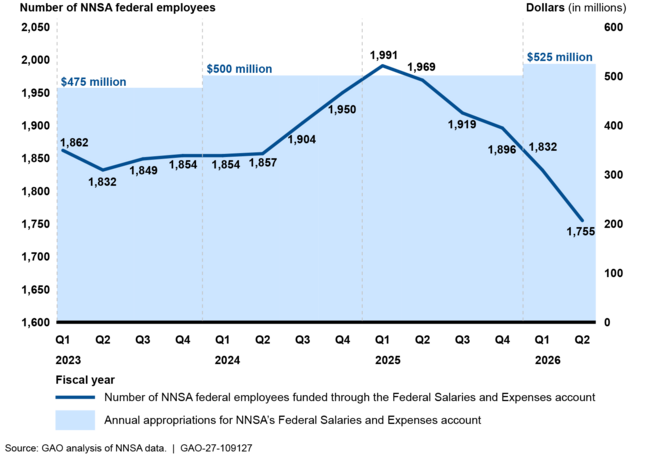
Note: The Federal Salaries and Expenses appropriation account funds the salaries, benefits, and other related expenses for most of NNSA’s federal workforce.
The reduction of NNSA’s workforce occurred because of two primary reasons: (1) very limited hiring and (2) employee separations—primarily employees choosing to retire or resign. Hiring was limited during the second quarter of fiscal year 2025 through the first quarter of fiscal year 2026.
Why GAO Did This Study
NNSA—a separately organized agency within the Department of Energy (DOE)—has a current workload that is at its highest level since the Cold War as the agency oversees a $200 billion, 2-decades-long effort to modernize nuclear weapons and related infrastructure.
In May 2024 (GAO-24-106167), GAO found NNSA continued to face challenges recruiting and retaining federal staff to meet the agency's mission needs, even though a statutory cap limiting the number of its federal employees was eliminated in fiscal year 2023. NNSA committed to developing a workforce planning process intended to inform future budget requests in response to its increased workload, the elimination of the cap, and consistent with GAO’s May 2024 report. The agency began building its workforce to meet mission needs in 2024. However, in response to presidential directives in early 2025, NNSA reduced the size of its federal workforce.
GAO was asked to examine NNSA’s retirements, resignations, terminations, and other voluntary or involuntary workforce reductions since January 2025. This report describes changes to NNSA’s federal workforce from the beginning of fiscal year 2023 through the second quarter of fiscal year 2026. GAO analyzed relevant NNSA data for workforce and personnel actions, including hires and separations, by program, office, and location. GAO also reviewed NNSA budget information and interviewed NNSA officials.
For more information, contact John Bumgarner at BumgarnerJ@gao.gov.