
State Department: Fly America Act’s Effects on Travel Costs and Personnel Experience
Fast Facts
The Fly America Act requires that all air travel funded by the U.S. government must use an airline owned by an American company—even when a foreign airline offers a cheaper ticket.
The requirement increases the State Department's travel costs by an estimated $0.7-$1.5 million annually. And it presents challenges for State personnel—for example, during mandatory evacuations when booking a flight on short notice can be difficult.
State can waive this requirement for its employees or their family members if, for instance, a U.S. airline doesn't offer the needed flight or there's a medical need.
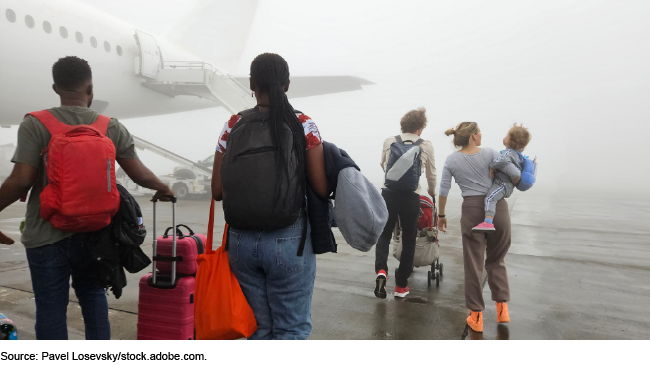
Group of people are walking on the tarmac of an airport. One of the people is carrying a baby near airplane in fog
Highlights
What GAO Found
The Fly America Act requires that, except under certain circumstances, all air travel funded by the U.S. government use a U.S.-flag air carrier service—which is generally provided by a U.S. airline or under a code share agreement with a foreign air carrier. GAO found that the Act increases State Department travel costs by an estimated $0.7 million to $1.5 million annually—about 1 to 2 percent of the $69 million State spent on air travel in fiscal year (FY) 2025. To derive this estimate, GAO analyzed a generalizable sample of simulated international travel itineraries for FY 2026. This sample consisted of 1,000 ticket pairs, each containing the least expensive unrestricted fare and most direct flight available for an Act-compliant ticket and -noncompliant ticket. For 5 percent of ticket pairs, GAO estimated that the Act increases State’s costs (reflecting both fare and travel time) by an average of $455 per ticket. For an additional 12 percent of ticket pairs, GAO estimated that the Act does not affect State’s costs. For the remaining 83 percent of ticket pairs, the Act’s effects on cost are uncertain because they are subject to assumptions about airline pricing strategies, among other factors.
Some State travelers experience challenges during urgent and routine travel as a result of the Acts, according to State documents, data, and officials. For urgent travel—for example, authorized or ordered departures from foreign posts and emergency travel for personal circumstances, such as for a funeral—Act-compliant flights can be difficult to find on short notice and approvals for exceptions may take time to process, according to officials. For routine travel, implementation of the Act poses challenges in three main categories: (1) compliant flight availability, (2) travel with pets, and (3) State’s administrative process to apply for an exception to the Act. In FY 2025, State approved employees’ applications for an exception to the Act, allowing them to use a foreign air carrier, for approximately 6 percent of itineraries between U.S. and foreign destinations. State most often approved requests claiming an exception to reduce trip duration, to reduce layovers abroad, to ensure timely arrival to accomplish State’s mission, and to travel with pets for new post assignments and evacuation travel. State rejected approximately 14 percent of waiver requests in FY 2025.
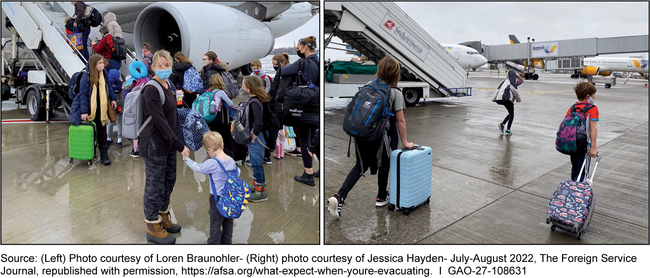
Ukraine Evacuation Flights Prior to Russian Invasion, Including Foreign Service Family Members
Why GAO Did This Study
The Act and its regulations allow travel on foreign carriers under certain circumstances, including when a U.S. air carrier is not available for medical reasons or traveler safety. However, a lower-price ticket on a foreign air carrier does not constitute an exception to the Act. The Act’s travel requirements may particularly affect State personnel, who represent 69 percent of all U.S. government personnel at U.S. posts abroad.
Congress included a provision in law for GAO to review the Act’s effects on U.S. government costs and State personnel. This report examines the Act’s effects on (1) State’s estimated travel costs and (2) State personnel’s experience with urgent and routine travel.
To examine the Act’s effects on State’s estimated travel costs, GAO developed a random, generalizable sample of 600 itineraries from the full universe of State’s 26,906 authorized itineraries for travel between a U.S. and a foreign destination in FY 2025. For each itinerary in this sample, GAO asked State to search for a pair of tickets—one ticket that complied with the Act and one that did not—for each route on specific dates in FY 2026. GAO analyzed any cost differences in the 1,000 resulting ticket pairs and extrapolated the results to derive a total cost estimate. To examine the Act’s effects on State personnel’s travel experience, GAO reviewed documentation, analyzed travel data, and interviewed State officials.
For more information, contact Chelsa Kenney at kenneyc@gao.gov.