
Performance and Accountability Report, Fiscal Year 2025
Fast Facts
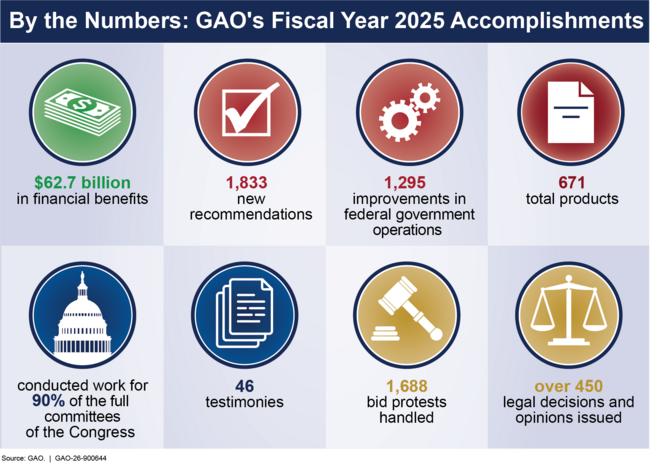
GAO's work yielded $62.7 billion in financial benefits for the federal government in FY 2025.
Our work improved the efficiency and effectiveness of federal programs and informed key legislative decisions. For example, provisions in the One Big Beautiful Bill Act require:
New limits on how states use taxes to fund their share of Medicaid costs—saving an estimated $191 billion in the next decade
A system that uses Social Security numbers to help ensure people aren't enrolled in multiple state health care programs, which could save an estimated $17 billion over 10 years
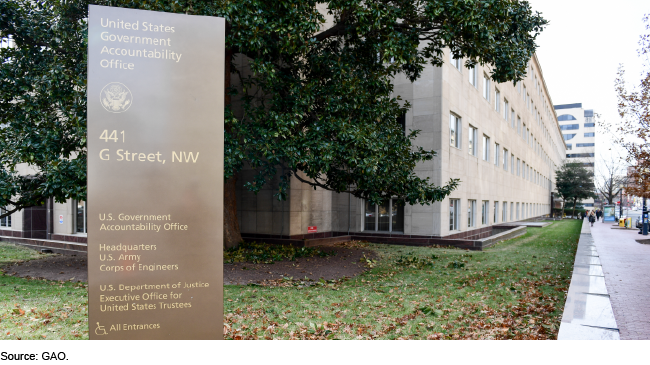
Photo of GAO headquarters in Washington, D.C.
Highlights
What GAO Found
GAO made significant accomplishments in FY 2025, as detailed in this Performance and Accountability Report for Fiscal Year (FY) 2025 (see figure). In the spirit of the Government Performance and Results Act, this annual report informs the Congress and the American people about what GAO has achieved on their behalf.
This report describes GAO's performance measures, results, and accountability processes for FY 2025. In assessing our performance, we compared actual results against targets and goals that were set in our annual performance plan and performance budget, and that were developed to help carry out our strategic plan. An overview of our annual measures and targets for 2025 is available here, along with links to a complete set of our strategic planning and performance and accountability reports.
This report includes a performance and financial snapshot for the American taxpayer for FY 2025, a letter from the Acting Comptroller General, and five parts.
Part I: Management's Discussion and Analysis. This section includes a statement attesting to the completeness and reliability of the performance and financial data in this report and the effectiveness of our internal control over financial reporting.
It includes a summary of our mission, organizational structure, strategies we use to achieve our goals, and processes for measuring our performance. In addition, it discusses our agency-wide performance results and use of resources in FY 2025. It also includes information on management challenges, external factors that affect our performance, and future challenges and priorities.
Part II: Performance Information. This section includes details on our performance results by strategic goal in FY 2025 and our targets for FY 2026.
Part III: Financial Information. This section includes details on our finances in FY 2025, including a letter from our Chief Financial Officer, audited financial statements and notes, and the reports from our external auditor and Audit Advisory Committee. This section also includes an explanation of the information each of our financial statements conveys.
Part IV: Inspector General's (IG) View of GAO's Management Challenges. This section includes our IG's perspective of our agency's management challenges.
Part V: Appendixes. This section provides the report's abbreviations and describes how we ensure the completeness and reliability of the data for each of our performance measures.
Why GAO Did This Study
As a legislative branch agency, GAO is exempt from many laws that apply to executive branch agencies. However, GAO generally holds itself to the spirit of many such laws, including the Government Performance and Results Act and the Federal Managers' Financial Integrity Act. Accordingly, the FY 2025 Performance and Accountability Report provides information on GAO's work, which it considers comparable to that reported by executive branch agencies that choose to prepare annual Performance and Accountability Reports in lieu of separate Agency Financial Reports.
For more information, contact Rebecca Gambler at GamblerR@gao.gov.