
Coast Guard: Actions Needed to Address Challenges that Hinder Maritime Security Operations
Fast Facts
We testified on U.S. Coast Guard maritime security operations before the House Homeland Security Committee, Subcommittee on Transportation and Maritime Security.
It is based primarily on the following reports:
- Coast Guard: Assessing Deployable Specialized Forces' Workforce Needs Could Improve Efficiency and Reduce Potential Overlap or Gaps in Capabilities
- Coast Guard: Actions Needed to Improve Maritime Interdictions
- Coast Guard: Actions Needed to Address Cutter Maintenance and Workforce Challenges
- Offshore Patrol Cutter: Coast Guard Should Gain Key Knowledge Before Buying More Ships
We made 26 recommendations to the Coast Guard in these reports. The agency has addressed some of our recommendations but still needs to address others.
A photo of the Capitol with the words GAO Testimony to Congress
Highlights
What GAO Found
In prior work, GAO identified challenges that have hindered the Coast Guard’s ability to meet its maritime security operation demands. GAO made the following recommendations to help address challenges pertaining to the Coast Guard’s workforce and assets, which it has yet to fully address.
- Workforce. In November 2019, GAO found that the Coast Guard lacked assurance that it had the right mix of deployable specialized forces personnel—who have capabilities needed to combat maritime threats—in the right units. GAO made two recommendations to address these issues. Further, in April 2025, GAO reported that even with increased recruiting, the service was approximately 2,600 service members (8.5 percent) short of its enlisted workforce target at the end of fiscal year 2024. GAO recommended that the service develop a plan to support its workforce retention.
- Vessels and aircraft. In June 2025 GAO found that the Medium Endurance Cutter’s availability to conduct missions declined from fiscal year 2020 through fiscal year 2024 due, in part, to maintenance challenges that limit its maritime security operations. This is exacerbated by persistent and longstanding challenges managing its planned $40 billion acquisition programs to modernize vessels and aircraft. In November 2025, GAO found that continued delays and cost overruns with the Offshore Patrol Cutter program—a high priority acquisition—are likely because of outdated cost estimates and incomplete ship design. GAO made nine recommendations to address these issues, including that Coast Guard stabilize design before constructing more ships.
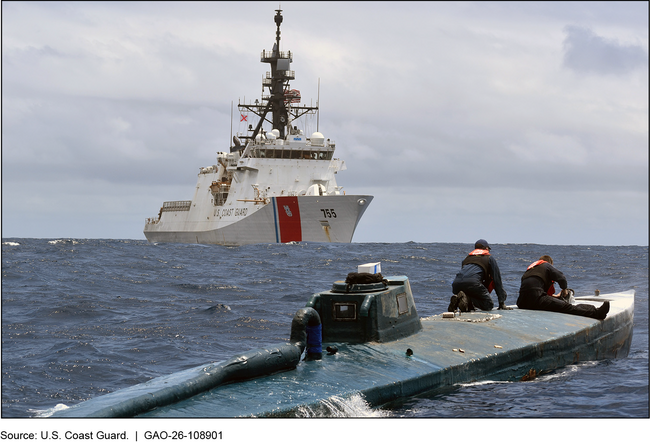
Coast Guard Deployable Specialized Forces Conducting Drug Interdiction Mission
Why GAO Did This Study
The U.S. government has identified transnational and domestic criminal organizations as a significant threat to the public, law enforcement, and national security.
The Coast Guard is a component of the Department of Homeland Security (DHS) and is the nation’s lead federal maritime law enforcement agency. It received nearly $25 billion in supplemental funding in fiscal year 2025 for various acquisitions and in support of efforts to modernize operations and capabilities. It conducts maritime security operations, including law enforcement boardings, drug interdiction, and other missions. The Coast Guard employs personnel and assets—including aircraft and vessels—to conduct maritime security operations.
This statement discusses Coast Guard challenges GAO previously identified related to its maritime security operations and actions to help address these challenges. This statement is based primarily on seven GAO reports published from November 2019 to January 2026.
Recommendations
GAO previously made 26 recommendations to the Coast Guard in the reports covered by this statement to help address challenges related to staffing, vessels, and aircraft, as well as acquisition delays and cost overruns.
DHS generally agreed with the recommendations. As of January 2026, four of the recommendations have been implemented. GAO continues to monitor the agency's progress in implementing the remaining recommendations.