
Hanford Cleanup: DOE’s Plans to Grout and Dispose of Millions of Gallons of Tank Waste
Fast Facts
The Hanford Site in Washington State is one of the largest and most expensive environmental cleanup projects in the world. The Department of Energy must treat and dispose of about 55 million gallons of radioactive waste that has been stored in underground tanks for decades.
In this Q&A report, we reviewed DOE's plan to grout, or harden the waste into a concrete-like material, and dispose of it offsite. For the grouting, DOE is considering whether to build a new facility onsite, ship waste to existing facilities, or both.
Grouting this waste is estimated to cost $480 million to $1.1 billion, excluding disposal and transportation costs.
A Shipment of Waste is Prepared at the Hanford Site in Washington State
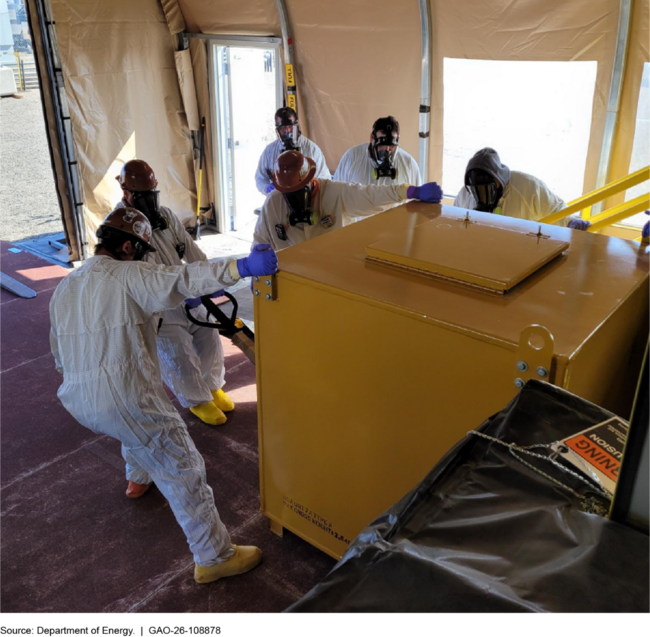
Workers in clean-suits and gas masks pull at a large, heavy-looking steel container
Highlights
What GAO Found
The Department of Energy (DOE) is pursuing options to grout (i.e., immobilize in a concrete-like mixture) a portion of waste from 22 underground storage tanks at the Hanford Site. Specifically, DOE plans to grout about 24 million gallons of waste that has low levels of radioactivity—called low-activity waste (LAW). The waste will then be disposed of at one of two commercial disposal facilities located outside of Washington State. DOE will generally follow five process steps to grout and dispose of Hanford LAW.
General Process Steps for Grouting and Disposing of Low-Activity Radioactive Waste from Hanford
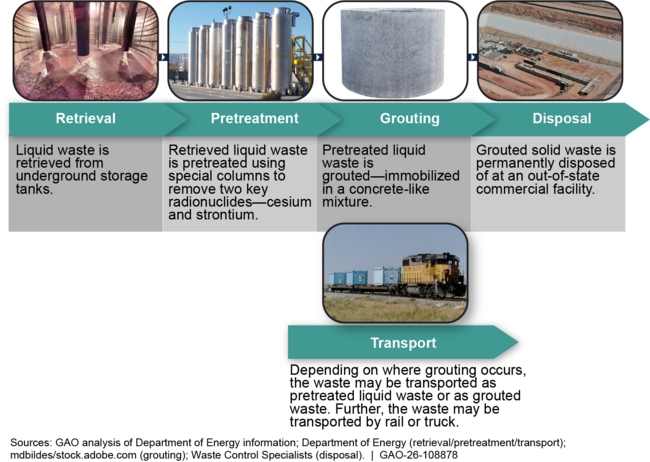
In December 2025, DOE’s tank waste contractor at the Hanford Site issued a solicitation to prospective subcontractors to submit proposals to grout the waste. As of April 2026, DOE and its contractor are evaluating proposals and plan to award one or more contracts later in 2026. As part of this evaluation, DOE is assessing options regarding where to grout this waste. DOE’s options include, for example, designing and constructing a new grouting facility onsite at Hanford or transporting liquid waste to existing grouting facilities for treatment and permanent disposal. In determining a path forward, DOE must consider a range of factors, including cost and schedule, associated risks, and disposal options. DOE must also consider whether to transport the waste in liquid or grouted form by truck or rail.
DOE officials and industry representatives agreed that a reasonable cost estimate for grouting Hanford LAW, in either a new or existing commercial grout facility, ranges from about $20 to $45 per gallon of waste. Accordingly, grouting 24 million gallons of LAW could cost $480 million to $1.1 billion. DOE officials and industry representatives emphasized these costs captured only the grouting process and did not include other key costs, such as transportation, disposal, and the need to address potential organic materials that were added during waste extraction operations and remain in a portion of the waste.
DOE is also exploring potential opportunities to continue grouting Hanford LAW beyond the initial 22 tanks. In doing so, DOE officials stated they must holistically consider the costs, schedules, and risks present across all of DOE’s efforts spanning the Hanford Site. They added that pursuing additional grouting opportunities could help the agency to address existing gaps in Hanford’s treatment capability and accelerate cleanup operations at the site.
Why GAO Did This Study
The Hanford Site in Washington State is home to one of the largest and most expensive environmental cleanup projects in the world. DOE’s mission at Hanford includes addressing approximately 55 million gallons of hazardous and radioactive waste stored in 177 underground tanks that must be retrieved and treated—or immobilized—before disposal. GAO has previously reported that grouting Hanford LAW could accelerate DOE’s cleanup mission and save billions of dollars.
Senate Report 119-39 includes a provision for GAO to assess DOE’s available options for grouting Hanford LAW. This report provides information on DOE’s options for grouting, transporting, and disposing of a subset of Hanford LAW and key factors for DOE’s consideration in pursuing identified options.
GAO assessed DOE documentation, relevant reports, and prior GAO work on DOE’s cleanup mission at Hanford and its options to treat and dispose of liquid tank waste. GAO also analyzed data from DOE’s Best Basis Inventory on the volume and radioactivity of selected underground storage tanks at Hanford. GAO interviewed DOE officials and industry representatives to identify and assess DOE’s options for grouting and transporting Hanford LAW as well as relevant factors affecting DOE’s decision-making.
For more information, contact Nathan J. Anderson at andersonn@gao.gov.