
Veterans Community Care Program: Information on Behavioral Health Referrals, Fiscal Years 2021 Through 2024
Fast Facts
The Department of Veterans Affairs can refer eligible veterans to health care providers outside of its medical facilities. VA has increasingly done so for veterans seeking behavioral health care, including for mental health or substance use conditions.
Veterans received over 600,000 referrals for behavioral health care from 2021 through 2024. More than half of these referrals were for outpatient therapy.
This Q&A report provides information on the referrals veterans received, including the care for which they were referred, and how much VA spent on that care.

A person wearing military dog tag seated across from a person with a clipboard.
Highlights
What GAO Found
The Department of Veterans Affairs (VA) operates the nation’s largest health care system through its Veterans Health Administration (VHA) and serves about 9 million veterans annually. VA’s Veterans Community Care Program allows eligible veterans to receive care from private sector community providers in certain circumstances. For example, veterans who face long wait times or other challenges accessing behavioral health services for mental health or substance use conditions at VHA facilities may receive them from community providers.
GAO found that veterans received over 600,000 referrals to obtain behavioral health services from community providers during fiscal years 2021 through 2024. Over half of these referrals were for outpatient psychotherapy care. VA data show the agency spent $4.29 billion on the community care veterans obtained through these referrals as of the time of this review, and over two-thirds of VA’s spending was associated with inpatient care, including residential treatment. Inpatient care is generally more expensive than outpatient care due to costs associated with overnight stays in a facility.
Veterans’ Behavioral Health Care Referrals to Community Providers and Associated VA Spending by Care Category, Fiscal Years 2021–2024
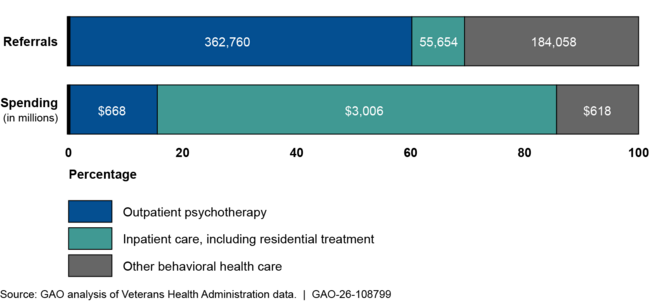
Specifically, GAO found that about 4 percent of behavioral health referrals (over 25,000 referrals) and 43 percent of spending (about $1.9 billion) were associated with residential substance use treatment in the community during these fiscal years. Residential treatment programs for substance use disorders allow veterans to receive intensive treatment in a supervised residential setting.
Why GAO Did This Study
GAO was asked to report on veterans’ behavioral health referrals to community care during fiscal years 2021 through 2024. This report provides information on the number of referrals veterans received during this period, the care veterans received through those referrals, and VA’s spending on that care (i.e., the total cost associated with these referrals).
GAO analyzed VA data and documentation on behavioral health referrals that veterans received in fiscal years 2021 through 2024 for which VA has received a claim from the community care provider as of January 2026. Each referral includes one category of care (e.g., outpatient individual psychotherapy) that indicates the specific services (e.g., counseling and therapy sessions) that the community provider is authorized to provide over a set duration of time (e.g., 6 or 12 months). GAO also interviewed VA officials knowledgeable about these data.
For more information, contact Sharon M. Silas at SilasS@gao.gov.