
Navy Shipbuilding: Improving Warfighter Engagement and Tools for Operational Testing Could Increase Timeliness and Usefulness
Fast Facts
The Navy uses operational testing to assess the capabilities of new ships. But "fleet organizations" that work in ship operations aren't consistently represented in test planning. This misses opportunities to get direct user feedback to make tests more relevant.
Using more digital tools could improve testing, too. For example, digital twins can allow the Navy to find and address some issues before live testing—saving money and time. But without a cohesive plan for developing and sustaining such tools, it will be difficult for the Navy to make testing more timely and useful. Our recommendations address these issues and more.
Arleigh Burke-Class Guided Missile Destroyer, Leaving Port
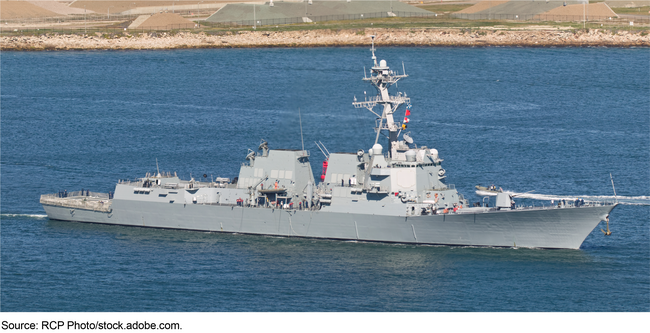
A photo of a large military ship in the water along a coastline.
Highlights
What GAO Found
Operational testing—used to evaluate the capabilites of a new vessel to perform in realistic and relevant conditions—is critical to the Navy’s understanding of a vessel’s ability to counter the advances of its adversaries.
Test Firing of a Navy Aircraft Carrier’s Ship Self-Defense System
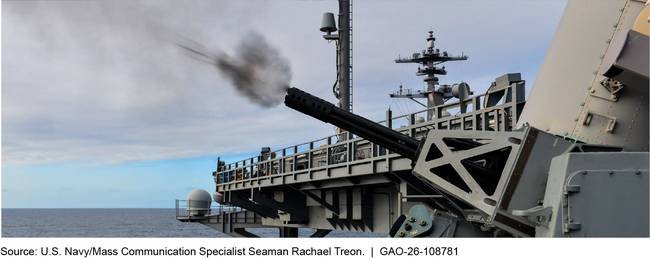
GAO found that Navy test and evaluation policy does not ensure consistent participation in test and evaluation working-level integrated product teams by key organizations representing the warfighter. Uncertainty about how warfighter organizations are represented in these teams—which are critical to test planning and execution for each shipbuilding program—poses challenges for ensuring that operational testing decisions reflect the current needs and interests of the fleet.
GAO also found that the Navy does not have a plan to replace the test capability provided by its aging self-defense test ship. The Navy uses this remotely operated vessel to test the self-defense systems that protect ships from incoming missiles. The Navy lacks a clear plan for replacing the unique capabilities of its test ship, as intended. This creates uncertainty for how the Navy will fulfill future operational testing requirements. A gap in, or loss of, such test capability could increase the risk to warfighters and ships in conflicts with adversaries.
In addition, while high-level Navy plans identify the need to invest in digital test infrastructure, GAO found that the Navy has yet to take coordinated action to respond to this need. For example, while some organizations had robust digital tools, GAO found that the Navy’s program-centric approach to fund, develop, and maintain digital test tools impedes investments in tools that could be widely used across shipbuilding programs. This program-centric approach also impairs the Navy’s ability to improve the timeliness and usefulness of operational testing. Without a cohesive plan for investing in the development and sustainment of its digital capabilities, the Navy risks not having the testing tools and infrastructure that it says it needs to confront an increasingly digital future—putting at risk U.S. warfighters’ ability to counter rapidly advancing adversaries.
Why GAO Did This Study
The U.S. Navy’s shipbuilding programs must deliver vessels with the capabilities needed to outpace new threats in an evolving maritime environment. Operational testing is central to the Navy demonstrating such capabilities.
A Senate report contains a provision for GAO to examine operational testing for Navy shipbuilding programs. GAO’s report addresses the extent to which (1) the Navy’s operational test and evaluation practices provide timely and useful information to acquisition decision-makers and warfighters, and (2) the Navy is developing and maintaining physical and digital test assets to support operational test and evaluation of its vessels. This is the public version of a sensitive report GAO issued in September 2025.
GAO reviewed operational test and evaluation documentation related to Navy vessels, interviewed officials from the Navy and the Office of the Secretary of Defense, and conducted site visits to three naval warfare centers and the Navy’s self-defense test ship.
Recommendations
GAO is making three recommendations to the Navy, which are intended to ensure that the Navy (1) has consistent representation from warfigher organizations in test planning, (2) makes a decision about maintaining the test capability currently provided by its self-defense test ship, and (3) establishes a cohesive plan for investing in digital test infrastructure. The Navy did not concur with GAO’s first recommendation, partially concurred with the second, and concurred with the third. GAO maintains that all three recommendations are warranted.
Recommendations for Executive Action
| Agency Affected | Recommendation | Status |
|---|---|---|
| Department of the Navy | The Secretary of the Navy should—in coordination with the Commander, U.S. Fleet Forces Command and Commander, Pacific Fleet—ensure that Navy policy, guidance, and practices provide for consistent participation in the test and evaluation working-level integrated product teams for Navy shipbuilding programs by user representatives from fleet forces organizations. (Recommendation 1) |
When we confirm what actions the agency has taken in response to this recommendation, we will provide updated information.
|
| Department of the Navy | The Secretary of the Navy should ensure that the Assistant Secretary of the Navy for Research, Development, and Acquisition—in coordination with the Chief of Naval Operations; Operational Test and Evaluation Force; and Director, Operational Test and Evaluation—makes a decision that outlines the Navy's plan for maintaining self-defense operational testing capability. This decision should be made in time to support the plan in future budgets and take into account, as applicable, planned actions to mitigate the effect that any gap in test ship availability will have on operational testing and evaluation. (Recommendation 2) |
When we confirm what actions the agency has taken in response to this recommendation, we will provide updated information.
|
| Department of the Navy | The Secretary of the Navy should establish a cohesive plan for investing in the development and sustainment of digital infrastructure that will support the Navy's ability to expand the use of enterprise-wide digital test assets for operational test and evaluation of Navy vessels. (Recommendation 3) |
When we confirm what actions the agency has taken in response to this recommendation, we will provide updated information.
|