
Democracy Assistance: State Should Require Plans to Mitigate Effects of Reported Antidemocratic Actions Overseas
Fast Facts
Historically, the U.S. has supported the spread of democratic values by funding pro-democracy programs in foreign countries. These democracy assistance funds from the U.S. Agency for International Development and the Department of State totaled about $14 billion in FY 2018-2023.
Recently, experts have noted a global trend toward authoritarianism. In countries where anti-democratic government activities have been reported, the agencies have had to repurpose democracy assistance funds. But without a plan, this caused confusion and loss of momentum in the programs they had funded.
We recommended that State create plans to help prevent this.
A person places an x inside a square to cast a vote.
Highlights
What GAO Found
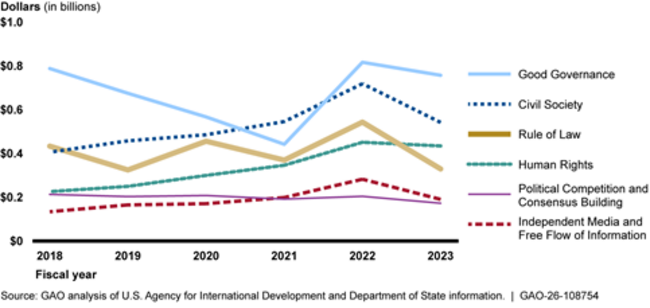
In fiscal years 2018 through 2023, the U.S. Agency for International Development (USAID) allocated about $9 billion and the State Department allocated about $5 billion for democracy assistance overseas. As the figure shows, allocations for the six categories of democracy assistance fluctuated during this period.
U.S. Democracy Assistance Allocations, Fiscal Years 2018–2023
USAID and State officials and representatives of organizations implementing U.S. democracy assistance in four countries GAO selected for its review identified several types of challenges they faced in providing this assistance. These challenges comprised actions by the countries' governments, such as harassment of civil society and media; aspects of the operating environment in each country, such as weak government capacity; and actions of U.S. and other donors, including competing diplomatic and democracy assistance priorities.
In the four selected countries, USAID and State did not plan to mitigate the risk that democracy assistance programs might have to shift, pause, or cease award activities that benefitted government entities. In fiscal years 2021 through 2024, after reported antidemocratic actions by the governments of some of the four countries, USAID and State paused or ceased assistance involving interaction with government entities and shifted assistance to nongovernmental entities. Agency officials told GAO that redirecting the assistance involved loss of programmatic momentum and confusion about how to proceed. GAO's review of 12 awards found USAID and State had not developed plans to mitigate this risk. According to agency officials, USAID and State did not require such planning.
A January 2025 executive order paused all U.S. foreign development assistance. In April 2025, State began a reorganization of the department, and in July 2025, the Secretary of State announced that USAID had ceased implementing foreign assistance. For future democracy assistance, establishing a requirement to mitigate the risk of having to redirect it away from host-country government entities would help State ensure that any decisions to pivot assistance are implemented efficiently.
Why GAO Did This Study
The quality of democracy has eroded in countries across the globe in recent years, according to organizations that construct and monitor democracy indexes. In fiscal years 2018 through 2023, the U.S. allocated more than $2 billion annually for assistance to promote democracy overseas.
A 2023 House Appropriations Committee print includes a provision for GAO to assess democracy assistance that USAID and State have provided. This report (1) describes USAID's and State's democracy assistance allocations in fiscal years 2018 through 2023, (2) discusses challenges the agencies and partner organizations identified as affecting the provision of this assistance in selected countries, and (3) examines the extent to which the agencies planned to mitigate specific risks in providing this assistance.
GAO analyzed data on democratic erosion and reviewed agency data and documents. GAO also visited El Salvador, Georgia, Sri Lanka, and Tunisia, selected on the basis of data about democratic erosion and U.S. democracy assistance funding. In each country, GAO held discussion groups with agency officials and partner organization representatives.
This is a public version of a sensitive report that GAO issued in September 2025. Information that State deemed sensitive has been omitted.
Recommendations
GAO is making two recommendations to State about mitigating risks related to democracy assistance that benefits host-country government entities. State neither agreed nor disagreed with these recommendations.
Recommendations for Executive Action
| Agency Affected | Recommendation | Status |
|---|---|---|
| Department of State | The Secretary of State should ensure that the head of any entity responsible for democracy assistance programs requires implementing partners to develop, during award design, a plan for mitigating the risk of having to shift, pause, or cease democracy assistance award activities that involve interacting with host-country government entities and to adjust this plan as needed throughout award implementation. (Recommendation 1) |
When we confirm what actions the agency has taken in response to this recommendation, we will provide updated information.
|
| Department of State | The Secretary of State should ensure that the head of any entity responsible for democracy assistance programs requires award managers to review, during award design, plans for mitigating the risk of having to shift, pause, or cease democracy assistance award activities that involve interacting with host-country government entities and to monitor adherence to these plans throughout award implementation. (Recommendation 2) |
When we confirm what actions the agency has taken in response to this recommendation, we will provide updated information.
|