
Disaster Loan Program: SBA Should Ensure Consistent Outreach to Survivors
Fast Facts
The Small Business Administration's Disaster Loan Program provides low-interest loans to help businesses and homeowners recover after a natural disaster.
SBA increased loan limits in 2023. In 2024, FEMA started allowing certain disaster survivors to apply for some types of FEMA assistance without applying for an SBA loan.
SBA's disaster offices issue press releases and fact sheets after disasters and include information about the loans. But each office shares its own version of these materials and some left out key details about the changes—leaving some survivors without clear or complete information.
We recommend that SBA address this.
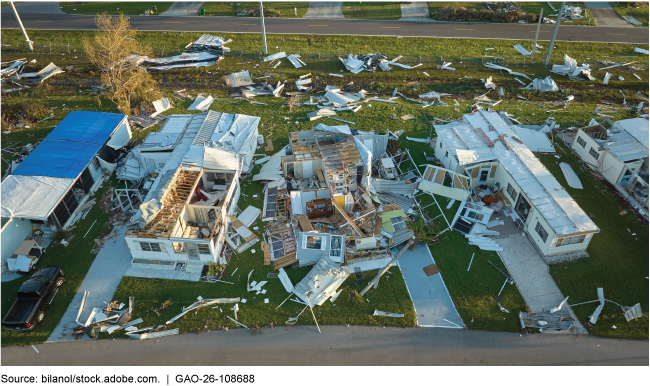
Homes destroyed by a tornado.
Highlights
What GAO Found
The Small Business Administration’s (SBA) Disaster Loan Program provides low-interest loans to businesses, nonprofits, homeowners, and renters to help repair, rebuild, and recover from physical and economic losses after a declared disaster.
In 2023 and 2024, SBA and the Federal Emergency Management Agency (FEMA) separately adopted rules affecting the program. SBA’s rule expanded options for loan recipients and adjusted program limits to reflect inflation. For example, it increased the maximum loan amount for repairing or replacing a primary residence from $200,000 to $500,000 and extended the loan deferment period from 5 to 12 months. FEMA’s rule removed the requirement that certain disaster survivors apply for an SBA loan—and either be denied or receive only partial funding—before qualifying for some types of FEMA assistance.
According to SBA’s guidance, its field operations centers are responsible for outreach materials for declared disasters that affect localized areas. SBA relies on press releases and fact sheets to inform disaster survivors and the media about the Disaster Loan Program. However, field operations centers did not consistently update SBA’s disaster-specific press releases or fact sheets to reflect key components of SBA’s 2023 and FEMA’s 2024 rules. GAO’s analysis of outreach materials for 76 presidentially declared disasters in 2023 and 2024 found that while materials from the two field operations centers were generally similar, they were not consistent in the information they included. For example, both centers included updated loan limits in all post-disaster fact sheets. However, the East Field Operations Center incorporated updated SBA language explaining that survivors could apply for certain FEMA assistance without first applying to SBA in 96 percent of its press releases, compared with 5 percent for the West Field Operations Center.
By implementing controls to ensure field operations centers consistently include standardized information in their disaster outreach materials, SBA would have greater assurance that survivors across regions receive key information needed to access resources and manage their recovery.
GAO also found that SBA’s 2023 rule addresses some challenges faced by rural and underserved areas in using the Disaster Loan Program. For example, the higher home lending limit could help homeowners and renters in rural areas manage construction costs when demand is high and supplies are limited.
Why GAO Did This Study
Recent natural disasters highlight the need for federal agencies to deliver assistance efficiently and effectively. In fiscal year 2024, the most recent year for which data were available, SBA’s Disaster Loan Program supported about $1.7 billion in disaster lending at an estimated cost of $341.4 million. That year, SBA approved more than 27,000 direct disaster loans to help borrowers recover from events such as floods, hurricanes, and tornadoes. In 2023 and 2024, SBA and FEMA, respectively, adopted rules that made changes affecting the program.
GAO was asked to examine the effects of these rules on the Disaster Loan Program, including changes in SBA’s implementation of the program. This report addresses SBA’s implementation of these rules, including how the agency communicated changes to survivors.
GAO reviewed SBA and FEMA rules and analyzed SBA press releases, fact sheets, staffing reports, and recovery center data for disasters declared in 2023 and 2024 to assess how SBA communicated rule changes and allocated resources. GAO also interviewed officials from SBA, FEMA, and local government in five states, selected based on geographic location, loans approved, and funds disbursed, to understand survivor experiences and how the new rules affected rural and underserved communities.
Recommendations
GAO recommends that SBA establish controls to help ensure that agency outreach materials across regions consistently include key information for those affected by disasters to access needed resources and manage their recovery. SBA neither agreed nor disagreed with our recommendation. GAO maintains that the recommendation should be implemented.
Recommendations for Executive Action
| Agency Affected | Recommendation | Status |
|---|---|---|
| Small Business Administration | The SBA Administrator should establish controls to help ensure that agency outreach materials across regions consistently include key information for those affected by disasters to access needed resources and manage their recovery. (Recommendation 1) |
When we confirm what actions the agency has taken in response to this recommendation, we will provide updated information.
|