
Federal Real Property: GSA Should Take Additional Steps to Improve Agencies’ Awareness of Meeting Spaces List
Fast Facts
Many federal buildings have special-use spaces like meeting rooms and conference centers that could be shared across agencies. This could help agencies reduce costs and use space more efficiently.
The General Services Administration has an online list of meeting spaces that federal agencies have volunteered to share. But some federal agency officials we talked with didn't know about the list.
We recommended GSA make agencies aware of the list and encourage them to update it.
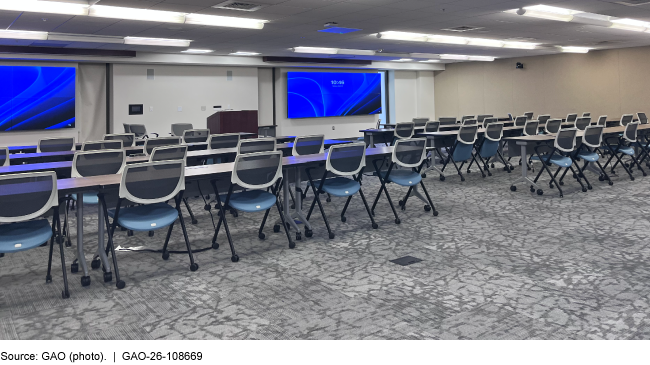
A conference room with 6 long tables and 40 chairs, arranged classroom-style facing 2 large monitors
Highlights
What GAO Found
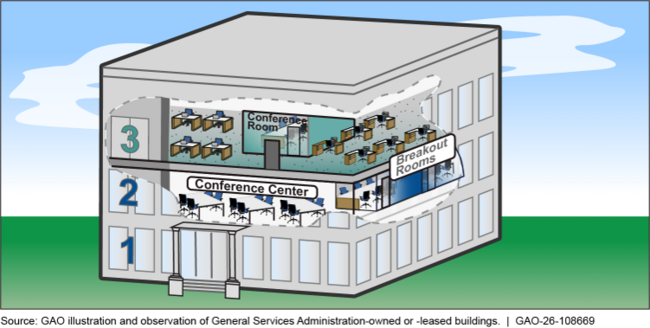
Federal buildings often contain special use spaces like meeting rooms and conference centers, some of which may be shared across agencies. Agencies varied in how they shared these spaces in the selected General Services Administration (GSA)-owned and -leased buildings GAO visited.
Interviewees, including officials from federal tenant agencies in those selected buildings, said that sharing these spaces can provide benefits, including:
- access to useful spaces their agency might not otherwise have,
- reduced costs and more efficient use of space (e.g., agencies do not need to lease or construct individual spaces), and
- increased collaboration between agencies.
However, interviewees also identified challenges to sharing, such as lack of awareness of what spaces are available or how to reserve them.
Illustrative Examples of Special Use Spaces in a Federal Building
GSA, which manages federal real property for tenant agencies, publishes an online list of meeting spaces that agencies volunteered to share. The list includes information such as room descriptions and a point of contact to reserve the space. However, the list is not comprehensive—some tenant agencies have not added their space to the list, and some GSA rooms are not on the list. GSA periodically emails agencies to request that they update the list, and it relies on agencies to distribute the list to their staff. However, most agency officials GAO interviewed in selected buildings were not aware of GSA’s list. GSA officials noted that federal turnover in 2025 contributed to reduced awareness of the list. They said that starting in 2025, more of their reminder emails were undelivered. Officials said they worked with agencies to update their contacts, and that they may be able to use other mechanisms to more broadly distribute the list. Improving the comprehensiveness of the list and agency awareness of it could help agencies share special use spaces, which could in turn potentially reduce costs by supporting GSA’s efforts to ensure efficient use of federal space.
Why GAO Did This Study
In recent years, GSA and others have taken steps to reduce unneeded federal real property, particularly office space, but building utilization across the federal government remains low.
The Thomas R. Carper Water Resources Development Act of 2024 includes a provision for GAO to report on the use of special use spaces in federal buildings to determine levels of use and identify opportunities for sharing, collocating, and other efficiencies.
This report addresses 1) how agencies share special use spaces in selected GSA-owned and -leased buildings, 2) the reported benefits and challenges related to sharing special use spaces, and 3) GSA’s efforts to promote sharing of special use spaces.
GAO conducted in-person site visits at six federal buildings selected for geographic diversity and whether there were multiple tenants, among other criteria. These site visits were composed of 1) a review of data or documentation; 2) observation of special use spaces; 3) interviews with GSA officials; and 4) interviews with officials from federal tenant agencies in those buildings. GAO also reviewed available GSA documentation and assessed GSA efforts against its strategic goals and GAO leading practices for interagency collaboration.
Recommendations
GAO recommends that GSA take additional steps to 1) improve the comprehensiveness of its federal meeting facilities list; and 2) increase tenant agency awareness of the list. GSA agreed with both recommendations and stated that it is developing a plan to address them.
Recommendations for Executive Action
| Agency Affected | Recommendation | Status |
|---|---|---|
| General Services Administration | The Administrator of GSA should improve the comprehensiveness of its federal meeting facilities list by adding all of GSA's relevant meeting spaces to the list and encouraging other agencies to add their spaces to the list. (Recommendation 1) |
When we confirm what actions the agency has taken in response to this recommendation, we will provide updated information.
|
| General Services Administration | The Administrator of GSA should take additional steps to increase tenant agency awareness of its federal meeting facilities list. This could include leveraging existing efforts, such as the results of GSA's shared space pilot and contact lists from other GSA programs, like the Space Intake Portal. (Recommendation 2) |
When we confirm what actions the agency has taken in response to this recommendation, we will provide updated information.
|