
College Athletics: Most Programs Spend More Than They Generate in Revenue
Fast Facts
Many colleges spend millions on athletic programs. Division I college athletic programs, the highest competitive level, spent $20.8 billion in the 2023-2024 academic year. Division II programs spent $2.7 billion.
In this Q&A, we looked at how these programs were funded in the 2023-2024 academic year. We found:
DI programs generated significant revenue from ticket sales, broadcast rights, and other sources
Most DI and all DII programs spent more money than they generated in revenue
Colleges collectively contributed billions of dollars to cover their athletics costs, partly from tuition and fees paid by students

Football teams face each other in the middle of a football field.
Highlights
What GAO Found
Intercollegiate athletics at four-year colleges in the National Collegiate Athletic Association (NCAA) are organized into divisions, subdivisions, and conferences. Division I (DI) colleges compete at the highest level and can offer students full athletics scholarships. Division II (DII) colleges typically offer partial athletics scholarships. In both divisions, expenses for most athletic programs were greater than the revenue they generated, according to GAO’s analysis of NCAA data for the 2014–15 and 2023–24 academic years.
In the 2023–24 academic year, the 352 DI colleges reported spending a total of $20.8 billion on athletics, which largely went to team and game expenses (including travel, equipment, and medical expenses), coach and support staff compensation, and athletics scholarships. The 69 “Power” colleges in the most competitive DI conferences accounted for more than half of this spending.
To help cover athletics expenses, DI college athletics programs generated $13.1 billion in revenue during the 2023–24 academic year. Power colleges generated $10 billion of this total amount, primarily through the sale of media rights to broadcast games, game day revenue (including ticket sales), and donations.
Across DI colleges, 94 percent of athletics programs, including 49 of the 69 Power colleges, spent more than they generated in revenue in the 2023–24 academic year. The median college reported a gap of $20.6 million. This gap was larger than the median a decade earlier ($12.3 million). Over this period, spending increased more than generated revenue in all DI subdivisions.
As generated revenue generally did not cover program expenses, most DI colleges reported contributing substantial funding to support athletics programs. Colleges contributed a total of $7.2 billion in the 2023–24 academic year. These college contributions are funded by tuition and fees paid by students, as well as other unrestricted funds from the college, such as income from investments. College contributions indirectly include federal funds students receive in federal student aid to pay their tuition and fees (see figure).
College Contributions for Division I College Athletics Programs, Based on Academic Year 2023–24 Data
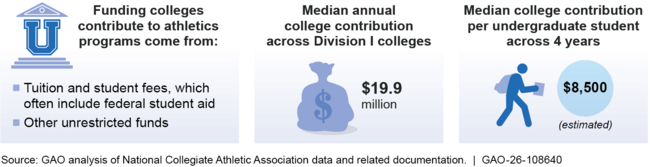
Note: Amounts reflected are illustrative estimates and do not reflect actual student payments to athletics programs.
All DII athletics programs spent more than the revenue they generated in the 2023–24 academic year. Combined, they spent $2.7 billion that year. To help cover this spending, they generated $0.4 billion and received $2.3 billion in college contributions.
Why GAO Did This Study
Many colleges spend millions of dollars on their athletics programs. Under the 2025 settlement of the In re College Athlete NIL Litigation case (House settlement), DI colleges can now share up to $20.5 million of revenue with student-athletes, starting with the 2025–26 academic year. Most DI colleges opted to participate in revenue sharing in that first year, which may impact finances for some college athletics programs.
There has been recent federal interest in college athletics as reflected in Executive Orders and proposed legislation. GAO was asked to examine college athletics costs given that colleges may use funds to support athletics programs that come partly from federal aid students receive to pay their tuition and fees. This report provides information about DI and DII intercollegiate athletics finances prior to the House settlement to depict the landscape before revenue sharing took effect.
To conduct this work, GAO reviewed DI and DII aggregated data from the NCAA’s membership financial database for the 2014–2015 and 2023–2024 (the most recent available data at the time of the analysis) academic years. These years were selected to analyze points in time over a ten-year period. The NCAA provided data to GAO but otherwise had no role in the development of this report; the findings and conclusions are GAO’s alone. GAO also interviewed representatives from four national stakeholder organizations knowledgeable about college athletics programs finances and operations.
For more information, contact Melissa Emrey-Arras at emreyarrasm@gao.gov.