
Federal Real Property: GSA Should Publicize Accessibility Complaint Process for Its Office Buildings
Fast Facts
Tens of millions of Americans live with disabilities. The U.S. Access Board allows the public to file complaints about the accessibility of federal office buildings. The board and the General Services Administration—which owns or leases federal buildings—work together to resolve those complaints.
However, many people don't know that they can file such complaints, according to industry stakeholders and disability advocates we interviewed.
We recommended that GSA publicize its accessibility complaint process to users of its buildings to increase public awareness.
Accessible Parking Space and Ramp for Individuals with Disabilities at the 2306/2312 Bannister Road Federal Building in Kansas City, Missouri
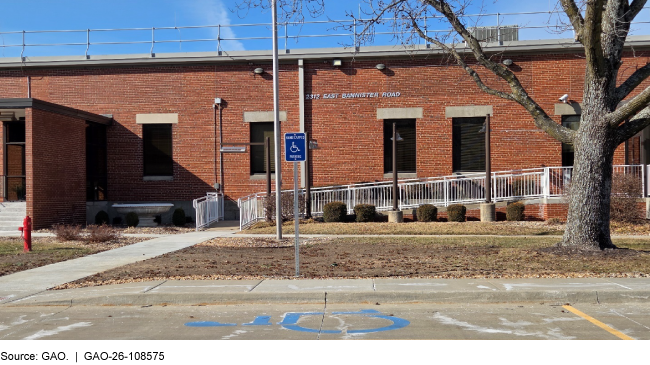
Accessible parking space and ramp at federal office building.
Highlights
What GAO Found
The General Services Administration (GSA) owns and leases thousands of office buildings, which are used by federal employees and the public. The Architectural Barriers Act of 1968 (ABA) requires that certain GSA office buildings be accessible to individuals with physical disabilities. According to GSA officials and documentation, GSA reviews alteration, leasing, and construction projects throughout the design process for compliance with its ABA Accessibility Standard.
The U.S. Access Board (Board), an independent federal agency, enforces the ABA by addressing complaints of potential violations of applicable ABA standards. The Board generally relies on complaints rather than inspections due to resource constraints, according to Board officials. Anyone may file complaints with the Board alleging ABA noncompliance of GSA buildings. From October 2022 to June 2026, the Board received 41 ABA complaints about GSA’s office buildings and closed 25; 16 are still in process. Some stakeholders who were aware of the process said it was effective in addressing ABA complaints.
However, the public is generally unaware that it can file complaints on accessibility barriers in GSA office buildings, according to almost all the industry stakeholders, federal employee unions, and disability advocates GAO interviewed. Moreover, GSA has not publicized the ABA complaint process. The Board relies on complaints it receives through its complaint process to learn about potential ABA violations and enforce the ABA. Without public information from GSA on this process, such as in its buildings, people with disabilities may be unaware that they are able to file ABA complaints and barriers to the accessibility of GSA office buildings may go unremedied.
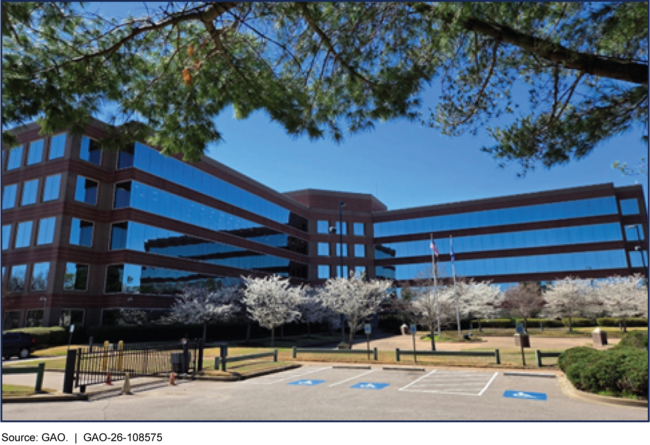
Accessible Parking Spaces at the Eaglecrest Building in Memphis, TN, Leased by the General Services Administration
Why GAO Did This Study
Tens of millions of Americans live with disabilities. Those individuals may need to access federal office buildings to work or to obtain government services. GSA’s national accessibility program helps ensure that these individuals can access the more than 6,000 office buildings owned or leased by GSA.
The Thomas R. Carper Water Resources Development Act of 2024 includes a provision for GAO related to GSA office buildings and the ABA. This report (1) describes GSA’s practices for ensuring compliance with the ABA during construction, alteration, and leasing of office buildings and recent changes to its ABA program; and (2) examines the extent to which ABA complaints about GSA office buildings are received and addressed, and the extent to which GSA makes individuals aware they can file complaints.
GAO reviewed relevant statutes, regulations, and agency documents. GAO conducted site visits to six GSA office buildings with open and closed ABA complaints and with recent construction, alteration, and leasing projects. GAO analyzed October 2022 to June 2026 complaint data from the Access Board. GAO also interviewed nine stakeholders including from industry organizations, federal employee unions, and disability advocates, as well as GSA and Access Board officials.
Recommendations
The Administrator of the General Services Administration should take steps to increase awareness of the ABA process to file complaints about accessibility barriers in GSA office buildings. For example, GSA could post signs with information about filing ABA complaints at the entry areas of its office buildings. GSA agreed with GAO’s recommendation.
Recommendations for Executive Action
| Agency Affected | Recommendation | Status |
|---|---|---|
| General Services Administration | The Administrator of the General Services Administration should take steps to increase awareness of the ABA process to file complaints about accessibility barriers in GSA office buildings. For example, GSA could post signs with information about filing ABA complaints at the entry areas of its office buildings. (Recommendation 1) |
When we confirm what actions the agency has taken in response to this recommendation, we will provide updated information.
|