
Coast Guard: Additional Action Needed to Address Marine Firefighting Challenges
Fast Facts
Fires on vessels are extremely dangerous and difficult for firefighters to respond to. In 2023, a marine vessel fire resulted in the deaths of 2 firefighters.
After this, the U.S. Coast Guard worked to address firefighting risks—but it could do more.
For example, the Coast Guard works with local port officials, land-based firefighters, and others to make plans before fires occur. But it doesn't always have dedicated local coordinators to lead those efforts. Training for land-based firefighters is also limited, e.g., not having hands-on exercises on vessels.
Our recommendations address these and other issues to improve marine firefighting efforts.
Coast Guard Responding to a Barge Fire in Delaware Bay, March 2026
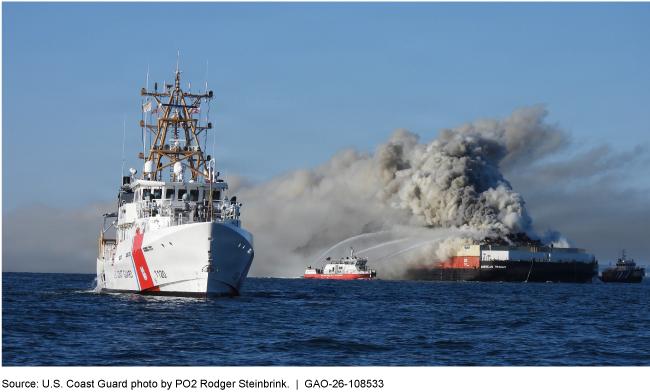
A large white ship in the foreground with a smaller boat in the background spraying water on a larger ship with smoke billowing off it.
Highlights
What GAO Found
Fires on vessels are among the most dangerous and challenging incidents to which firefighters can respond. Vessels may also carry hazardous cargo, like lithium-ion batteries, further complicating marine firefighting responses. According to U.S. Coast Guard data, there were 886 nearshore marine fires that occurred between 2015 and 2025. About one quarter (206) of these resulted in either death, injury, over $200,000 in damage, or a total loss of the vessel.
The U.S. Coast Guard is the principal federal agency responsible for overseeing marine safety. For marine firefighting, the Coast Guard plays a coordinating role while land-based fire departments extinguish fires. Following a marine fire that resulted in two firefighter deaths in 2023, the Coast Guard established a task force to address various marine firefighting challenges. The task force has taken several steps to address them but gaps remain.
Examples of Firefighting Challenges, Coast Guard Actions, and Gaps
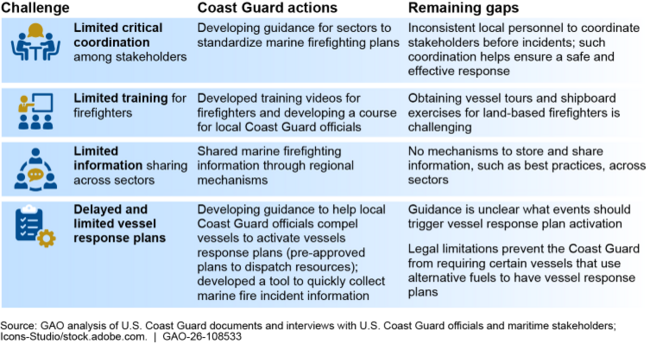
Designating consistent Coast Guard field personnel to lead coordination before marine fires occur, facilitating more hands-on training for firefighters on vessels, and establishing an information sharing mechanism would help ensure firefighters have the knowledge and skills necessary to safely and effectively extinguish vessel fires. Further, developing guidance on what warrants vessel response plan activation would help ensure resources are quickly mobilized and better ensure the safety of firefighters.
The number of vessels that use alternative fuels continues to grow. However, legal limitations prevent the Coast Guard from requiring nontank vessels that use alternative fuels—such as ferries powered by lithium-ion batteries—to have vessel response plans related to hazardous substance discharges. These limitations predate the widespread use of alternative fuels. Having that authority would empower the Coast Guard to better ensure vessels and firefighters can quickly receive assistance in the event of a fire.
Why GAO Did This Study
The Coast Guard has issued regulations requiring certain vessels to have response plans that identify the resources that would respond to marine fires related to oil discharges.
The National Defense Authorization Act for Fiscal Year 2026 includes a provision for GAO to review, among other things, the Coast Guard’s efforts related to marine firefighting. This report examines (1) how frequently nearshore marine fires occur and the characteristics of those fires and (2) what challenges exist in marine firefighting and how the Coast Guard is addressing them.
GAO analyzed Coast Guard data for 2015 through 2025; reviewed Coast Guard guidance and investigative reports; and interviewed Coast Guard officials, fire chiefs based in seven Coast Guard sectors, and representatives from maritime and firefighting stakeholder associations.
Recommendations
Congress should consider amending existing law to ensure that owners and operators of nontank vessels that use alternative fuels prepare vessel response plans related to hazardous substance discharges.
GAO is also making five recommendations to the Coast Guard, including to designate marine firefighting coordination responsibilities to specific field positions, engage with fire departments to coordinate training, establish a mechanism to store and share marine firefighting information, and develop factors maritime stakeholders and the Coast Guard should consider regarding vessel response plan activation. The Coast Guard agreed with all five recommendations.
Matter for Congressional Consideration
| Matter | Status | Comments |
|---|---|---|
| Congress should consider amending the Federal Water Pollution Control Act to ensure that owners and operators of nontank vessels that use alternative fuels prepare vessel response plans for responding to worst case discharges of hazardous substances and the substantial threat of such discharges. (Matter for Consideration 1) | When we confirm what actions the agency has taken in response to this recommendation, we will provide updated information. |
Recommendations for Executive Action
| Agency Affected | Recommendation | Status |
|---|---|---|
| United States Coast Guard | The Commandant of the Coast Guard should designate, in coordination with Captains of the Port, marine firefighting coordination responsibilities to specific field unit positions. (Recommendation 1) |
When we confirm what actions the agency has taken in response to this recommendation, we will provide updated information.
|
| United States Coast Guard | The Commandant of the Coast Guard should ensure Captains of the Port, or their designees, engage with fire departments and maritime stakeholders to coordinate shipboard training opportunities, including vessel tours and exercises. (Recommendation 2) |
When we confirm what actions the agency has taken in response to this recommendation, we will provide updated information.
|
| United States Coast Guard | The Commandant of the Coast Guard should establish a mechanism to store and share marine firefighting information, such as best practices, with Coast Guard officials and maritime stakeholders. (Recommendation 3) |
When we confirm what actions the agency has taken in response to this recommendation, we will provide updated information.
|
| United States Coast Guard | The Commandant of the Coast Guard should develop and distribute information to maritime stakeholders and Coast Guard sectors on factors to consider when determining whether vessel response plans should be activated for marine fires. For example, the Coast Guard could compile examples of when vessel response plans were appropriately activated or identify factors to consider in deciding when to activate vessel response plans based on prior marine fires. (Recommendation 4) |
When we confirm what actions the agency has taken in response to this recommendation, we will provide updated information.
|
| United States Coast Guard | The Commandant of the Coast Guard should issue regulations pursuant to the Oil Pollution Act of 1990 requiring owners and operators of tank vessels to prepare vessel response plans for responding to worst case discharges of hazardous substances and the substantial threat of such discharges. (Recommendation 5) |
When we confirm what actions the agency has taken in response to this recommendation, we will provide updated information.
|