
COVID-19: Federal Efforts and Stakeholder Views on Expediting the Transportation of Personal Protective Equipment
Fast Facts
Supply chain issues during the COVID-19 pandemic made it hard to quickly access "PPE"— personal protective equipment—such as masks and gloves.
So federal agencies took actions to transport PPE by air. For example, the Federal Aviation Administration allowed airlines to transport cargo in the passenger cabins of aircraft, and the Federal Emergency Management Agency paid to fly PPE into the country.
Representatives of related industries and port authorities told us they used several methods to expedite PPE. This included using "peel piles" at ports to pre-sort containers with PPE as they arrived, allowing quicker access.
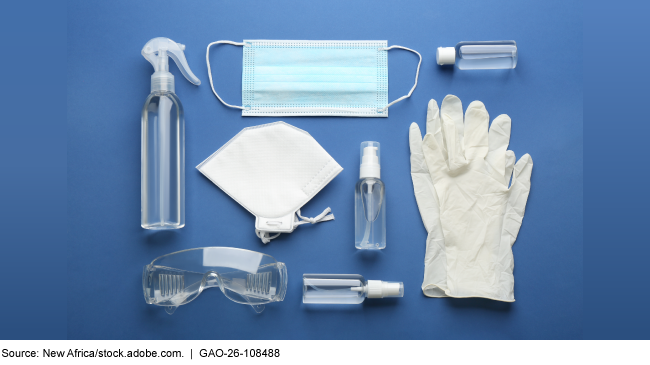
Flat lay composition with medical gloves, protective googles, masks, and hand sanitizer on blue background
Highlights
What GAO Found
Personal protective equipment (PPE)—such as masks and gloves—helps minimize exposure to hazards, including illnesses. In response to the COVID-19 pandemic (March 2020–May 2023), the Federal Emergency Management Agency (FEMA) and the Department of Transportation (DOT) expedited the transportation of PPE by air and helped mitigate supply chain challenges.
- FEMA. From March through June 2020, FEMA conducted Project Airbridge, in which FEMA paid for the air transportation of PPE from overseas to the U.S. to reduce shipment times. FEMA funded 437 flights to transport approximately 1.2 billion PPE items, primarily gloves, masks, and gowns.
- DOT. DOT used selected legal authorities to help expedite the transportation of PPE by air and to provide transportation industry stakeholders with regulatory relief that could have expedited the transportation of PPE. For example, DOT’s Federal Aviation Administration issued exemptions from certain regulations during the COVID-19 pandemic to allow certain passenger air carriers to transport cargo in the passenger cabins of aircraft.
DOT and other federal agencies also coordinated with transportation industry stakeholders specifically to mitigate supply chain issues and keep goods moving during the pandemic, which may have expedited the transportation of PPE.
Boxes of Personal Protective Equipment Transported in the Passenger Cabin of an Aircraft During the COVID-19 Pandemic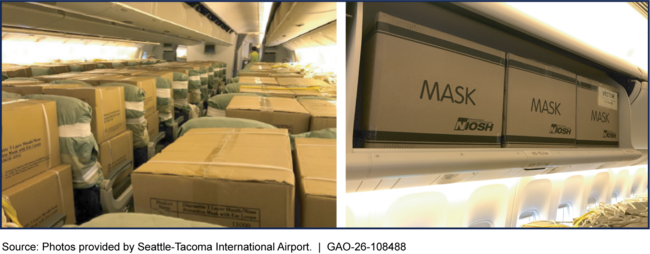
Stakeholders GAO interviewed shared perspectives on methods to expedite the transportation of PPE used during the COVID-19 pandemic, and many said that an increased federal role was unnecessary or could have had negative consequences. For example, two stakeholders cited the use of “peel piles” to designate areas at ports for containers from specific shippers as a method used to expedite goods during the pandemic, including PPE. Many stakeholders said they did not think more federal involvement was needed in expediting the transportation of PPE during the pandemic, or that increased federal involvement could have had negative consequences. For example, stakeholders said that federal involvement in prioritizing a container on a ship could have caused delays at ports. Furthermore, several of these stakeholders stated that the private sector and industry partners were better suited to take the lead in expediting the transportation of goods through the supply chain.
Why GAO Did This Study
During the COVID-19 pandemic, significant challenges, including global demand and supply chain issues, made it difficult to quickly access PPE. Delays in the transportation of PPE may have contributed to the spread of COVID-19, which killed nearly 1.2 million people in the U.S. as of June 1, 2024.
Public Law 118-159 includes a provision for GAO to review the expedited transportation of PPE during the COVID-19 pandemic. This report describes, among other things, (1) how DOT and other relevant federal agencies expedited the transportation of PPE during the pandemic, including using selected legal authorities to do so; and (2) selected industry stakeholder perspectives on methods used to expedite the transportation of PPE during the COVID-19 pandemic, including their views on whether an increased federal role was needed.
GAO reviewed documentation and interviewed officials from five federal agencies that played a role in expediting the transportation of PPE: DOT, FEMA, Health and Human Services (HHS), the Department of Defense, and the Federal Maritime Commission. GAO also reviewed relevant statutes, regulations, and executive orders and analyzed available data from FEMA and HHS that described the amount and type of PPE that these agencies transported during the COVID-19 pandemic.
GAO interviewed a nongeneralizable sample of 21 stakeholders representing three groups relevant to the transportation of PPE: transportation industries, health care distributors, and port authorities. GAO selected these stakeholders based on factors including geographic diversity, involvement in federal efforts to expedite the transportation of PPE, or market share of their respective industry.
For more information, contact Elizabeth Repko at RepkoE@gao.gov.