
Law Enforcement: DOJ Should Improve Training and Misconduct Guidelines for Nonfederal Task Force Officers
Fast Facts
Some DOJ agencies—specifically, the Bureau of Alcohol, Tobacco, Firearms, and Explosives; the Drug Enforcement Administration; the FBI; and the U.S. Marshals Service—partner with nonfederal law enforcement officers on hundreds of task forces. These task forces investigate criminal and national security matters, such as drug trafficking and counterterrorism.
We identified ways to improve how these task forces operate. For example, DOJ should ensure that nonfederal officers complete training on federal authorities—such as how to properly serve federal warrants—before engaging in operations.
Our recommendations address this and other issues.
Line of law enforcement personnel wearing gear on a training mission
Highlights
What GAO Found
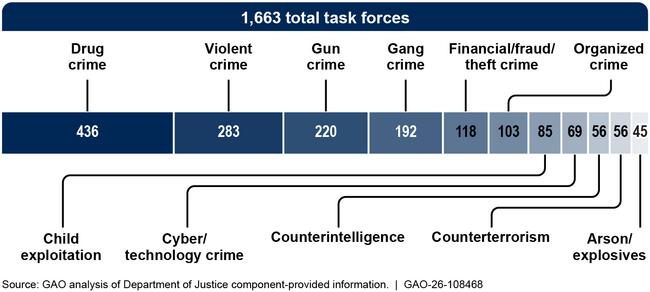
The Department of Justice (DOJ) routinely forms task forces to investigate national security issues and criminal activity, including various forms of trafficking, terrorist threats, and violent gang activity. Through these task forces, DOJ law enforcement agencies partner with thousands of nonfederal officers from state, local, tribal, and territorial law enforcement agencies.
Number and Types of Active Department of Justice Task Forces, as of April 2026
All four of the DOJ components GAO reviewed—the Bureau of Alcohol, Tobacco, Firearms, and Explosives (ATF); Drug Enforcement Administration (DEA); Federal Bureau of Investigation (FBI), and the U.S. Marshals Service—use training to communicate task force officer roles and responsibilities. This training includes the DOJ components’ legal authorities and policies, including how to conduct federal investigations or exercise federal law enforcement authorities. However, ATF, DEA, and FBI allow nonfederal officers to engage in task force operations (e.g., serve warrants) before they have completed their initial task force officer training. Requiring nonfederal task force officers to complete training on relevant legal authorities and policies before engaging in task force operations would ensure components achieve the intent of their training and reduce the risk that officers will participate in task force operations without fully understanding the federal authorities they were deputized to exercise.
ATF, DEA, FBI, and the U.S. Marshals Service policies require federal supervision of nonfederal task force officers, such as reviewing investigative reports and monitoring performance. These policies also require employees to report allegations of misconduct by nonfederal task force officers to their management. However, GAO found the four DOJ components do not have guidelines and criteria for field managers (such as the special agent in charge of a field office) to apply in adjudicating such allegations. By establishing guidelines field managers can use to adjudicate misconduct allegations, such as the conditions under which nonfederal officers should be removed from a task force, DOJ components can ensure they are applying the same criteria across their task forces. In the absence of such guidelines, there is increased risk of inconsistent adjudications, which could jeopardize the integrity of task force operations and erode public trust in task force effectiveness.
Why GAO Did This Study
DOJ deputizes nonfederal officers to serve on federal task forces to obtain valuable insights into regional or local criminal activity and assist the investigative work of DOJ’s federal law enforcement officers.
GAO was asked to review DOJ task force policies for nonfederal officers. This report addresses, among other things, the extent to which DOJ components have policies and procedures to (1) communicate task force roles and responsibilities and (2) supervise nonfederal task force officers.
To address these objectives, GAO analyzed component-level policies, task force agreements, and laws; and interviewed officials from the four components DOJ identified as leading task forces. To identify policies and procedures implemented at the field- and task force-levels, GAO reviewed documents and interviewed members of a nongeneralizable sample of eight task forces, based on task force type and location.
Recommendations
GAO is making seven recommendations, including that (1) ATF, FBI, and DEA update policies to require nonfederal task force officers to receive training on legal authorities and policies before using their new federal deputation authority, and (2) that they along with the U.S. Marshals Service develop guidelines for field management to use when adjudicating misconduct allegations against nonfederal task force officers. DOJ agreed with all seven recommendations.
Recommendations for Executive Action
| Agency Affected | Recommendation | Status |
|---|---|---|
| Bureau of Alcohol, Tobacco, Firearms and Explosives | The Director of the Bureau of Alcohol, Tobacco, Firearms, and Explosives should update its policy to include a requirement for nonfederal task force officers to receive their initial training on federal legal authorities and policies before engaging in task force operations requiring their use of federal deputation authority. (Recommendation 1) |
DOJ agreed with the recommendation. When we confirm what actions the agency has taken in response to this recommendation, we will provide updated information.
|
| Drug Enforcement Administration | The Administrator of the U.S. Drug Enforcement Administration should update its policy to include a requirement for nonfederal task force officers to receive their initial training on federal legal authorities and policies before engaging in task force operations requiring their use of federal deputation authority. (Recommendation 2) |
DOJ agreed with the recommendation. When we confirm what actions the agency has taken in response to this recommendation, we will provide updated information.
|
| Federal Bureau of Investigation | The Director of the Federal Bureau of Investigation should update its policy to include a requirement for nonfederal task force officers to receive their initial training on federal legal authorities and policies before engaging in task force operations requiring their use of federal deputation authority. (Recommendation 3) |
DOJ agreed with the recommendation. When we confirm what actions the agency has taken in response to this recommendation, we will provide updated information.
|
| Bureau of Alcohol, Tobacco, Firearms and Explosives | The Director of the Bureau of Alcohol, Tobacco, Firearms, and Explosives, in consultation with the Office of the Deputy Attorney General, should develop guidelines to inform field management decisions when adjudicating allegations of nonfederal task force officer misconduct. (Recommendation 4) |
DOJ agreed with the recommendation. When we confirm what actions the agency has taken in response to this recommendation, we will provide updated information.
|
| Drug Enforcement Administration | The Administrator of the U.S. Drug Enforcement Administration, in consultation with the Office of the Deputy Attorney General, should develop guidelines to inform field management decisions when adjudicating allegations of nonfederal task force officer misconduct. (Recommendation 5) |
DOJ agreed with the recommendation. When we confirm what actions the agency has taken in response to this recommendation, we will provide updated information.
|
| Federal Bureau of Investigation | The Director of the Federal Bureau of Investigation, in consultation with the Office of the Deputy Attorney General, should develop guidelines to inform field management decisions when adjudicating allegations of nonfederal task force officer misconduct. (Recommendation 6) |
DOJ agreed with the recommendation. When we confirm what actions the agency has taken in response to this recommendation, we will provide updated information.
|
| United States Marshals Service | The Director of the U.S. Marshals Service, in consultation with the Office of the Deputy Attorney General, should develop guidelines to inform field management decisions when adjudicating allegations of nonfederal task force officer misconduct. (Recommendation 7) |
DOJ agreed with the recommendation. When we confirm what actions the agency has taken in response to this recommendation, we will provide updated information.
|