
Weapon Systems Annual Assessment: Requiring Mature Technologies Could Enable Shift to Rapid Delivery
Fast Facts
DOD is again working to reform its acquisition processes to help deliver innovative weapons rapidly. But in this year's annual report, we found DOD struggled to fully enact existing reforms to achieve speed.
- Key decisions are delayed for some of the costliest weapon programs—raising questions about how realistic their schedules are
- Consistently following leading practices for product development could speed it up
Some programs began on a rapid acquisition pathway with tech that requires more time to develop—slowing on-time delivery of needed weapons. Our recommendation addresses this.
DOD's weapon systems acquisition is on our High Risk List.
The MH-139A helicopter program delayed a key acquisition decision.

Photo of a person rappelling from a helicopter in flight
Highlights
What GAO Found
The Department of Defense (DOD) continues to struggle to deliver technologies quickly and within budget. Since its last annual assessment, GAO found:
- Programs are delaying interim events and milestones for some of the costliest major defense acquisition programs (MDAP).
- DOD has increased its use of the middle tier of acquisition (MTA) rapid prototyping and fielding pathways—intended to be completed in 5 years.
- Some programs began on the MTA pathway with technologies that require more time to develop, hindering timely delivery of essential capabilities.
- Programs do not consistently follow leading practices for product development that could help DOD achieve its stated goals.
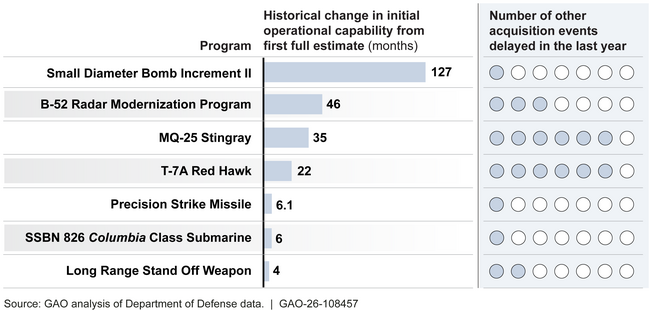
Schedule delays persisted across MDAPs, signaling overly optimistic time frames. The overall average time frame to deliver a capability increased this year to over 12 years. Further, several MDAPs have not set new delivery dates or are delaying critical interim milestones. By keeping delivery dates static, these programs raise questions about how realistic their estimates are. This means the 12-year average will likely increase in the future.
Selected Programs Delayed Acquisition Events Since Last Year
MTA portfolio size increased. DOD plans to invest at least $49 billion across 23 of its most expensive MTA programs. The cost of the MTA portfolio increased, mainly because more of the largest and most time-consuming programs used the pathway this year.
Some programs began the MTA pathway with immature technologies, hindering timely transition. In multiple annual assessments, GAO found that almost half the MTA programs entered the pathway with immature technologies. Leading practices call for programs to have mature technologies prior to beginning development. Leading practices also call for programs to off-ramp immature technologies that could delay delivery of a minimum viable product (MVP), which establishes an initial set of capabilities on which DOD can iterate.
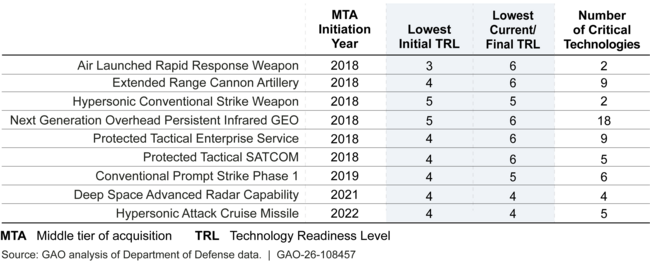
However, DOD policy does not clearly require programs entering the MTA pathway to start with multiple technologies that are mature or direct programs to develop immature technologies separately from the MTA pathway. For example, between 2018 and 2025, 18 out of 40 programs have entered the MTA pathway with immature technologies. In addition, MTA programs GAO reviewed are ending without delivering a fieldable capability.
For example, GAO found that technologies for seven of eight programs currently on the pathway remain immature and will require additional development. Since 2018, nine programs that entered the MTA pathway with multiple immature technologies made limited progress in maturing those technologies, which could delay delivering fieldable capabilities to the warfighter.
Some MTA Programs Entered the Pathway with Immature Technologies
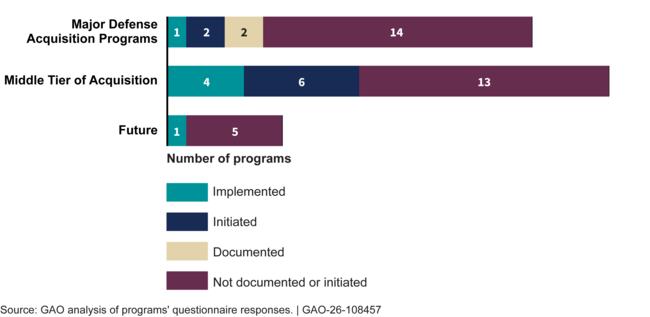
Weapon systems do not consistently implement leading practices to deliver innovative capability with speed. Most programs, including newer programs like MTAs and future weapon system acquisitions, that GAO reviewed do not fully implement leading practices to achieve efficiencies. In reports dating back to 2022, GAO has recommended that DOD revamp its weapon system acquisition, test and evaluation, systems engineering, and digital engineering policies to fully incorporate iterative development and other leading practices. DOD concurred with many recommendations but has yet to fully implement them.
Most Programs Have Yet to Fully Incorporate a Minimum Viable Product
Why GAO Did This Study
DOD plans to invest over $2.4 trillion to develop and acquire its costliest weapon programs. However, it continues to face persistent challenges in achieving the schedule and capability goals of these weapon systems. DOD is currently undertaking a new series of reforms, such as the November 2025 Acquisition Transformation Strategy, intended to ensure rapid delivery of effective solutions to meet warfighting needs. In June of 2024 and 2025, GAO found that DOD struggled to execute prior reforms that were also intended to help achieve speed in delivering capability. This resulted in a status quo of slow, linear development approaches.
This report, GAO's 24th annual assessment, responds to a provision Congress included in statute for GAO to annually review selected DOD acquisition programs and efforts. This report (1) assesses the characteristics and performance of 104 of DOD's costliest weapon programs; and (2) analyzes selected programs' implementation of leading practices for product development, as described in GAO-23-106222, among other objectives.
GAO identified programs for review based on cost and acquisition status; collected and analyzed program documents; used a questionnaire to obtain data from program offices; and interviewed DOD officials.
Recommendations
GAO is recommending that DOD ensure that acquisition policies for programs rapidly delivering capabilities and integrating technologies, like those using the MTA pathway, require that programs start with mature technologies or develop associated immature technologies separately. DOD concurred with the recommendation.
Recommendations for Executive Action
| Agency Affected | Recommendation | Status |
|---|---|---|
| Department of Defense | The Secretary of Defense should ensure that acquisition policies for programs intending to rapidly deliver capabilities that integrate multiple technologies, including those using the MTA pathway, require that such programs initiate with only technologies considered mature or develop associated immature technologies separate from the program effort. (Recommendation 1) |
When we confirm what actions the agency has taken in response to this recommendation, we will provide updated information.
|