
Southern Border Security: DOD Used Multiple Strategies to Fund Operations
Fast Facts
Each year, millions of people enter the U.S. along its nearly 2,000-mile-long border with Mexico. But the border is also vulnerable to illegal activities, such as drug smuggling and organized crime.
In January 2025, the president directed the Department of Defense to help the Department of Homeland Security gain complete operational control of the border.
We reviewed DOD’s costs to support these operations. As of March 2026, DOD reported $2.64 billion in costs and used a combination of funding strategies to support these operations. The department also set up a process to track costs.
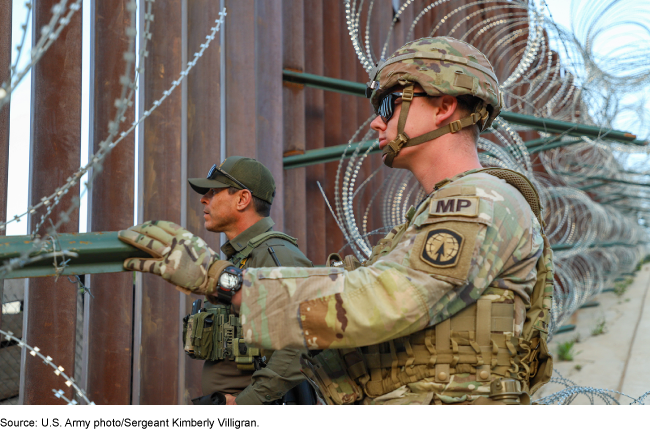
U.S. Army solider and Border Patrol agent stand at border wall
Highlights
What GAO Found
The Department of Defense (DOD) used multiple strategies to fund support for southern border operations since the start of fiscal year 2025 and into fiscal year 2026. Specifically, DOD
- realigned $1.74 billion in funding from amounts appropriated for fiscal year 2025 from various funding categories;
- transferred $608 million from or through DOD’s Drug Interdiction and Counter-Drug Activities, Defense account;
- relied on military construction authorities to fund border barrier projects using $300 million from within existing military construction appropriation accounts;
- began obligating amounts from $1 billion appropriated in Public Law 119-21, commonly known as the One Big Beautiful Bill Act; and
- began providing some support to the Department of Homeland Security (DHS) in fiscal year 2026 that is eligible for reimbursement.
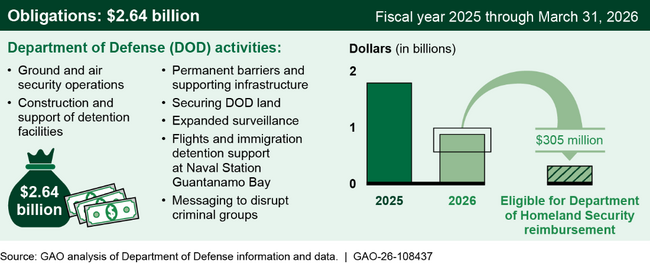
As of March 31, 2026, DOD has reported obligating $2.64 billion for southern border operations since the start of fiscal year 2025. These costs include DOD-directed activities, such as securing DOD-administered lands along the border, known as National Defense Areas, and constructing permanent border barriers. These costs also include DOD support to DHS in response to requests for assistance. Of the $2.64 billion DOD obligated, DOD reported $305 million is eligible for reimbursement by DHS.
DOD Southern Border Operations and Costs
The Office of the Under Secretary of Defense (OUSD) (Comptroller) and the military services established a process for tracking southern border costs that included issuing guidance and business rules for pulling data from the military services’ financial ledgers into Advancing Analytics—known as Advana—DOD’s enterprise-level management system used for reporting. In addition, OUSD (Comptroller) officials stated they are working to finalize standard operating procedures that would codify DOD’s process to manage and execute costs of southern border operations and provide continuity in the event of personnel turnover.
Why GAO Did This Study
The nearly 2,000-mile-long U.S. border with Mexico is a critical point of entry for millions of people annually. However, it is also vulnerable to illegal border crossings, smuggling of drugs and contraband, and organized crime. In January 2025, the President declared a national emergency at the southern border and directed DOD to assist DHS in obtaining complete operational control of the border.
GAO was asked to review DOD’s costs to support operations at the southern border. Senate Report 119-39 accompanying a bill for the National Defense Authorization Act for Fiscal Year 2026 also includes a provision for GAO to examine similar issues. This report examines (1) how DOD has funded support for operations, (2) how much DOD has reported in costs, and (3) how DOD has tracked costs for its southern border operations since the start of fiscal year 2025.
GAO analyzed DOD documentation and guidance regarding funding sources and cost tracking processes. GAO analyzed cost summary reports for fiscal years 2025 and 2026. GAO also met with DOD officials and commands obligating the most funding for southern border operations.
GAO provided a draft of this report to DOD for review and comment. DOD did not provide official comments. DOD provided technical comments, which GAO incorporated as appropriate.
For more information, contact Rashmi Agarwal at agarwalr@gao.gov.