
FEMA Workforce: Staff Reductions and Lack of Planning May Impact Mission Readiness
Fast Facts
The Federal Emergency Management Agency has faced longstanding workforce management challenges, including staff shortages, that make supporting disaster response and recovery difficult.
We found that FEMA reduced its workforce without using strategic workforce planning. The agency also proposed future workforce actions without assessing its current and future workforce needs. As a result, FEMA may not have a workforce capable of effectively responding to disasters now or in the future.
We made matters to Congress and recommendations to FEMA to address these issues.
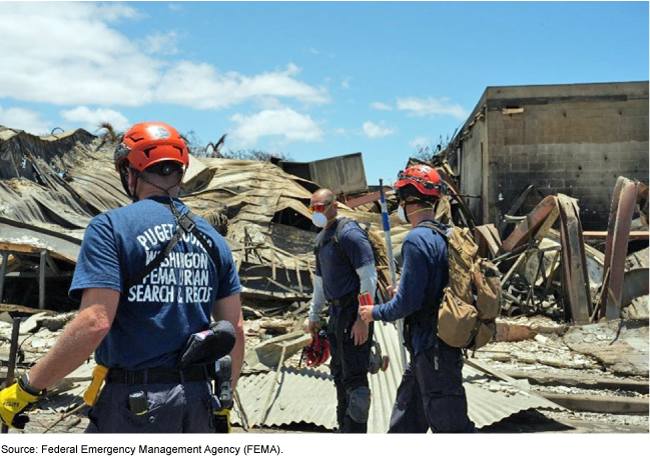
Three men wearing or carrying hard hats, masks, gloves, packs, and utility belts stand near the remains of a destroyed building.
Highlights
What GAO Found
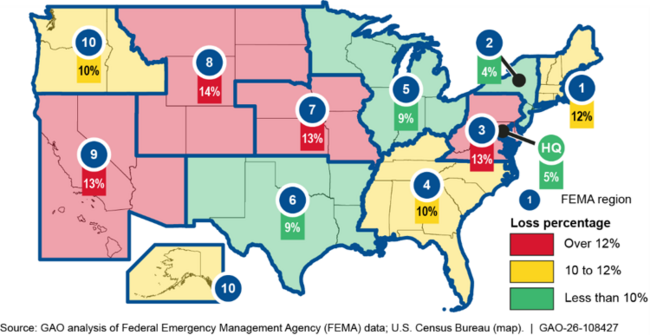
The increasing number and complexity of disasters demonstrates the need to ensure that the Federal Emergency Management Agency’s (FEMA) workforce can meet its core mission to help people before, during, and after disasters. In response to 2025 presidential directives, many federal agencies have taken steps to reduce the size of their workforces. In fiscal year 2025, FEMA employed about 25,134 employees, on average. However, over 4,300 employees separated from FEMA in fiscal year 2025—a 55 percent increase in separations from fiscal year 2024 (see figure). These separations have resulted in a loss of institutional knowledge and experienced personnel, according to FEMA officials, and have exacerbated longstanding workforce challenges.
In 2025, FEMA rescinded its strategic plan. As a result, the agency has no overall strategic direction on which to base workforce planning—a systematic and continuous process for identifying the size and composition of a workforce needed to achieve an agency’s mission. Without a strategic plan that outlines clear goals and objectives, FEMA cannot effectively determine its future workforce needs, potentially putting its mission at risk.
In addition, GAO found that FEMA did not base its 2025 and 2026 workforce reduction decisions, proposed future workforce actions, or workforce policy changes on the results of a workforce analysis—an assessment of the current state of the workforce and a forecast of future organizational requirements. FEMA took these actions without assessing whether it had the necessary staffing capacity to meet its mission, including its statutory requirements. Without workforce planning, FEMA is not positioned to determine whether it has the right number of people with the right skills in the right positions at the right time to meet its mission. Further, for more than a decade, GAO has identified challenges FEMA has encountered in maintaining a sufficient workforce to effectively meet its mission. Although FEMA has made progress towards addressing some of these challenges, actions by Congress would provide additional accountability to ensure that FEMA maintains a workforce capable of meeting its mission while addressing long-standing workforce management challenges.
Percentage of Headquarters and Regional FEMA Staff Separations Due to Voluntary Workforce Reduction Programs, Jan. 20, 2025–Jan. 10, 2026
Why GAO Did This Study
FEMA has long-standing workforce management challenges that make supporting disaster response and recovery difficult. As such, GAO added strengthening FEMA’s disaster workforce and capacity to its High Risk List in February 2025.
GAO was asked to review FEMA’s ability to provide effective staffing for disaster response and recovery and how FEMA is addressing any workforce challenges. This report examines (1) how FEMA’s workforce changed in 2025 and 2026; (2) the extent to which FEMA has strategic direction to identify workforce needs; and (3) the extent to which FEMA has assessed the ability of its workforce to meet its mission needs.
GAO evaluated FEMA’s workforce planning efforts against key practices for workforce planning and analyzed data on FEMA’s workforce size and composition. GAO also reviewed documentation related to (1) workforce changes and decisions in 2025 and 2026 and (2) FEMA’s strategic direction. Lastly, GAO interviewed FEMA officials in headquarters and all 10 regions.
Recommendations
GAO recommends that Congress consider requiring that significant FEMA workforce decisions be informed by the results of the agency’s workforce planning process. Congress should also consider requiring FEMA to report to Congress on the results of its workforce planning process prior to the start of each year’s hurricane season.
GAO is also making three recommendations to FEMA, including that it issue a strategic plan with clear goals and objectives and develop and implement a workforce planning process that includes a workforce analysis. DHS agreed with the recommendations.
Matter for Congressional Consideration
| Matter | Status | Comments |
|---|---|---|
| Congress should consider requiring that significant FEMA workforce decisions be informed by the results of the agency's workforce planning process. (Matter for Consideration 1) | As of August 2026, Congress has not enacted legislation to address this matter. | |
| Congress should consider requiring FEMA report to Congress on the results of its workforce planning process prior to the start of each year's hurricane season. (Matter for Consideration 2) | As of August 2026, Congress has not enacted legislation to address this matter. |
Recommendations for Executive Action
| Agency Affected | Recommendation | Status |
|---|---|---|
| Federal Emergency Management Agency | The FEMA Administrator should issue a FEMA Strategic Plan that includes clear goals and objectives. (Recommendation 1) |
DHS concurred with this recommendation. In commenting on the report, DHS said it would take steps to develop and issue a FEMA Strategic Plan, to include clear goals and objectives. DHS indicated that FEMA would wait until a FEMA Administrator was confirmed before starting to implement this recommendation. The Senate confirmed a FEMA Administrator in August 2026. GAO continues to believe that without timely completion of a Strategic Plan FEMA is at risk of being underprepared and under-resourced to effectively respond to future disasters. When we confirm what actions the agency has taken in response to this recommendation, we will provide updated information.
|
| Federal Emergency Management Agency | The FEMA Administrator should develop and implement a workforce planning process that includes a workforce analysis, which assesses its workforce and mission needs, in accordance with OPM's Workforce Planning Guide. (Recommendation 2) |
DHS concurred with this recommendation. In commenting on the report, DHS said that the FEMA Office of the Chief Human Capital Officer and Office of Response and Recovery will lead the design and implementation of an agency-wide workforce analysis and planning process. However, DHS indicated that FEMA would wait until the outlines of the FEMA Strategic Plan were in place before starting to implement this recommendation. GAO continues to believe that without timely completion FEMA is at risk of being underprepared and under-resourced to effectively respond to future disasters. When we confirm what actions the agency has taken in response to this recommendation, we will provide updated information.
|
| Federal Emergency Management Agency | The FEMA Administrator should ensure that its annual staffing plan developed in response to Executive Order 14356 is informed by its workforce planning process. (Recommendation 3) |
DHS concurred with this recommendation. In commenting on the report, DHS said that the FEMA Strategic Hiring Committee will incorporate the results of FEMA's workforce analysis and planning process into their annual Staffing Plan efforts. When we confirm what actions the agency has taken in response to this recommendation, we will provide updated information.
|