
High School Aviation Maintenance Programs: FAA Should Assess Expanding Access to the Mechanic Knowledge Test
Fast Facts
Aircraft mechanics play a key role in making sure our aviation system is safe. The Federal Aviation Administration issues certificates to these mechanics and the schools that train them.
One way to make sure we have enough aircraft mechanics is to train young workers—and nearly 100 aviation maintenance programs serve high school students in the U.S. But some of these programs aren't certified by the FAA. Students at uncertified programs aren't eligible to take its general knowledge test, a first step in becoming a certified mechanic.
We recommended that FAA reassess whether students from uncertified programs should be allowed to take this test.
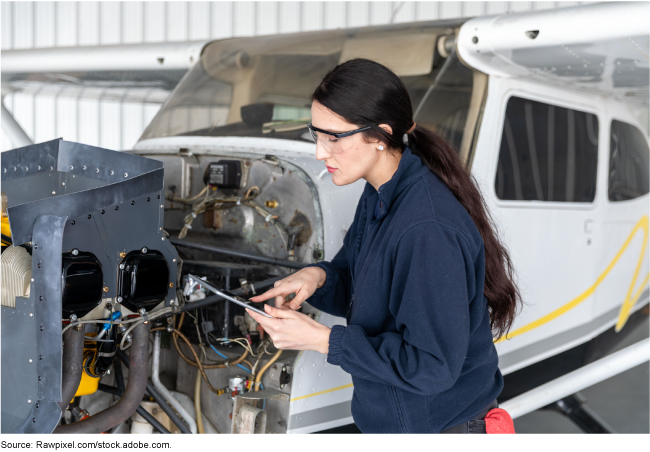
A female mechanic wearing safety glasses standing next to an aircraft.
Highlights
What GAO Found
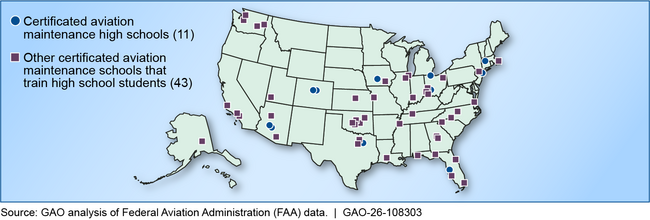
The Federal Aviation Administration (FAA) issues certificates to aircraft mechanics and to the more than 200 aviation maintenance schools that train them. Eleven of these certificated schools are high schools, and 43 are colleges, universities, or career and technical centers that serve high school students. In addition, at least 43 high schools offer programs in aviation maintenance but are not certificated by FAA. The school representatives that GAO interviewed had little data on career outcomes but cited a range of pathways that graduates have pursued, including further training and enrolling in 4-year colleges.
FAA-Certificated Schools That Train High School Students in Aviation Maintenance
Stakeholders identified several barriers to students becoming aircraft mechanics, especially limited awareness of the career option among students entering high school. Stakeholders also offered options to address these barriers, such as internships with aviation industry partners to increase awareness. Some stakeholders cited as a barrier the ineligibility of students from uncertificated schools, who do not have the requisite work experience or additional education, to take the general written knowledge test—typically the first in a series of FAA tests that students must pass to become an FAA-certificated aircraft mechanic. For example, one stakeholder said that having to take courses at a certificated school can be costly after taking courses at an uncertificated school.
The FAA Reauthorization Act of 2024 requires FAA to task the Aviation Rulemaking Advisory Committee to establish the Airman Knowledge Testing Working Group by May 2025, to assess whether students who have successfully completed an aviation maintenance curriculum should be allowed to take the general written knowledge test. FAA has not established this working group or obtained this assessment. FAA officials said they were unable to do so because, according to the Department of Transportation, it terminated all members of the advisory committee pursuant to an executive order, which required termination of advisory committees deemed to be unnecessary. Convening a group of industry stakeholders and aviation experts to conduct an assessment, through the advisory committee or other mechanism, could help FAA obtain a range of perspectives on the potential benefits and drawbacks of allowing graduates of uncertificated schools to take the test. Through this assessment, FAA could also determine whether expanding access to the test could help address future workforce demand.
Why GAO Did This Study
A sufficient supply of aircraft mechanics, who service and repair aircraft, is necessary to ensure a safe aviation system. The Bureau of Labor Statistics estimates there will be about 11,300 open positions for aircraft mechanics annually through 2034. One way to meet this need is to recruit and train younger workers.
The FAA Reauthorization Act of 2024 includes a provision for GAO to review programs that train high school students in aviation maintenance and identify certain barriers for program graduates. This report discusses, among other things, (1) the number of such programs and the career outcomes of their graduates; and (2) barriers to students becoming aircraft mechanics through these programs, and options to address those barriers.
GAO analyzed FAA data and conducted a literature search to identify high school aviation maintenance programs, including those partnering with schools certificated by FAA. GAO also interviewed aviation industry stakeholders, including representatives of 12 certificated or uncertificated schools, selected based on type of school and geographic diversity. In addition, GAO compared FAA’s actions with statutory requirements.
Recommendations
GAO recommends that FAA establish a group of industry stakeholders and aviation experts to assess whether students should be allowed to take FAA’s general written knowledge test for mechanics after successfully completing an aviation maintenance curriculum at an uncertificated school. DOT concurred with the recommendation.
Recommendations for Executive Action
| Agency Affected | Recommendation | Status |
|---|---|---|
| Federal Aviation Administration | The FAA Administrator should establish a group of industry stakeholders and aviation experts to assess whether high school students, upon successful completion of aviation maintenance curricula at uncertificated schools, should be allowed to take the general written knowledge test. (Recommendation 1) |
When we confirm what actions the agency has taken in response to this recommendation, we will provide updated information.
|