
Military Installations: Remote and Isolated Locations Face Challenges Delivering Critical Support Services
Fast Facts
Remote and isolated military bases are often far from larger cities or located in resource-limited environments. This makes the delivery of critical support services—such as health care or housing—challenging.
But DOD hasn't established a clear definition of 'remote and isolated' bases. Doing so could help DOD better identify these installations and develop strategies to address identified risks.
DOD also reduced its civilian workforce in 2025, which made it more difficult to hire people in critical support service positions at these bases. DOD hasn't assessed the impact of these reductions.
We recommended that DOD address these issues.
A military base in an austere location
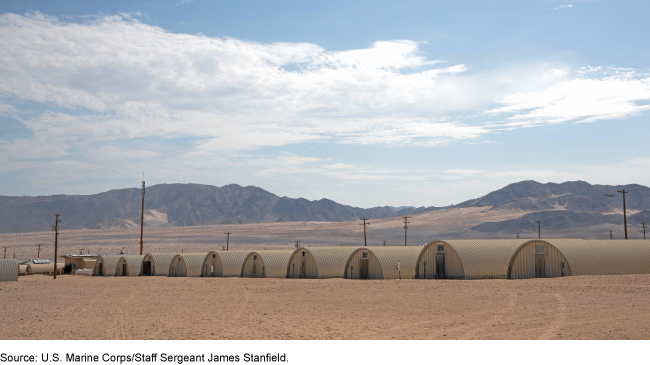
Military prefabricated structures in a mountainous, desert area
Highlights
What GAO Found
Remote and isolated military installations are often away from population centers or located in austere environments, making the delivery of critical support services, such as health care or housing, challenging. GAO found that while remote and isolated installations consistently faced challenges in areas such as recruiting and retaining civilian personnel, the causes and severity of those challenges differed by location. For example, in Alaska, Eielson Air Force Base had the most vacant positions (428) while Fort Greely and Clear Space Force Station had no vacant critical support services positions.
In 2024, the Department of Defense (DOD) issued guidance for designating installations as remote and isolated. As of May 2026, the Departments of the Army and Navy compiled lists of remote and isolated installations in accordance with this guidance. The Department of the Air Force has opted not to make a formal designation at this time. A DOD official stated that efforts to fully develop the risk assessment process outlined in the same guidance will begin once the initial designations of remote and isolated installations are complete. However, this guidance does not establish a clear definition for what a remote and isolated installation is. Moreover, other guidance varies in how these installations are defined. A consistent definition of remote and isolated installations would enhance DOD’s ability to produce an accurate picture of what is considered remote and isolated across the enterprise for purposes of identifying and assessing risks among these installations.
Photos of Remote and Isolated Military Installations

DOD implemented multiple efforts to reduce its civilian workforce since January 2025 that had significant impacts on the ability to staff or hire civilian positions in critical support services at remote and isolated installations. However, DOD has not assessed the effect of these reductions on remote and isolated locations where recruiting and retaining civilian personnel can be difficult. Collecting specific lessons learned at remote and isolated installations from the civilian workforce reduction efforts could assist DOD in understanding the effect of such reductions.
Why GAO Did This Study
DOD has established policies and programs intended to enhance quality of life and well-being of service members and their families. Installations that could be considered remote and isolated often have reduced support services for service members and their families.
The Joint Explanatory Statement accompanying the James M. Inhofe National Defense Authorization Act for Fiscal Year 2023 included a provision for GAO to assess civilian positions supporting critical services at remote installations. This report (1) describes the ability to fill civilian personnel positions in critical support services at remote and isolated installations and challenges providing critical support services at these locations; and assesses the extent to which DOD has (2) designated installations as remote and isolated and assessed risks at these locations; and (3) developed lessons learned from civilian workforce reductions on critical support service positions at remote and isolated installations.
GAO reviewed documentation and interviewed officials from a non-generalizable sample of nine remote and isolated installations to discuss the provision of critical support services at those installations. GAO also collected data from these installations for fiscal years 2023 through 2025 on vacancy rates and time to hire for civilian positions in the critical support services.
Recommendations
GAO is making two recommendations, including that DOD update its guidance to ensure the term “remote and isolated installations” is clearly defined and to specifically examine lessons learned from civilian workforce reduction efforts at these locations. DOD concurred with these recommendations.
Recommendations for Executive Action
| Agency Affected | Recommendation | Status |
|---|---|---|
| Department of Defense | The Secretary of Defense should ensure that the Under Secretary of Defense for Personnel and Readiness updates DOD's definition of remote and isolated installations in existing guidance to clarify how to measure the adequacy of critical support services when designating installations as remote and isolated. (Recommendation 1) |
When we confirm what actions the agency has taken in response to this recommendation, we will provide updated information.
|
| Department of Defense | The Secretary of Defense should ensure the Under Secretary of Defense for Personnel and Readiness, as part of implementing our prior recommendation on collecting and sharing lessons learned from the department's implementation of civilian workforce reduction efforts in 2025, includes a specific examination of the impact of civilian workforce reductions at remote and isolated installations. (Recommendation 2) |
When we confirm what actions the agency has taken in response to this recommendation, we will provide updated information.
|