
Inflation Reduction Act: U.S. Fish and Wildlife Service Should Develop Performance Goals for Its Wildlife Refuge Projects
Fast Facts
The U.S. Fish and Wildlife Service manages a network of 856 million acres of land and water used for recreation and wildlife protection. FWS awarded funds it received from the Inflation Reduction Act to states, nonprofits and local agencies for projects that restore habitats and infrastructure and make them more resilient against future weather events.
FWS developed an implementation plan with objectives for each project. But FWS didn't set performance goals to measure progress. This means that FWS doesn't know the extent to which the projects are meeting those objectives.
Our recommendations address this and other issues.
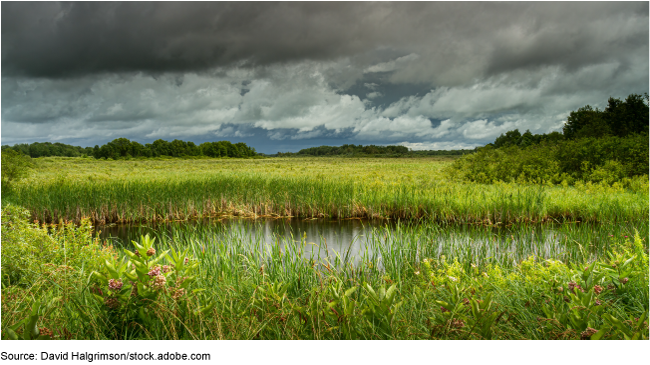
A prairie pond in Minnesota with flat grasslands.
Highlights
What GAO Found
The Inflation Reduction Act of 2022 (IRA) provided $125 million in supplemental appropriations to the U.S. Fish and Wildlife Service (FWS) to rebuild and restore units of the National Wildlife Refuge System (NWRS) and state wildlife management areas. Among other things, the appropriations are intended to increase the resiliency of habitats and infrastructure to withstand weather events. As of April 1, 2026, FWS had obligated 99.6 percent of the appropriations, primarily for financial awards to state agencies and other partners for the design, implementation, and monitoring of nine projects across 23 states and more than 75 NWRS units. For example, a northern forest project aims to restore forests, improve wildlife habitat, and reduce flood risks in the Northeast and Midwest. FWS has expended about $48.9 million, or 39 percent, of its appropriations. FWS officials told GAO that, so far, the IRA projects have resulted in the restoration of more than 5,000 acres of wetlands and 16,000 acres of other habitats.
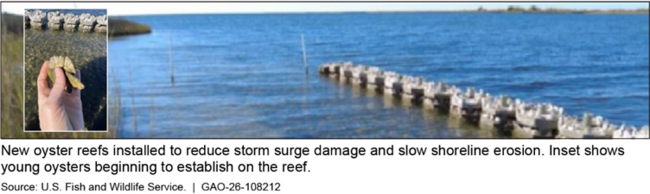
Work on U.S. Fish and Wildlife Service’s Inflation Reduction Act of 2022 Project in North Carolina
To select projects for IRA funding, FWS officials stated that the agency identified NWRS areas with planned, but unfunded, activities that aligned with the purpose of the IRA appropriations, such as to increase the resiliency of NWRS areas to weather events. FWS also prioritized projects in parts of the country that had not previously received supplemental appropriations, such as for disaster assistance, and where FWS could collaborate with long-standing partners, including state and local agencies, to expand the geographic scope of work. Once projects were selected, FWS’s regional offices used existing processes and partnerships to determine activities to undertake, such as building water control structures to reduce flood risks and fences to improve bison management. FWS then used standard agency policies and procedures, such as recipient risk guidance, to issue financial awards and contracts to carry out activities.
To oversee IRA projects, FWS developed an implementation plan with objectives for meeting the purpose of the IRA appropriations. For example, the plan calls for projects to improve the capacity to recover from extreme weather events. FWS tracked data, such as acres restored, but did not establish performance goals for measuring progress toward the objectives. By developing and using performance goals for assessing progress toward the objectives in its IRA implementation plan, FWS can better develop and use evidence to assess the extent to which the IRA projects are achieving intended results, and change course if they are not.
Why GAO Did This Study
FWS, within the U.S. Department of the Interior, manages NWRS, a national network of 856 million acres of land and water dedicated to protecting fish and wildlife habitats and providing outdoor recreation opportunities, such as hunting and fishing. IRA appropriations for NWRS and state wildlife management areas are available to FWS for obligation through September 2026 and amount to over 23 percent of NWRS’s typical annual appropriations. FWS uses grants, cooperative agreements, and contracts to fund partners, including federal and state agencies and nonprofits.
GAO was asked to review FWS’s use of its IRA appropriations. This report (1) describes how FWS has obligated and expended IRA appropriations for NWRS and state wildlife management areas; (2) describes how FWS selected, prioritized, and funded projects for these appropriations; and (3) examines how FWS provided oversight for these projects to ensure they achieve intended results.
GAO reviewed FWS obligations and expenditures data through April 1, 2026; FWS documents about its use and oversight of IRA appropriations; and recipients’ single audit reports. GAO interviewed selected financial award and contract recipients based on factors such as geographic variation, as well as FWS and Interior officials. GAO also compared FWS efforts with federal guidance and key practices, such as for performance management.
Recommendations
GAO is making two recommendations, including that FWS develop and use performance goals for each IRA project to determine if FWS is meeting the purpose of the IRA appropriations and achieving the objectives in its IRA implementation plan. FWS concurred.
Recommendations for Executive Action
| Agency Affected | Recommendation | Status |
|---|---|---|
| United States Fish and Wildlife Service | The FWS Director should direct the NWRS Chief to develop and use performance goals for each of its IRA Section 60302 projects to determine if the agency is meeting the purpose of the IRA appropriations and making progress toward achieving the objectives in its IRA implementation plan. (Recommendation 1) |
FWS concurred with this recommendation. When we confirm what actions FWS has taken in response to this recommendation, we will provide updated information.
|
| United States Fish and Wildlife Service | The FWS Director should ensure that FWS's comprehensive review of the NWRS includes (1) determining the critical skills and staffing levels that are needed to achieve NWRS goals, and (2) developing strategies to address any gaps in those critical skills and overall staffing levels. (Recommendation 2) |
FWS concurred with this recommendation. When we confirm what actions FWS has taken in response to this recommendation, we will provide updated information.
|