
Federal Rulemaking: Agencies Continue to Use Good Cause and Other Mechanisms to Forgo Public Comments
Fast Facts
During the federal rulemaking process, agencies generally must seek public comment before issuing final rules. But they can forego public comment if they find they have "good cause" —such as needing to respond to an urgent crisis.
We reviewed how often agencies use the "good cause exception." Agencies cited it for about 71% of major interim final rules we reviewed. This was consistent with our findings in prior work.
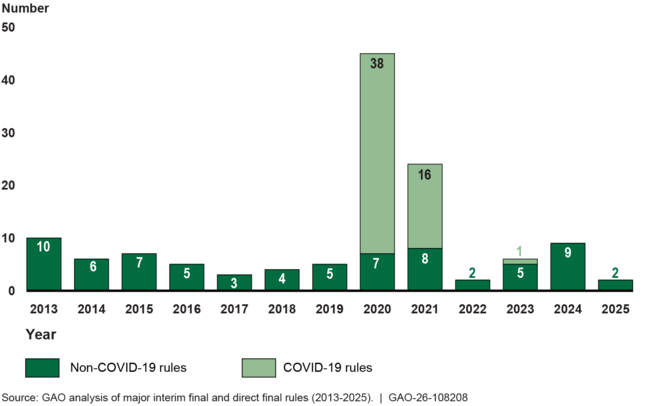
Agencies' use of this exception peaked during the COVID-19 pandemic in 2020 and 2021. Then it returned to more typical levels.

An envelope labeled "public comment" lays on top of several pages of paper.
Highlights
What GAO Found
During the rulemaking process, agencies are generally required to issue a notice of proposed rulemaking (NPRM) and seek public comment before issuing a final rule. They can expedite the process and forgo this requirement when they find good cause that the process would be impracticable, unnecessary, or contrary to the public interest. This can occur, for example, when agencies are responding to natural disasters or public health emergencies. Agencies cited good cause reasons for expedited rulemaking for about 71 percent of major interim final rules GAO reviewed and that agencies published between January 20, 2013, and January 20, 2025. This is consistent with GAO’s 2012 report, which found that 77 percent of major rules issued without an NPRM cited good cause for doing so.
GAO found that the use of expedited rulemaking increased during the peak of the COVID-19 pandemic in 2020 and 2021. There was little variation in use during non-pandemic years from January 20, 2013, through January 20, 2025, as agencies issued between two and 10 major rules without an NPRM per year. During the pandemic agencies expedited the issuance of 55 rules in response to COVID-19. Agencies cited good cause for 41 of these rules.
Number of COVID-19 and Non-COVID-19 Major Rules Reviewed Using Expedited Rulemaking, by Year, Jan. 20, 2013–Jan. 20, 2025
Agencies reported on the economic effects of 66 percent of the rules that GAO reviewed. COVID-19 related rules were less likely to include this information due to the emergency nature of the rules. Agencies requested public comments for 99 percent of the interim final rules that GAO reviewed and received comments on 94 percent of these rules. This is an increase from GAO’s 2012 report which found agencies requested comments for 63 percent of major rules issued without an NPRM.
Why GAO Did This Study
On average, agencies publish over 2,000 final regulations each year to achieve goals such as ensuring access to food and healthcare services and addressing national emergencies. The Administrative Procedure Act establishes the basic procedural requirements agencies generally must follow when issuing regulations, including providing the public with an opportunity to comment on proposed rules. Public participation can improve the quality of rules, ensure fair treatment, and promote accountability. However, providing for public participation might not be appropriate in every situation before issuing a final rule and agencies may find good cause that notice-and-comment procedures are impracticable, unnecessary, or contrary to the public interest.
GAO was asked to provide information on the frequency, reasons, and trends for agencies issuing final rules without an NPRM. This report addresses (1) how frequently agencies found good cause to issue rules without an NPRM; (2) the extent to which the effect of the COVID-19 pandemic led to changes in issuing rules without prior notice-and-comment; and (3) the extent to which agencies assessed the rules’ economic benefits, among other things.
GAO reviewed 116 major interim final and 12 direct final rules published between January 20, 2013, and January 20, 2025. GAO also reviewed associated documents for the rules, relevant laws, executive orders, and guidance related to waiving notice-and-comment, and agencies’ use of regulatory flexibility during the pandemic.
For more information, contact Lisa Van Arsdale at vanarsdalel@gao.gov.