
DHS Annual Assessment: Dynamic Environment Affects Efforts to Manage Acquisition Risks
Fast Facts
The Department of Homeland Security plans to spend at least $55 billion on programs to develop and buy ships, technology systems, and more for national security.
Under current legislation, DHS expects to receive at least $14 billion in additional funding, with most of that money going toward Coast Guard and Customs and Border Protection programs. At the same time, some DHS programs faced staffing and oversight changes.
For example, some programs lost as much as 20% of their staff, which puts program goals at risk. And in October 2025, DHS dissolved a key acquisition oversight office.
We have ongoing work in these areas.
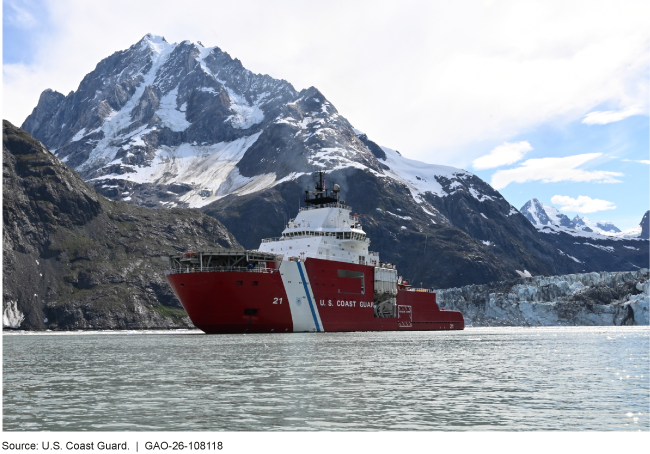
Coast Guard ship at sea with snow-topped mountain behind it.
Highlights
What GAO Found
The U.S. Department of Homeland Security (DHS) and its components spend billions annually on programs to acquire systems and capabilities that support national security. In fiscal year (FY) 2025, GAO reviewed 27 DHS major acquisition programs—generally, those with total costs over $300 million. To support timely delivery of capabilities and minimize cost growth, DHS policy requires programs to get DHS approval for their baseline cost, schedule, and performance goals. Of the 27 programs reviewed, 19 had received this approval while the other 8 had not yet reached the stage where this was required.
As of September 30, 2025, 15 of the 19 programs had revised their baseline goals since initially setting them, some of them multiple times. Most programs with revised baselines delayed their plans to deliver full capabilities. Baselined costs collectively increased a projected $11.4 billion, or 26 percent, since they were first set. Of those 19 programs, 18 were meeting their most recent baseline goals. One program—the Coast Guard’s Offshore Patrol Cutter—has ongoing efforts to revise its baseline to reflect recent schedule delays and cost increases.
DHS’s programs face a continually changing environment, which affects their ability to manage cost and schedule risks. For example:
- Staff. Uncertainties around staff could risk programs’ ability to achieve future milestones. Specifically, in FY 2025, eight programs experienced at least a 20 percent or more reduction in staff, resulting in lost subject matter expertise and technical skills.
- Acquisition oversight. In October 2025, DHS decided to dissolve the office responsible for department-level oversight of major acquisition programs. DHS officials stated some of the oversight responsibilities had been moved to other parts of DHS. However, as of January 2026, DHS officials were unsure what level of oversight DHS would continue to provide. In May 2026, at least one part of that office was reconstituted, according to DHS officials.
- Funding. Twelve of the 27 programs expect to receive at least $14 billion in funding from the 2025 Budget Reconciliation Act.
GAO will continue to monitor DHS’s updated acquisition oversight structure as well as DHS’s portfolio of major acquisition programs.
Why GAO Did This Study
DHS plans to invest over $55 billion to acquire systems for its current portfolio of major acquisition programs—over $11 billion more than DHS had initially planned.
The Explanatory Statement accompanying a bill for the DHS Appropriations Act, 2015 includes a provision for GAO to review DHS’s major acquisitions on an ongoing basis. This report assesses (1) how DHS major acquisition programs have performed since establishing their baseline cost, schedule, and performance goals; and (2) the status of DHS’s acquisition portfolio, including any cost and schedule risks.
GAO selected 27 of DHS’s largest acquisition programs to determine program status as of the end of FY 2025. Of these, GAO identified 19 with DHS-approved acquisition baselines for further analysis. GAO reviewed key documents; collected cost, schedule, and performance information; and interviewed DHS officials.
For more information, contact Travis J. Masters at masterst@gao.gov.