
Immigration Courts: Stakeholder Perspectives on the Use of Remote Hearings
Fast Facts
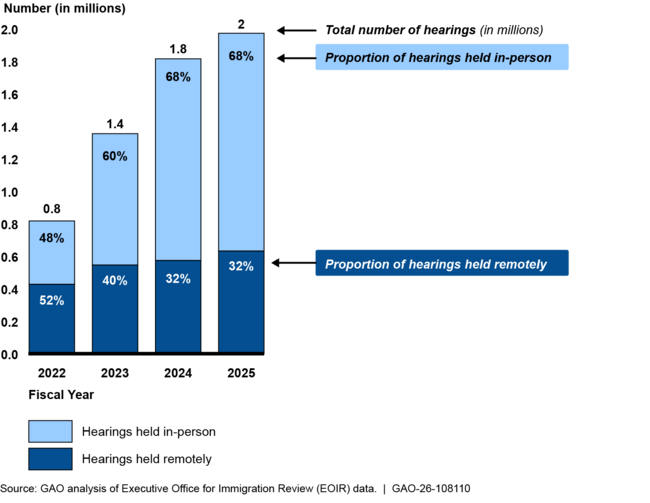
The Department of Justice's Executive Office for Immigration Review holds immigration hearings to determine whether noncitizens will be removed from the country. About 2 million immigration hearings occurred in FY 2025. Almost a third of these hearings took place remotely, through video teleconferencing or by telephone.
We spoke with immigration judges, attorneys for the government, and attorneys for noncitizens who described mostly positive experiences with remote hearings. For example, they said that remote hearings gave them greater flexibility and reduced the time and costs associated with appearing in person.

Judge wearing a robe sitting at a computer raising hand during remote court hearing
Highlights
What GAO Found
The Department of Justice’s Executive Office for Immigration Review (EOIR) conducts immigration court proceedings both in-person and using remote technology, such as WebEx—an internet-based video teleconferencing platform, or telephone. Per EOIR policy, immigration judges may use discretion to decide which, if any, remote medium is used by participants in a hearing. EOIR collects data on the medium used for each hearing, which reflects the location of only the judge and respondent. According to GAO’s analysis of this data, of the nearly 6 million hearings held from fiscal year 2022 through 2025, about 63 percent or 3.8 million hearings were in-person. Of the approximately 2.2 million remote hearings, most used WebEx (about 78 percent or 1.7 million). During this time, the number of remote hearings increased almost 50 percent, while the number of in-person hearings increased more dramatically. EOIR officials stated that as the COVID-19 pandemic subsided, immigration courts began scheduling more hearings overall, with more hearings taking place in-person.
Number and Percentage of Immigration Court Hearings Held Remotely and In-person, Fiscal Years 2022–2025
EOIR officials and selected immigration judges and attorneys described generally favorable experiences with remote immigration hearings. They identified benefits of using remote technology, such as reducing the time and cost associated with in-person hearings, increasing the efficiency of hearings, and allowing respondents increased access to private bar attorneys.
Some court stakeholders also provided perspectives on challenging aspects of remote hearings, such as variation in judge preferences for remote hearings, and technology limitations for language interpretation options. However, they told GAO these challenges did not outweigh the benefits of holding remote immigration hearings.
Why GAO Did This Study
Each year, EOIR immigration judges preside over immigration court proceedings for hundreds of thousands of respondents—foreign nationals charged on statutory grounds of removability. In 2017, GAO reported that EOIR would benefit from collecting more reliable data on the use of remote technology in immigration hearings, among other actions.
The Explanatory Statement accompanying the Consolidated Appropriations Act, 2024, includes a provision for GAO to update the portion of its 2017 report that addressed the use of remote technology in immigration courts. This report examines (1) what EOIR data show about remote and in-person immigration hearings from fiscal year 2022 through 2025 and (2) the benefits and challenges of using remote technology for immigration court hearings and any actions EOIR has taken to address challenges.
GAO reviewed EOIR policies and procedures regarding the use of remote technology in immigration hearings and analyzed EOIR data on immigration hearings from fiscal year 2022 through 2025. In addition, GAO interviewed officials from EOIR and the Office of the Principal Legal Advisor (OPLA) within the Department of Homeland Security‘s U.S. Immigration and Customs Enforcement.
GAO also interviewed immigration judges and OPLA attorneys from four immigration court locations selected to represent courts with variation in the size of geographic area of responsibility and hearing volume, and members of two nongovernmental organizations for immigration judges and attorneys who represent respondents. Further, GAO conducted in-person and remote observations of 22 immigration hearings from 11 immigration courts across the U.S.
For more information, contact Heather MacLeod at MacleodH@gao.gov.