
Inflation Reduction Act: EPA’s Use and Oversight of $11.5 Billion in Appropriations
Fast Facts
EPA received billions from the Inflation Reduction Act of 2022 to reduce air pollution, including greenhouse gases. As of March 2026, EPA has spent $690 million, most of which was for grants to state governments to reduce air pollution, such as by deploying emissions-free, heavy-duty vehicles.
EPA awarded most of this money through competitive grants and used its standard processes to choose winners. EPA is also conducting an additional level of oversight for these grants—something it normally only does for 10% of its grants.
However, EPA has lost hundreds of staff due to early retirements and is evaluating its staffing needs for oversight.
Environmental Protection Agency building entrance
Highlights
What GAO Found
The Inflation Reduction Act of 2022 (IRA) provided about $41.5 billion in supplemental appropriations to the U.S. Environmental Protection Agency (EPA) for grants and other investments to reduce air pollution and enhance national climate resilience. EPA primarily used the appropriations to create new grant programs and has awarded hundreds of grants. In 2025, EPA terminated grants funded by $30 billion of IRA appropriations and several grant recipients were challenging the terminations in court as of June 2026.
Of the roughly $11.5 billion in appropriations unaffected by the terminations and related litigation, Public Law 119-21, commonly known as the One Big Beautiful Bill Act (OBBBA), rescinded the budget authority for about $1.2 billion that EPA had not yet obligated. As of March 2026, EPA was overseeing about $10.2 billion in appropriations it obligated before OBBBA was enacted and which are not affected by ongoing litigation. EPA has expended about $686 million of these obligated funds.
Status of About $11.5 Billion in Appropriations Provided to EPA in the Inflation Reduction Act of 2022 (IRA), as of March 2026
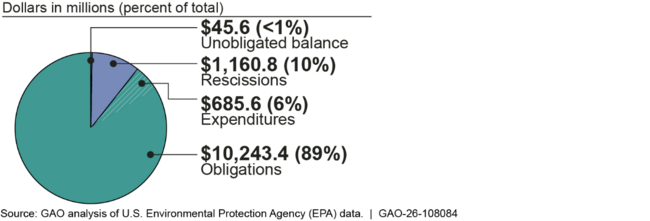
Note: Percentages exceed 100 percent because expenditures are a subset of obligations. The unobligated balance reflects the amount EPA has not yet obligated from the appropriations unaffected by OBBBA’s rescissions.
EPA’s obligations are mostly for competitive grants, and state governments received the largest number of grants. Of the about $10.2 billion in total obligations, EPA obligated about $8.6 billion from fiscal years 2023 to 2026 for efforts to reduce air pollution across the country, including replacing certain heavy-duty vehicles with emissions-free equivalents such as battery-electric or hydrogen fuel cell vehicles, deploying emissions-free equipment at U.S. ports, and improving energy efficiency in commercial and public buildings.
EPA used the agency’s standard policies and procedures when it reviewed and selected recipients for competitive grants. Specifically, GAO found that EPA followed its competition policy by providing notice to potential applicants of its program goals, eligibility requirements, and evaluation criteria. EPA reviewers ranked the merit of eligible applicants using points-based scoring systems and made recommendations to agency selection officials, who made the final selection decisions.
GAO found that EPA is using its standard processes for overseeing recipients’ use of funds. EPA requires that grant recipients submit periodic performance reports. According to the agency, it plans to conduct an additional level of oversight for all its IRA grants through an in-depth assessment at least once during their performance periods. EPA officials stated they are assessing the agency’s resource needs in light of staff reductions that have occurred since January 2025 and are using contractor support to fill in gaps where necessary.
Why GAO Did This Study
The appropriations provided by the IRA constitute a significant increase in funds available to EPA, which typically have been about $9 billion per year.
GAO was asked to review EPA’s use of IRA appropriations, including any related changes to the agency’s staffing. Additionally, the IRA includes a provision for GAO to support oversight of the distribution and use of IRA appropriations. This report provides information about EPA’s use and oversight of the $10.2 billion the agency obligated and the processes EPA used to make funding decisions.
GAO reviewed EPA obligations and expenditures data through March 2026. GAO also reviewed legal requirements, relevant EPA documents, and recipients’ single audit reports. GAO interviewed selected grant recipients based on factors such as geographic variation, as well as EPA officials.
For more information, contact J. Alfredo Gómez at gomezj@gao.gov.