
Disaster Assistance: FEMA Actions Needed to Better Support People with Disabilities in Disasters
Fast Facts
People with disabilities are more likely than other survivors to face hardship due to a major disaster. The Federal Emergency Management Agency supports state and local partners who help disaster survivors, including people with disabilities.
However, FEMA no longer trains its partners on including people with disabilities in disaster response. Nor does the agency routinely coordinate with partners before disasters to support this population. And FEMA's application for financial assistance may make it hard for some people with disabilities to apply.
Our recommendations address these issues.
FEMA seal on top of the American flag
Highlights
What GAO Found
The Federal Emergency Management Agency (FEMA) has made guidance, grants, and specialized staff available to state and local governments and other organizations that support disaster survivors, including people with disabilities. FEMA has some guidance for state and local partners on incorporating the needs of people with disabilities into disaster planning and response. FEMA has also offered training for its partners on including people with disabilities in disaster operations but removed this training from its curriculum in 2025 to ensure compliance with various Executive Orders, according to officials. It has now been over a year since the training was offered. Without this training, FEMA’s state and local partners risk not being able to effectively assist people with disabilities. FEMA also has regional staff who can coordinate with state and local partners to support people with disabilities, which state and local officials said was beneficial. However, this coordination has been inconsistent across regions, and this role is not standardized. Clearly documenting a responsibility for disability specialists to coordinate with state and local partners would help ensure equitable access to assistance for people with disabilities when a disaster happens.
FEMA also makes information, grants, and staff support directly available to survivors with disabilities. For example:
- FEMA publishes disaster planning and recovery guidance for people with disabilities and caregivers on its website.
- FEMA’s individual assistance grants can provide financial assistance to replace assistive devices and medically required equipment, among other things.
- FEMA provides specialized services to help people with disabilities apply for grants, such as providing sign language interpretation via video. It also has staff who investigate complaints of discrimination based on disability.
However, some people with disabilities may face obstacles when applying for grant assistance, according to stakeholders GAO interviewed. These obstacles include unclear application questions and eligibility letters written at a grade 12 reading level. FEMA has not solicited feedback from people with disabilities on its overall grant application process, limiting its ability to ensure accessibility. Being able to more easily navigate the application process could help ensure people with disabilities receive assistance after a disaster.
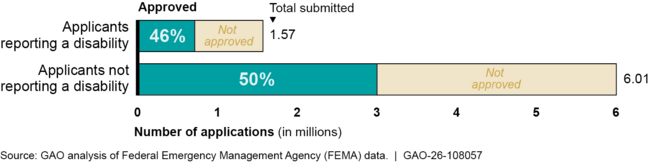
GAO’s analysis shows that 4 percentage points fewer applicants with disabilities were approved than those without disabilities from 2022 through 2025.
FEMA Disaster Assistance Applications Received and Approved in 2022–2025
Why GAO Did This Study
People with disabilities are far more likely than people without disabilities to face hardship due to a major disaster, according to the National Council on Disability. FEMA plays a role in helping state and local governments, nonprofits, and others support survivors after a disaster. It also provides grants to states to help rebuild infrastructure and financial assistance to disaster survivors. The Think Differently About Emergencies Act included a provision for GAO to review the assistance FEMA provides to help people with disabilities.
This report examines the extent to which FEMA (1) works with state and local governments and others to support people with disabilities in disasters and (2) directly helps people with disabilities and their families.
GAO analyzed data from 2022 through 2025 on FEMA’s grants to disaster survivors and reviewed relevant federal laws and agency policy. GAO also interviewed FEMA officials; officials at organizations that support people with disabilities; and state and local officials and organizations in Hawaii, Louisiana, and Kentucky, which experienced different types of disasters in separate FEMA regions from 2023 through 2025.
Recommendations
GAO is making three recommendations that FEMA address the needs of people with disabilities in disasters by re-instituting disability training for state and local partners, standardizing the role of regional disability staff to coordinate with state and local partners before disasters, and soliciting feedback on the accessibility of the financial assistance application process. FEMA concurred with our recommendations.
Recommendations for Executive Action
| Agency Affected | Recommendation | Status |
|---|---|---|
| Federal Emergency Management Agency | The FEMA Administrator should re-institute training to state and local partners on addressing the needs of people with disabilities in disasters. (Recommendation 1) |
When we confirm what actions the agency has taken in response to this recommendation, we will provide updated information.
|
| Federal Emergency Management Agency | The FEMA Administrator should document and standardize that the disability specialist role in all regions includes coordinating with relevant state and local partners before disasters happen to ensure that the needs of people with disabilities are taken into account during disasters. (Recommendation 2) |
When we confirm what actions the agency has taken in response to this recommendation, we will provide updated information.
|
| Federal Emergency Management Agency | The FEMA Administrator should solicit and incorporate feedback on its IA application process from people with different types of disabilities to address issues we identified in this report, such as use of plain language and the discontinuation of door-to-door assistance teams, and make it easier for people with disabilities to apply for assistance. (Recommendation 3) |
When we confirm what actions the agency has taken in response to this recommendation, we will provide updated information.
|