
K-12 Education: Improved Oversight Could Help DOD Schools Better Support Students with Literacy and Math Skill Deficits
Fast Facts
Teacher support to address individual students' reading and math deficits or learning disabilities can improve academic outcomes. We visited Department of Defense schools in districts that serve about 60% of DOD school students with identified learning disabilities.
Staff at all the schools we visited said teachers needed opportunities to give input on training to help them develop this support for their students. But DOD didn't ask for their input. Asking for and acting on teachers' input would help DOD ensure teachers have the training they need to tailor instruction to meet students' needs.
Our recommendations address this and other issues.

Students raising their hands in a classroom.
Highlights
What GAO Found
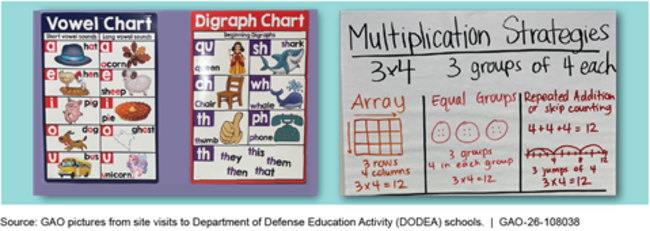
In school year 2024–2025, about 10 percent of the approximately 60,000 K-12 students attending Department of Defense Education Activity’s (DODEA) schools full time received strategic instruction. This is short-term extra help in a small group setting (see figure). About 5 percent had a “specific learning disability” (SLD). SLDs are a group of disorders, such as dyslexia and dyscalculia, related to understanding language or doing mathematical calculations. The number of DODEA students with SLDs increased 29 percent from school years 2018–2019 through 2024–2025.
DODEA Instructional Materials for Students with Literacy and Math Deficits
Most staff in the 11 selected schools GAO visited—in five districts that serve 63 percent of DODEA students with SLDs—outlined obstacles to timely identifying students needing strategic instruction or special education for SLDs. These included limited screening tools, challenges with submitting complete student referrals for strategic instruction and special education, and delayed special education evaluations. For example, at nine of 11 schools, staff said they needed more or better screening tools to identify students. DODEA’s screening tools do not directly assess elementary school students’ foundational phonics skills, which help identify reading deficits. They also are not available for all students. These limitations make it difficult to identify students who are behind grade level when they arrive at a school—which is important given DODEA’s highly mobile population. In July 2026, DODEA officials said that they procured universal screening tools for all grades and plan to start administering them in late 2026. When implemented, these tools will provide key data to fill gaps in identifying students’ needs and connect them to support.
DODEA staff at all 11 schools we visited also cited obstacles to helping students meet their literacy and math goals. These included strategic instruction and special education teachers not receiving professional learning relevant to their roles, not having adequate access to data on students’ grades, and varied practices across DODEA schools that result in eligible students not receiving needed help to meet grade-level expectations. For example, during GAO’s interviews, 32 of 44 strategic instruction and special education teachers rated their professional learning opportunities as “bad” or “very bad.” Further, staff at all 11 schools said they wanted teachers to be able to provide input on needed professional learning—for example, opportunities focused on identifying students with literacy and math deficits and SLDs. DODEA guidelines say that professional learning should advance teachers’ ability to apply acquired knowledge and skills targeted to their role. Asking for and acting on teacher feedback would help DODEA advance teachers’ ability to apply the skills needed to help students with literacy and math deficits and SLDs meet their learning goals.
Why GAO Did This Study
Students in military families—many of whom attend DODEA schools—face unique challenges due to frequent moves. DODEA families have raised concerns about access to literacy and math supports and special education services. Research shows that instruction tailored to students’ needs can improve academic outcomes and reduce the number of students referred to special education.
The Joint Explanatory Statement accompanying the 2025 National Defense Authorization Act includes a provision for GAO to examine services for DODEA students with literacy and math deficits and SLDs. GAO examined (1) the number of students receiving strategic instruction or having an SLD, (2) the extent DODEA provides guidance and tools to identify these students, and (3) the extent DODEA supports teachers in helping students.
GAO analyzed DODEA data from school years 2018-2019 through 2024-2025 on student enrollment and reviewed relevant federal laws and DOD policies. GAO conducted in-person site visits to schools in five of nine DODEA districts, selected for variation in number of students with SLDs, among other things. GAO interviewed DODEA officials and held 47 group interviews with teachers, administrators, and other stakeholders. GAO also administered a nongeneralizable opt-in online questionnaire to parents of DODEA students with SLDs.
Recommendations
GAO is making eight recommendations to DOD, including to (1) improve screening students for literacy and math deficits; and (2) solicit teacher input on professional learning. DOD agreed with five recommendations and partially agreed with three, as discussed in the report.
Recommendations for Executive Action
| Agency Affected | Recommendation | Status |
|---|---|---|
| Department of Defense | The Secretary of Defense should ensure that the DODEA Director eliminates gaps in DODEA's current approach to screening students for literacy and math deficits. This could include adopting screening tools that assess foundational phonic skills in elementary school and expanding access to existing screeners that are currently only available to middle and high school students already receiving strategic literacy or math instruction. (Recommendation 1) |
DOD agreed with this recommendation. DOD noted steps it has taken to address it, such as procuring Navvy + aimswebPlus to support universal screening and earlier identification of student learning needs. They will continue to monitor implementation and screening outcomes to ensure student needs are met as early as possible. Initial administration is scheduled for November/December 2026. We will monitor the progress of these and any additional efforts.
|
| Department of Defense | The Secretary of Defense should ensure that the DODEA Director analyzes data on the reasons why Student Support Teams reject referrals for students who may benefit from additional literacy and math support and use this information to better ensure the completeness, quality, and timeliness of referrals. (Recommendation 2) |
DOD partially concurred with this recommendation. DOD noted that recent system enhancements have increased the availability of data on Student Support Team referrals. It also noted that this will help inform decisions regarding the completeness, quality, and timeliness of referrals. DOD further stated that the Student Support Team is a general education problem-solving team that makes referrals to multiple pathways for specialized support, such as strategic instruction classes or special education. Our report clarifies the relationships between the Student Support Team, strategic instruction, and special education. Nevertheless, there is significant confusion among DODEA staff about the data needed to successfully support a referral to the Student Support Team for students who may benefit from additional literacy and math support. We continue to believe that understanding the reasons why Student Support Teams reject referrals would help ensure the completeness, quality, and timeliness of referrals, and ultimately ensure that students who qualify for additional support get it more quickly.
|
| Department of Defense | The Secretary of Defense should ensure that the DODEA Director identifies referrals for special education that have been rejected due to poor quality or incomplete information and use the results to improve the completeness and quality of referrals systemwide. For example, by identifying the districts with the highest rejection rates using available data in its special education information system, DODEA could identify common patterns for rejections due to poor quality or incomplete data and take achievable steps to improve the quality of the referrals. (Recommendation 3) |
DOD partially agreed with this recommendation. DOD stated that it will explore available data sources to support informed decision-making while preserving the integrity of Case Study Committee final determinations, which are unique to each case's circumstances. We maintain that the purpose of identifying districts with the highest rejection rates is to identify common patterns that could improve the quality of the referrals themselves. Improving the quality of referrals would ultimately ensure that students the Case Study Committee determines are qualified for additional support get it more quickly.
|
| Department of Defense | The Secretary of Defense should ensure that the DODEA Director analyzes factors within its control contributing to delays in the special education evaluation process and take appropriate steps to address them. (Recommendation 4) |
DOD agreed with this recommendation. DOD will continue providing ongoing training and support on evaluations and timeline requirements. They will also continue to monitor timeline data, collaborate with military medical partners and identify opportunities to reduce delays and improve coordination across the system. We will monitor the progress of these and additional efforts to address this recommendation.
|
| Department of Defense | The Secretary of Defense should ensure that the DODEA Director clarifies that feedback forms provided to strategic instruction and special education teachers at the end of agency-wide professional learning sessions are designed for general feedback about these teachers' future professional learning needs and use this feedback to inform future professional learning offerings. (Recommendation 5) |
DOD agreed with this recommendation, stating that it provides opportunities to gather educator feedback and evaluate professional learning offerings in various ways. Teacher feedback is regularly considered to help inform the planning and delivery of future professional learning opportunities. They will continue to provide feedback links. We will monitor the progress of these and other efforts to address this recommendation.
|
| Department of Defense | The Secretary of Defense should ensure that the DODEA Director ensures that special education teachers who teach students needing specialized reading interventions receive the professional learning necessary to teach these interventions with fidelity. This should include systemwide monitoring of teacher certifications for specialized reading interventions, as well as associated training rates. (Recommendation 6) |
DOD agreed with this recommendation. DOD noted various professional learning opportunities it provides, such as synchronous and asynchronous training and coaching; and vendor-provided training, when available. The Department also monitors participation in professional learning and will continue to monitor participation and completion of professional learning to improve literacy outcomes for students requiring specialized reading support. We will monitor the progress of these and additional efforts to implement this recommendation.
|
| Department of Defense | The Secretary of Defense should ensure that the DODEA Director ensures that all elementary school special education teachers have access to data on their students' test scores, grades on assignments, and academic progress. In doing so, DODEA should direct school administrators to provide special education teachers with a clear method to access their students' data or provide dedicated collaboration time between special education and general education teachers. (Recommendation 7) |
DOD agreed with this recommendation. DOD stated that it will continue reinforcing expectations that special education teachers have timely access to student performance data necessary to support instructional planning, progress monitoring and collaboration with families and general education staff. We will monitor any additional progress DOD makes to address this recommendation.
|
| Department of Defense | The Secretary of Defense should ensure that the DODEA Director ensures that all students DODEA has identified as being eligible for additional support in literacy or math receive the necessary support to remediate academic skill deficits so that students can successfully meet the demands of their grade-level instruction. (Recommendation 8) |
DOD partially concurred with this recommendation. DOD believes this recommendation is based, in part, on the assumption that all students identified as eligible for strategic instruction should ultimately receive that intervention. Strategic instruction classes are DODEA's primary method for remediating academic skill deficits so that students can successfully meet the demands of their grade-level instruction. We continue to believe it is critical for DODEA to do all that it can to ensure its students receive the support needed to do so. This recommendation is intended to work within the primary remediation structure that DODEA itself set forth. All students DODEA has identified as needing extra support to meet the math and literacy expectations of their grade levels receive the appropriate support to do so, regardless of how it is delivered. We continue to believe that doing so is critical to ensure that students are equipped with the necessary foundational skills to be productive members of society after they leave school.
|