
Bank Regulatory Reviews: Action Needed to Better Identify and Address Unnecessary or Unduly Burdensome Requirements
Fast Facts
The Economic Growth and Regulatory Paperwork Reduction Act of 1996 requires federal banking agencies to retrospectively review regulations to find and address unnecessary or undue regulatory burdens. However, it's hard to tell if these efforts are effective.
For example, agencies don't have documented procedures for identifying outdated or unnecessary regulations or determining whether issues raised in reviews warrant action. By having documented procedures and incorporating leading practices, agencies could improve the likelihood that these reviews meaningfully reduce burdens.
We made recommendations to address these issues.

Bank building
Highlights
What GAO Found
The Economic Growth and Regulatory Paperwork Reduction Act of 1996 (EGRPRA) requires the federal banking agencies to solicit and review public comments on their regulations to identify and eliminate outdated, unnecessary, or unduly burdensome regulations on insured depository institutions, as appropriate.
How Federal Banking Agencies Conduct Decennial EGRPRA Reviews
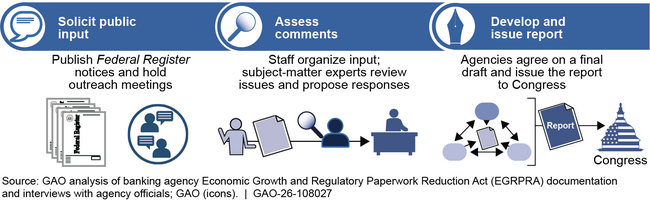
Outcomes from the EGRPRA reviews are often difficult to identify, and their connection to subsequent regulatory actions is often unclear. As a result, it can be difficult to determine the extent to which actions described in the EGRPRA report were driven by the review itself. For example, some actions described in the 2017 EGRPRA report were initiated in response to other statutory requirements, while other actions were initiated before or concurrently with the review. Representatives from six of eight organizations GAO interviewed said the reviews do not often lead to actions to modify or eliminate unnecessary regulations, and a public interest group representative noted that it is difficult to connect the EGRPRA reviews with concrete regulatory changes.
Another reason EGRPRA reviews’ outcomes are unclear is that the agencies do not have documented procedures for identifying outdated or unnecessary regulations or determining whether issues raised in the reviews warrant action. Two agencies have draft procedures that could help address these gaps, but they have not yet been fully developed or demonstrated in practice. Implementing documented procedures would help ensure that issues identified through the review are systematically evaluated and lead to clear determinations about whether they warrant action and, where appropriate, regulatory changes. Having documented procedures also is important given the long time frame between EGRPRA reviews.
Additionally, the agencies’ EGRPRA review processes reflect some leading practices for retrospective regulatory reviews, such as coordinating across agencies and soliciting public input, but do not fully reflect others. In particular, the agencies have not incorporated practices related to prioritizing which rules to analyze, conducting cost-benefit analysis, and assessing the combined burden of multiple regulations. As a result, they may not consistently focus on the most significant issues, assess regulatory impacts and trade-offs, or understand how multiple regulations collectively affect regulated entities.
Why GAO Did This Study
EGRPRA requires the Board of Governors of the Federal Reserve System, Federal Deposit Insurance Corporation, and Office of the Comptroller of the Currency to review their regulations at least once every 10 years and submit a joint report to Congress. As of July 2026, the agencies were conducting their third such review.
The Dodd-Frank Wall Street Reform and Consumer Protection Act includes a provision for GAO to report annually on financial services regulations. This report examines (1) how the federal banking agencies have conducted their EGRPRA reviews, (2) the outcomes of those reviews, and (3) the extent to which they reflect leading practices.
GAO reviewed reports by federal agencies; examined available documentation from the previous and current EGRPRA reviews, guidance, and regulations issued by the federal banking agencies; and interviewed agency officials and eight organizations selected because they submitted EGRPRA comments in the previous and current reviews.
Recommendations
GAO is making six recommendations, specifically that each federal banking agency should (1) implement procedures for identifying outdated, unnecessary, or unduly burdensome regulations and taking actions to address them during their EGRPRA reviews; and (2) incorporate into these reviews a framework for prioritizing rules for retrospective analysis, cost-benefit analysis, and assessment of cumulative regulatory burden. While the agencies outlined some actions they have taken, they neither agreed nor disagreed with the recommendations.
Recommendations for Executive Action
| Agency Affected | Recommendation | Status |
|---|---|---|
| Federal Reserve System | The Chair of the Board of Governors of the Federal Reserve System should complete the development and implementation of documented procedures for identifying outdated, unnecessary, or unduly burdensome regulations and taking action to address them during the EGRPRA review. (Recommendation 1) |
When we confirm what actions the agency has taken in response to this recommendation, we will provide updated information.
|
| Federal Reserve System | The Chair of the Board of Governors of the Federal Reserve System should incorporate into the agency's EGRPRA review, to the extent practicable, (1) a framework for prioritizing rules for retrospective analysis; (2) cost-benefit analysis; and (3) an assessment of cumulative regulatory burden, where feasible. (Recommendation 2) |
When we confirm what actions the agency has taken in response to this recommendation, we will provide updated information.
|
| Federal Deposit Insurance Corporation | The Chairman of FDIC should complete the development and implementation of documented procedures for identifying outdated, unnecessary, or unduly burdensome regulations and taking action to address them during the EGRPRA review. (Recommendation 3) |
When we confirm what actions the agency has taken in response to this recommendation, we will provide updated information.
|
| Federal Deposit Insurance Corporation | The Chairman of FDIC should incorporate into the agency's EGRPRA review, to the extent practicable, (1) a framework for prioritizing rules for retrospective analysis; (2) cost-benefit analysis; and (3) an assessment of cumulative regulatory burden, where feasible. (Recommendation 4) |
When we confirm what actions the agency has taken in response to this recommendation, we will provide updated information.
|
| Office of the Comptroller of the Currency | The Comptroller of the Currency should develop and implement documented procedures for identifying outdated, unnecessary, or unduly burdensome regulations and taking action to address them during the EGRPRA review. (Recommendation 5) |
When we confirm what actions the agency has taken in response to this recommendation, we will provide updated information.
|
| Office of the Comptroller of the Currency | The Comptroller of the Currency should incorporate into the agency's EGRPRA review, to the extent practicable, (1) a framework for prioritizing rules for retrospective analysis; (2) cost-benefit analysis; and (3) an assessment of cumulative regulatory burden, where feasible. (Recommendation 6) |
When we confirm what actions the agency has taken in response to this recommendation, we will provide updated information.
|