
Air Traffic Control Systems: Ambitious New Modernization Effort Needs to Improve Cost and Schedule Planning
Fast Facts
The Federal Aviation Administration has struggled for decades to modernize its outdated air traffic control systems, which are critical for safe and efficient flight operations. In May 2025, it launched an initiative to accelerate these efforts.
FAA has made progress implementing this initiative, but it could be prioritizing speed over costs and air traffic disruptions. For example, FAA doesn't have a lifecycle cost estimate or master schedule for related projects. Without them, the agency could end up causing air traffic disruptions or prolonging reliance on severely outdated systems.
Our recommendations address these issues.
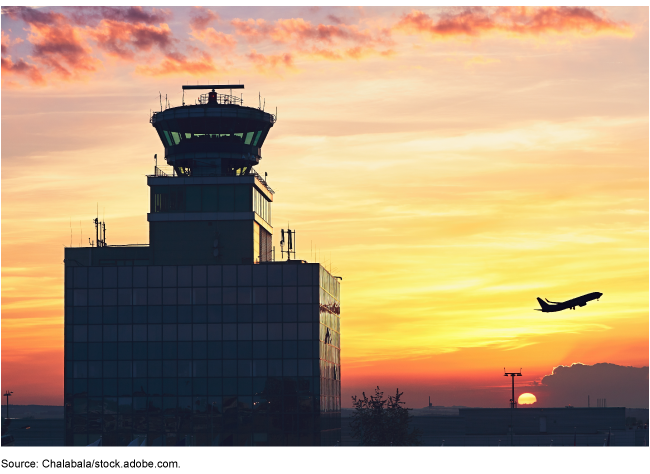
A plane taking off behind an air traffic control tower
Highlights
What GAO Found
The Federal Aviation Administration’s (FAA) Brand New Air Traffic Control System (BNATCS) has an ambitious goal to significantly accelerate the modernization of outdated air traffic control (ATC) systems. The goal is to be achieved at an unprecedented speed. The first of two phases aims to modernize communication, surveillance, weather, and training systems, among other things. For example, FAA plans to modernize voice radio systems 9 years earlier than initially planned. Phase 1 is to be fully completed by December 2028. In July 2025, Congress appropriated $12.5 billion to support BNATCS and FAA is using most of the funds for phase 1. For phase 2, FAA plans to develop new automation systems to track aircraft and optimize traffic. FAA stated that they will need approximately $10.2 billion for this phase (not including facilities). FAA does not yet have an estimated date for when phase 2 will be started or completed.
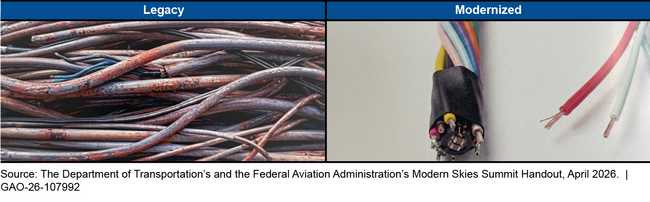
FAA has made progress in implementing portions of phase 1. For example, as of May 2026, FAA reported replacing 2,560 of 5,170 old and frail copper wires with high-speed fiber optic communications cables.
Copper Wires from the 1960s Are Being Replaced with Fiber Optic Cables
FAA has not developed a comprehensive and well-documented lifecycle cost estimate for BNATCS. In June 2026, FAA officials provided high-level estimates per program for phase 1. However, officials were unable to provide the analysis that supported these figures. In addition, officials acknowledged that the estimate does not include government costs, most of the operations costs for phase 1, or any of the costs for phase 2. In addition, FAA has not developed an integrated master schedule for phase 1. Instead, FAA has 11,389 individual project schedules that are not integrated. As a result, individual projects are scheduled for installations at the same sites, generally without optimizing the schedules to reduce impacts to controller operations. Officials stated they have plans to address this issue, however; they did not have a time frame for when the issue would be resolved.
While accelerating this modernization is critical, FAA’s lack of a reliable lifecycle cost estimate and an integrated master schedule introduce heightened risk to BNATCS. GAO’s decades-long bodies of work on acquisitions and FAA modernizations indicate that these risks increase the likelihood of FAA repeating its history of cost overruns, delays, and unmet performance targets. If these risks are realized, FAA would need to continue to rely on severely outdated systems that are prone to failure leading to more flight delays and safety incidents.
Why GAO Did This Study
FAA air traffic controllers rely on a myriad of legacy systems to monitor weather, conduct surveillance, and manage communications for up to 45,000 flights per day. This aging and unreliable technology has contributed to an increase in flight delays and aviation incidents. FAA has attempted to modernize ATC systems since the 1980s, but has experienced challenges and delivered limited results. In September 2024, GAO reported that over 75 percent of FAA’s 138 ATC systems were unsustainable or potentially unsustainable. GAO also reported that FAA was not moving fast enough to modernize its systems. In May 2025, the Secretary of Transportation announced the latest FAA modernization effort, BNATCS.
Due to the importance of successfully implementing this latest modernization effort, GAO was asked to examine FAA’s progress. GAO’s objectives were to (1) identify the initial plans and status of BNATCS and (2) assess the extent to which FAA has established a cost estimate and schedule to support BNATCS.
GAO analyzed FAA’s planning and implementation materials. GAO also assessed available schedule and cost estimation documentation and compared them to best practices. Further, GAO interviewed FAA officials regarding BNATCS status, cost, and schedule.
Recommendations
GAO is recommending that FAA prioritize (1) developing a reliable lifecycle cost estimate for BNATCS and (2) developing a detailed integrated master schedule for BNATCS phase 1. Transportation partially concurred with both recommendations. GAO believes both recommendations are sound and should be fully addressed.
Recommendations for Executive Action
| Agency Affected | Recommendation | Status |
|---|---|---|
| Federal Aviation Administration | The Administrator of FAA should prioritize developing a lifecycle cost estimate in accordance with GAO's cost estimating best practices for the BNATCS initiative. (Recommendation 1) |
When we confirm what actions the agency has taken in response to this recommendation, we will provide updated information.
|
| Federal Aviation Administration | The Administrator of FAA should prioritize developing a detailed integrated master schedule in accordance with GAO's scheduling best practices for BNATCS phase 1. (Recommendation 2) |
When we confirm what actions the agency has taken in response to this recommendation, we will provide updated information.
|