
Security Cooperation Workforce: DOD Plans to Fully Implement Reforms by Fiscal Year 2028
Fast Facts
DOD’s security cooperation workforce builds the capacity of partner nations' security forces through activities like training and weapons sales—valued at $104.4 billion in FY 2025.
To ensure this workforce has the right skills and technologies, the FY 2024 National Defense Authorization Act directed DOD to improve the workforce's management and professional development.
Facing staffing and other challenges, DOD has completed work on 46 of the 66 reforms we identified in the act. For example, DOD created new professional certification levels and requirements for training.
DOD plans to implement all reforms by the end of FY 2028.

Military personnel writing at desks.
Highlights
What GAO Found
Five Defense Security Cooperation Agency (DSCA) teams are implementing the security cooperation workforce provisions in the National Defense Authorization Act for Fiscal Year 2024. Of the 66 provisions in the law we identified and reviewed, the agency has completed work on 46, is in progress on 15, and has not started implementing the remaining five. DSCA expects to complete work on all security cooperation workforce provisions in fiscal year 2028. For example:
- The Human Capital Initiative has completed work on 23 provisions and is in progress on 11 provisions. For example, the team has completed the provision to identify and code security cooperation workforce positions. It is in progress of implementing the provision to develop a management information system with the qualification, assignments, and tenure of security cooperation workforce personnel.
- The Defense Security Cooperation Service has completed work on two of four provisions related to ensuring that security cooperation workforce offices possess the requisite personnel, and that such personnel possess the skills needed to properly perform their missions.
Status of Security Cooperation Workforce Provisions, by Defense Security Cooperation Agency Implementation Team, as of May 2026
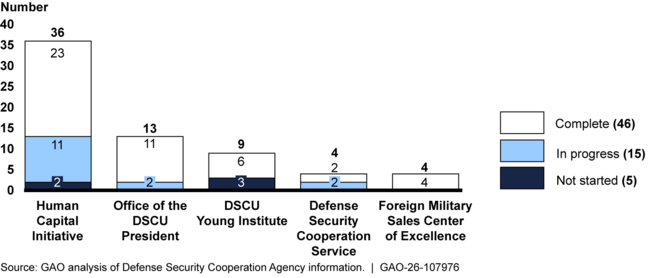
Note: DSCU = the Defense Security Cooperation University
DSCA officials implementing the security cooperation workforce provisions have identified and made plans to address personnel shortfalls and other challenges. For example, DSCA officials said that the federal civilian hiring freeze, implemented in January 2025, has been a factor in not being able to hire personnel to fill positions in the Human Capital Initiative. Officials are addressing this challenge by assigning key tasks and duties to other team members and leveraging other DSCA expertise to overcome critical skill gaps. As another example, officials identified challenges related to the development of a management information system. Officials said that DOD’s various security cooperation workforce components use different data systems to track positions and personnel. Until this management information system is in place, analysis of the security cooperation workforce position data is being done manually.
Why GAO Did This Study
To advance the U.S. national security strategy and foreign policy, the Department of Defense’s (DOD) security cooperation workforce works on activities that build the capacity of partner nations’ security forces through security assistance, including foreign military sales. This workforce includes military and civilian personnel in the U.S. and overseas who are responsible for planning, monitoring, or conducting these types of activities. DSCA, within DOD, plays a key role in planning and executing these programs.
Congress included provisions to help modernize and professionalize the security cooperation workforce in the National Defense Authorization Act for Fiscal Year 2024 The statute also includes a provision for GAO to evaluate DOD’s implementation of these provisions. GAO examined (1) the status of DSCA’s implementation of the Act’s security cooperation workforce provisions and (2) DSCA’s plans to address the challenges it identified in implementing the provisions.
GAO reviewed and analyzed DSCA documents describing actions the agency is taking to implement the provisions. GAO identified a total of 66 provisions in the law. GAO assessed the status as “complete” if there was evidence of actions taken that addressed the provision with no significant identified actions remaining to implement it. “In progress” indicates there is some evidence of actions taken to address the provision, and “not started” means that, as of May 2026, DSCA had not taken any actions to address the provision. GAO also interviewed DSCA officials responsible for managing these efforts about these actions and challenges in implementing the provisions.
For more information, contact James A. Reynolds at reynoldsj@gao.gov.