
Navy Ship Modernization: DOD Needs Comprehensive Strategy to Field Hypersonic Missile Capability
Fast Facts
The Navy is installing the Conventional Prompt Strike hypersonic missile on 3 ships and plans to add it to some future submarines. The Army is also buying the missile. Together, the services are investing over $50 billion in this effort.
But DOD doesn't have a comprehensive plan to help the Army and Navy coordinate on these purchases—preventing it from making cost-saving choices. For example, Army and Navy officials coordinate on day-to-day operations. But they don’t coordinate on bigger-picture issues, like how to invest money efficiently in the shared production line for the missile.
We recommended that DOD address these issues.
Flight Test of the Conventional Prompt Strike Hypersonic Missile
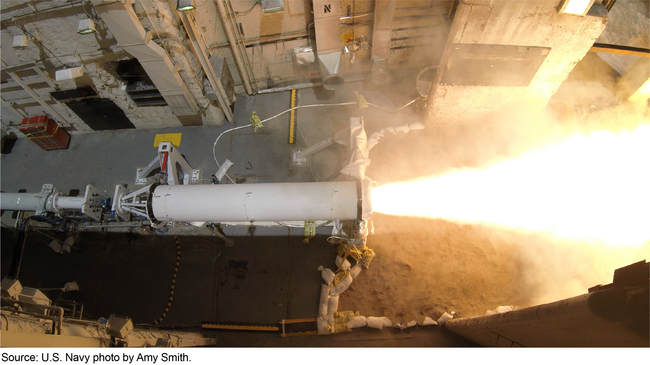
Photo of missile test
Highlights
What GAO Found
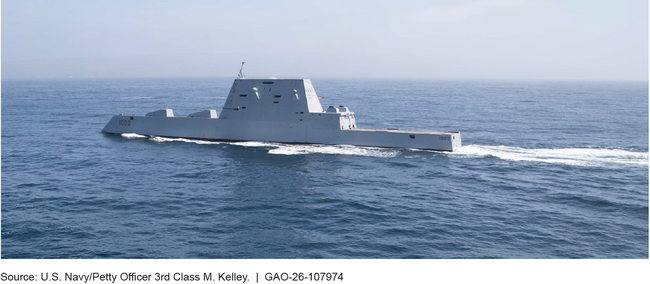
The Navy is currently 24 months behind in its efforts to modernize three DDG 1000 Zumwalt class destroyers to host the Conventional Prompt Strike (CPS) hypersonic missile as part of its surface strike mission. Both the DDG 1000 and CPS efforts face challenges:
- Although modernization of the first ship in the class, USS Zumwalt (DDG 1000), was 94 percent complete as of January 2026, it is behind schedule due to unplanned work.
- The DDG 1000 class ships have unique systems, such as its radar, combat, and network systems, that are costly and difficult to sustain and maintain.
- The CPS effort was originally scheduled to begin flight testing on the DDG 1000 class in 2025 but this is now planned for 2027 due to funding and testing challenges.
- The CPS program encountered quality and production issues putting the current rate well below the production goal of 12 missile rounds per year.
USS Zumwalt (DDG 1000)
DOD is planning to invest at least $50 billion into developing, testing, producing, and fielding CPS capability across several programs, including: CPS, Virginia class submarine, and the Army’s Long-Range Hypersonic Weapon, among others. While Navy and Army officials told GAO that they coordinate with each other, the services largely manage investment decisions for these programs separately, which contributes to inefficiencies and delays.
DOD does not have a comprehensive strategy across all programs that ensures that each program’s investments achieve CPS’s common objectives. Without a comprehensive investment strategy that includes more formal coordination, the Army and Navy are not well-positioned to make timely and efficient investments in key areas, such as addressing shortfalls on their shared production lines or ensuring the economical sustainment and performance of the DDG 1000.
Why GAO Did This Study
The Navy intends to provide its three DDG 1000 Zumwalt class ships with the ability to strike surface targets. In 2021, the Navy decided to add hypersonic CPS missiles—at a planned cost of nearly $50 million per missile—to the DDG 1000 class destroyers to enable the U.S. to strike valuable, heavily defended targets from a distance with a non-nuclear payload. To do so, the Navy is modernizing the ships to include installing a vertical launch system for CPS missiles. The Navy plans to add the CPS missile system to some Virginia class submarines. The Army is developing its own version of the CPS, called the Long-Range Hypersonic Weapon, and is responsible for producing the missile glide body for both services, among other responsibilities.
A House report includes a provision for GAO to review the Navy’s large surface combatant program, including efforts to modify the DDG 1000 for its new mission. This report examines (1) the status of the DDG 1000 modernization, including CPS development, testing, and integration, and what risks these programs face; and (2) the extent to which DOD has a comprehensive strategy across various programs needed to field the CPS missile capability.
GAO reviewed relevant Navy and Army documentation and interviewed Navy and Army officials and contractor representatives. GAO also visited ship and missile contractor facilities in Mississippi and Alabama.
Recommendations
GAO is recommending that DOD develop and regularly review a comprehensive strategy that guides the coordination of investment decisions for delivering CPS capability. DOD concurred with this recommendation.
Recommendations for Executive Action
| Agency Affected | Recommendation | Status |
|---|---|---|
| Department of Defense | The Secretary of Defense should ensure that the Under Secretary of Defense for Acquisition and Sustainment, in coordination with the Secretaries of the Navy and Army, develops a comprehensive strategy that outlines how all programs involved with delivering CPS portfolio capability should coordinate and regularly review investment decisions. (Recommendation 1) |
When we confirm what actions the agency has taken in response to this recommendation, we will provide updated information.
|