
Nuclear Waste Cleanup: Better Data and Project Prioritization Vital to Managing Aging Infrastructure and Communicating Needs
Fast Facts
The Office of Environmental Management has thousands of facilities to help clean up nuclear waste from decades of weapons production and research. Cleanup activities include remediating groundwater, treating radioactive waste, and more.
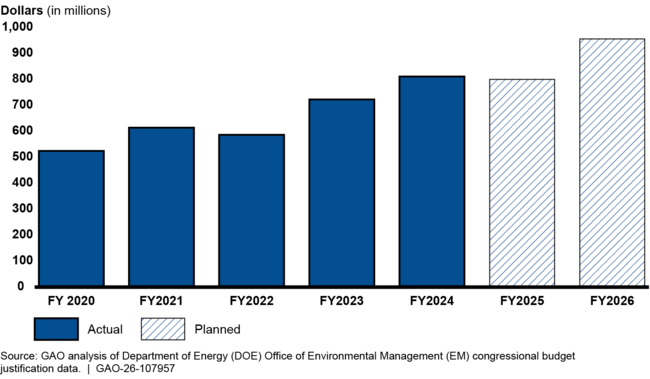
But many of these facilities are 50–70 years old and well beyond their designed life. And, annual maintenance costs for the facilities have nearly doubled since FY 2020 to over $950 million in 2026.
We recommended this office communicate to Congress the potential cost savings it identified in its prioritization model for maintenance activities, among other things.
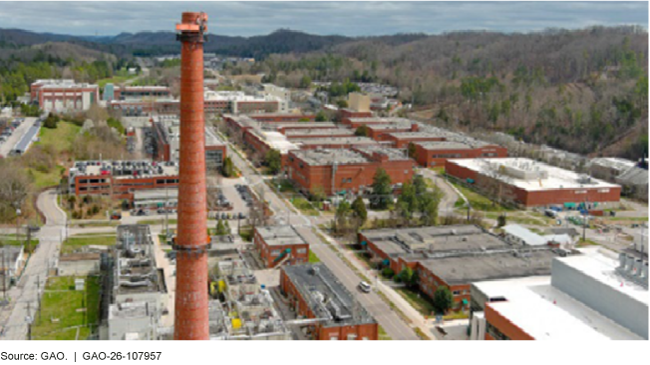
Aerial photograph of a town with buildings, roads, and mountains in the background.
Highlights
What GAO Found
The Department of Energy’s (DOE) Office of Environmental Management (EM) reported over $1.5 billion in repair needs across its about 4,300 operating facilities, as of June 2025. EM’s budget request included over $950 million in maintenance spending in fiscal year 2026, an 80 percent increase since fiscal year 2020.
EM Direct-Funded Maintenance and Repair Spending, Fiscal Years (FY) 2020–2026
EM sites and headquarters use data from condition assessments of facilities to make maintenance decisions. EM validates these data for accuracy using scorecards. According to GAO’s analysis, some scorecards included inaccurate or unsupported data and did not have completed corrective action plans. Also, GAO’s review of site responses to a questionnaire found that some sites used different methods to generate data elements categorized as performance measures by a DOE order. As EM uses these data to make decisions for funding repairs, accurate and comparable data would help EM to better plan, prioritize, and fund the continued reduction of its maintenance needs.
EM headquarters uses the Master Asset Plan—a document that outlines the infrastructure necessary to meet EM’s current mission requirements—to document its maintenance needs. Eight of 13 EM sites reported that this plan does not capture their maintenance needs, in part because sites have more granular data about their maintenance needs than headquarters uses in this plan. This plan also contains 19 projects identified in a cost savings model that could use surplus funds to produce about $120 million in savings for EM. However, EM has not communicated the benefits of completing these unfunded maintenance projects to Congress. Aligning its plan with EM site needs and communicating potential benefits would help EM to manage its maintenance needs and save millions of dollars in the long term.
Why GAO Did This Study
EM is responsible for addressing hazardous and radioactive waste at sites contaminated from decades of nuclear weapons production and nuclear energy research. EM has reported significant repair needs and deferred maintenance, which increase safety, cost, and mission risks. EM sites reported that these costs will further increase over the next 5 years.
Senate Report 118-188 accompanying a bill for the fiscal year 2025 National Defense Authorization Act includes a provision for GAO to evaluate the status of EM’s infrastructure and how EM completes and prioritizes maintenance of its infrastructure. This report (1) describes the status of EM’s infrastructure, (2) examines the extent to which EM maintenance practices align with DOE policies and guidance, and (3) examines how EM prioritizes maintenance in its budget planning. GAO reviewed data on EM facilities and interviewed EM headquarters, site officials, and contractor staff. GAO also analyzed responses from EM sites to a questionnaire on their infrastructure maintenance and reviewed EM budget materials.
Recommendations
GAO is making four recommendations to DOE. Two recommendations are related to improving data accuracy and comparability for facility data from EM sites. GAO is also recommending EM headquarters incorporate additional information from EM sites in its planning to better communicate maintenance needs, and that EM communicate benefits from its own cost-saving recommendations to Congress. EM concurred with the first two recommendations and partially concurred with the last two recommendations, as discussed in the report.
Recommendations for Executive Action
| Agency Affected | Recommendation | Status |
|---|---|---|
| Office of Environmental Management | The Assistant Secretary for EM should ensure sites create and complete corrective action plans to correct data validation issues identified in the FIMS validation scorecard process. (Recommendation 1) |
DOE agreed with the recommendation and said the Office of Environmental Management will coordinate with its field offices to create and track the status of corrective action plans. DOE expects to complete this update by the end of 2026. We will follow up with DOE after it has taken action.
|
| Office of Environmental Management | The Assistant Secretary for EM should ensure EM sites have procedures to accurately and comparably capture deferred maintenance and annual actual maintenance FIMS data elements, as required in DOE Order 430.1C. (Recommendation 2) |
DOE agreed with the recommendation and said the Office of Environmental Management will coordinate with its field sites to review current procedures for real property reporting requirements and propose changes as needed. DOE expects to complete this update by the end of 2026. We will follow up with DOE after it has taken action.
|
| Office of Environmental Management | The Assistant Secretary for EM should better incorporate more reliable information from EM sites in the Master Asset Plan, such as site project prioritization decisions for infrastructure maintenance projects, to better reflect site maintenance needs. (Recommendation 3) |
DOE partially agreed with the recommendation and said the Office of Environmental Management will evaluate current reporting requirements for the Master Asset Plan. EM stated in its comments that the plan does not prioritize EM-wide funding needs or provide direction to the sites. We recognize this and note that it is intended to communicate site prioritization decisions. Given the differences we found in the data between the Master Asset Plan and sites' integrated priority lists, as well as site officials' views that few to none of the maintenance needs are reflected in the Master Asset Plan, more reliable information is needed for the plan to function as intended. We will follow up with DOE after it has taken action.
|
| Office of Environmental Management | The Assistant Secretary for EM should communicate to Congress the reductions in cost and risk to mission that can be achieved by specific projects identified by their prioritization model. (Recommendation 4) |
DOE partially agreed with the recommendation and said the Office of Environmental Management will issue a memo to the sites to emphasize the importance of including additional information to support funding requests. The Master Asset Plan includes a project prioritization model that generates recommendations for how EM could utilize small increases in funding to make significant differences in reducing risks. A model that shows how to save millions of dollars while reducing risk is a powerful tool, but EM will not realize the goal of its model--to maximize the expected return from a limited budget--if it does not inform those who can help EM achieve its goal. We will follow up with DOE after it has taken action.
|