
Hydrogen Energy: Technologies Offer Potential Benefits but Face Challenges to Widespread Use
Fast Facts
Hydrogen can be used to power vehicles, store energy from the grid, fuel rockets, and more.
The U.S. could produce vast amounts of hydrogen from domestic resources. But the current use of hydrogen for energy is minimal. Challenges to broader use include cost and difficulties with transportation and storage.
This technology assessment offers policy options that support a range of related policy goals. Options include clearer regulations, infrastructure development, and support for expanding the applications of hydrogen energy.
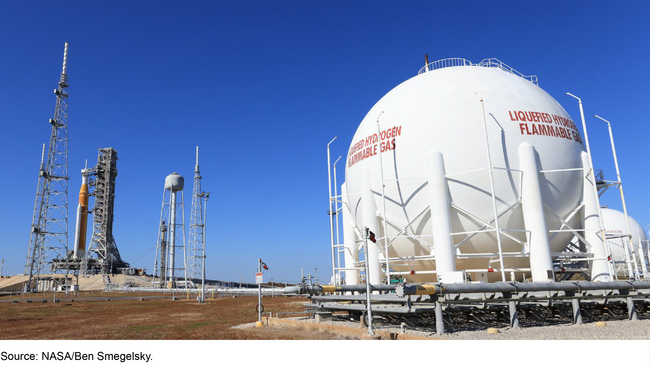
A landscape view of a large white tank that says liquified hydrogen, connected to a rocket ship and launch tower, with other tall metal structures nearby.
Highlights
What GAO Found
Hydrogen energy technologies offer long-duration energy storage, increased transportation efficiencies, quiet operation, reduced air polluting emissions, and potentially broad availability. For example, hydrogen fuel cell power generation technologies could provide quiet, clean backup power to data centers and other large-scale operations during power outages. These generation technologies could increase overall electricity grid security by providing long-duration energy storage. Currently, hydrogen fuel cells provide about 0.03 percent of utility-scale electricity generation.
Current and potential hydrogen energy technologies

However, hydrogen energy technologies have not been widely adopted because of hydrogen’s relatively high cost and limited market. Additionally, GAO identified four technical challenges to widespread use:
- Efficiency and safety. Hydrogen’s physical characteristics make it particulary susceptible to efficiency losses, leakage, and emergency response risks.
- Infrastructure. Transport and storage infrastructure is generally lacking or confined to certain regions of the U.S., and existing natural gas pipeline infrastructure might not be suitable for hydrogen.
- Geography. Geographic constraints can increase transport and storage costs for hydrogen users.
- Regulation and permitting. Unclear federal jurisdiction and lack of standards can slow down projects.
Since the 1950s, the U.S. has made periodic investments in hydrogen as a potential power source and transportation fuel. Relevant past legislation cited goals such as energy security and resilience, market competitiveness, and prioritizing use of lower-emission energy technologies. GAO offers seven options that policymakers could consider to advance these goals and address challenges to hydrogen energy use. GAO formulated these options for five policy goals, identified through a review of historical congressional legislation related to hydrogen energy. See tables 1–5 in this report for additional policy options and details.
Policy Goals and Policy Options for Hydrogen Energy Technologies
| Policy goal: Energy security and resilience. | |
|---|---|
|
Policy options (report p. 21)
|
Opportunities
Considerations
|
| Policy goal: U.S. hydrogen market competitiveness. | |
|
Policy options (report p. 22)
|
Opportunities
Considerations
|
| Policy goal: Low-carbon energy transition. | |
|
Policy options (report p. 24)
|
Opportunities
Considerations
|
| Policy goal: Prioritize technologies with near-term potential. | |
|
Policy options (report p. 27)
|
Opportunities
Considerations
|
| Policy goal: Research, development, and innovation. | |
|
Policy options (report p. 28)
|
Opportunities
Considerations
|
Source: GAO. | GAO-26-107932
Why GAO Did This Study
Hydrogen is a versatile chemical with many potential uses, including vehicle fuel cells, aviation fuel, and power generation. For decades, interest in hydrogen energy technologies to augment or replace diesel, natural gas, and electricity has garnered billions of dollars in research and development. The U.S. could produce hydrogen in vast quantities from domestically abundant resources. However, hydrogen energy is generally more costly than alternatives and infrastructure is lacking, so whether it will replace incumbent technologies is unclear.
This report examines: (1) current and emerging technologies for hydrogen production, transport, storage, and use; (2) potential benefits and challenges to developing or using these technologies; and (3) possible policy options.
To conduct this technology assessment, GAO searched the relevant literature; reviewed documents and reports; interviewed stakeholders from government, industry, academia, and nonprofits; conducted site visits; attended a conference; and convened a 3-day meeting of 18 experts from government agencies, industry, academia, and federally funded research and development centers. GAO is identifying policy options in this report.
For more information, contact Karen L. Howard, PhD at HowardK@gao.gov.