
Could Hydrogen Be the Future of Energy or Is It All Hot Air?
Hydrogen has been proposed as a solution to the world’s energy problems for at least 100 years. Among its virtues, it produces no greenhouse gases when burned as fuel, and in principle its supply is unlimited.
Yet, hydrogen has fallen well short of its promise and doesn’t feature among the technologies currently reshaping the energy sector.
Today’s WatchBlog post looks at our new report about hydrogen energy and some policy options that could help the U.S. better tap its potential.
Image

Hydrogen: the Swiss Army knife of energy
Hydrogen (H) is the most abundant element in the universe. But our planet doesn’t have much hydrogen in usable form (a molecule of two H atoms, called H2). We need to produce it using another form of energy.
The good news is that it’s versatile. Hydrogen can be produced using any kind of energy—fossil, solar, nuclear—and it can be used for almost anything that requires energy. For that reason, it’s been likened to a Swiss Army knife.
The use that’s most common right now is not technically part of the energy sector: 90% of U.S. hydrogen goes to manufacturing processes like fossil fuel refining and fertilizer production.
How is hydrogen energy currently used? Hydrogen energy is, so far, a niche product. For example, it’s great for indoor forklifts because it runs quietly, produces no air pollution, and takes only 3 minutes to refuel. Hydrogen is also a preferred rocket fuel because it delivers more energy per pound than any other conventional fuel.
But some scientists have envisioned it being used throughout the energy sector. The dream is that it could replace fossil fuels, which will eventually run out. And if hydrogen is produced using low-carbon energy, it could be part of a permanent solution to climate change.
Daunting obstacles: cost, transportation, and storage
That dream is far off. Hydrogen currently provides 0.03% of the country’s electricity and less than 0.01% of its vehicle fuel. The main obstacle is that it costs more, sometimes much more, than the competition.
Average Retail Transportation Fuel Prices in October 2025
Image
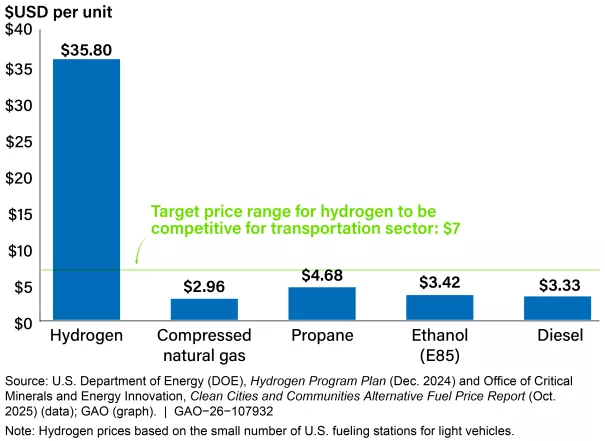
And even if the cost could be brought down, other obstacles could hamper the technology. For one thing, hydrogen requires specialized infrastructure for storage and transportation. For another, processes like compression are more expensive for hydrogen than for fossil fuels, so cost might need to be even lower than the alternatives.
Congress, industry, and other policymakers do have options if they want to pursue hydrogen energy. For example, they could sponsor research to improve transport and storage. And they could invest in using hydrogen for applications where it offers the highest potential, like energy storage to stabilize the electricity grid.
For more on the technology and the policy options, check out our new report.
- GAO’s fact-based, nonpartisan information helps Congress and federal agencies improve government. The WatchBlog lets us contextualize GAO’s work a little more for the public. Check out more of our posts at GAO.gov/blog.
- Got a comment, question? Email us at blog@gao.gov.
GAO Contacts
Image



Related Products

GAO's mission is to provide Congress with fact-based, nonpartisan information that can help improve federal government performance and ensure accountability for the benefit of the American people. GAO launched its WatchBlog in January, 2014, as part of its continuing effort to reach its audiences—Congress and the American people—where they are currently looking for information.
The blog format allows GAO to provide a little more context about its work than it can offer on its other social media platforms. Posts will tie GAO work to current events and the news; show how GAO’s work is affecting agencies or legislation; highlight reports, testimonies, and issue areas where GAO does work; and provide information about GAO itself, among other things.
Please send any feedback on GAO's WatchBlog to blog@gao.gov.