
K-12 Education: Research on Effectiveness of Professional Development Is Mixed, but Teachers Find Collaborative Learning Most Useful
Fast Facts
The Department of Education provides more than $2 billion in grants each year to support K-12 teacher professional development, among other things. State and local officials say the grant program's flexibility and simple requirements helped them meet local educational needs.
While the studies we reviewed found that teacher professional development is generally associated with higher student test scores, the research is mixed about which types are most effective.
When surveyed, most teachers said collaborative learning opportunities with other teachers improved their teaching and their students' learning.

A group of people in a classroom talking while sitting in groups.
Highlights
What GAO Found
Teacher professional development is generally associated with higher student test scores, according to meta-analyses GAO reviewed. However, research is mixed about which specific elements of teacher professional development contribute to these higher scores. For example, one of the three meta-analyses that reviewed coaching—one specific element of teacher professional development—found a generally positive association between coaching and student test scores, while the other two meta-analyses found no association.
Most teachers (67 percent) said collaborative learning opportunities with other teachers improved their teaching or their students’ learning, according to a nationally representative RAND survey of K-12 public school teachers from school year 2022–23. Similarly, teachers who responded to GAO’s nongeneralizable questionnaire said collaborative professional development was useful for their classroom teaching. For example, respondents said professional learning communities helped them share resources, exchange ideas, or reflect on teaching practices or issues in the classroom.
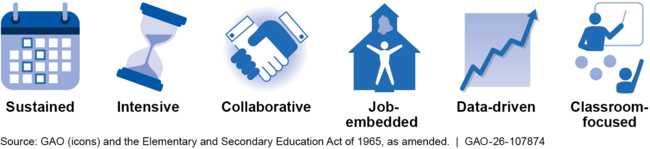
Title II, Part A (Title II-A)—a formula grant program in the Elementary and Secondary Education Act of 1965, as amended (ESEA)—provides federal funds to states and school districts for activities such as teacher professional development. State and local officials from the three states and nine school districts GAO spoke with said that Title II-A’s flexibility and straightforward requirements helped them meet their communities’ educational needs. For example, New Mexico officials described using Title II-A funds to train school district officials on mentoring and recruitment, build a statewide cadre of mentors, and train teachers for leadership and administrative positions. In addition, officials from six of nine school districts reported that requirements applicable to Title II-A—which include that professional development be “data-driven” and “sustained (i.e., not stand-alone, one-day, or short-term workshops),” among others—helped to ensure that professional development is high quality or effective (see figure).
Selected Requirements for Professional Development Under the Elementary and Secondary Education Act of 1965, as Amended
Why GAO Did This Study
Congress appropriated about $2.2 billion in Title II-A grants each year from fiscal years 2022 through 2024, making it the second largest formula grant program in the ESEA. GAO was asked to review whether Title II-A funds were being used in a manner likely to raise student achievement. This report describes (1) the elements of professional development that research finds to be effective, (2) the elements of professional development that teachers find most useful, and (3) the experiences of selected states and school districts using Title II-A to support effective instruction.
GAO reviewed five meta-analyses that measured the effectiveness of teacher professional development and five U.S. Department of Education studies of randomized controlled trials of teacher professional development programs. In addition, GAO analyzed RAND’s nationally representative American Instructional Resources Survey reports from school years 2022–23 and 2023–24 and developed and disseminated a questionnaire to teachers understand the professional development elements they find useful. GAO also interviewed officials from the New Mexico, Pennsylvania, and Tennessee state educational agencies and nine school districts to understand how these states and districts used Title II-A funds to improve instruction. GAO selected these states and school districts based on characteristics such as the level of state Title II-A funds received, geographic distribution, and urbanicity.
For more information, contact Jacqueline M. Nowicki at nowickij@gao.gov.