
Naval Shipyards: Complete Information Needed for Decision-Making on Multibillion-Dollar, 50-Year Infrastructure Program
Fast Facts
The Navy is taking on its largest-ever construction and restoration effort to improve poor conditions and outdated infrastructure at its 4 shipyards. These shipyards are essential to ensuring the Navy’s aircraft carriers and submarines are fit to fight in operations. This effort could take over 50 years and ultimately cost more than $200 billion.
But we found that Navy and congressional oversight requirements don't include regular evaluation of costs, risks, and performance for this effort. Having such information for decision-making would ensure that current plans evolve with the Navy’s future needs.
Our recommendations address this and more.
Construction of a Dry Dock at Portsmouth Naval Shipyard in Kittery, Maine
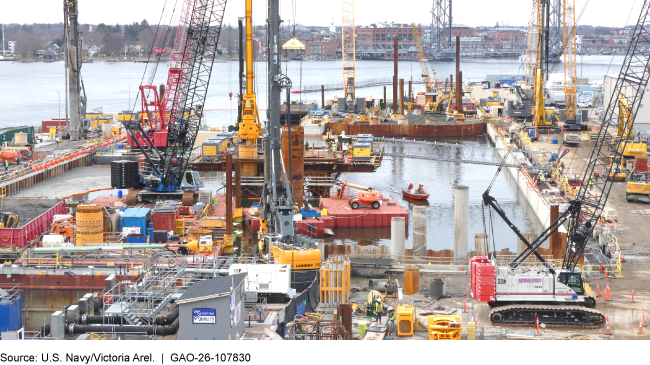
A dry dock construction site at Portsmouth Naval Shipyard.
Highlights
What GAO Found
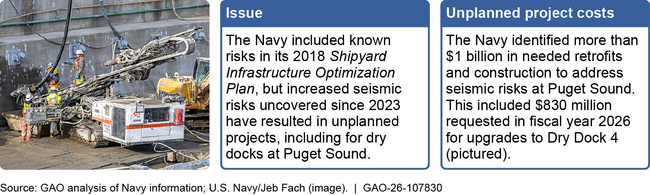
The Navy’s Shipyard Infrastructure Optimization Program (SIOP) will surpass $200 billion and take over 50 more years to execute, based on GAO’s analysis of Navy plans. Developing the plans and cost estimates to rebuild the Navy’s four public shipyards has taken the Navy years longer—and will cost much more—than originally anticipated due to multiple challenges and changes involved in the program. For example, environmental issues led to additional projects and more extensive work affecting project plans and costs at the shipyards, including Puget Sound Naval Shipyard (see figure).
Seismic Risks Identified at Puget Sound Naval Shipyard
The Navy established an oversight framework to guide SIOP plans and decisions over the duration of the program. The framework includes tools and requirements typically used for major defense acquisition programs—like for missiles, aircraft, or ships. However, the Navy has not outlined steps in the framework to reevaluate program objectives and resources as the program progresses over the next several decades. Without building such reviews into key future decision points, the Navy is limiting its ability to ensure that capabilities in SIOP’s plans today continue to be aligned or adjusted to support future fleet warfighting needs.
Further, while the Navy provides Congress with reports and briefings on various aspects of SIOP, the Navy does not provide Congress with consolidated, standardized information on full program costs and risks because there is no requirement to do so. In contrast, major defense acquisitions are required to provide annual program status reports with detailed metrics, including total costs to date, cost and schedule baselines, and risks, to track and monitor progress. Without a full picture of how much has been spent, what remains to be funded, and what risks may affect SIOP progress, Congress could make consequential decisions for SIOP based on incomplete information, thus risking billions in taxpayer dollars and a lack of program oversight for the decades to come.
Finally, the Navy created several organizations to manage SIOP projects and challenges. For example, the Navy created organizations for project oversight and program integration teams to coordinate issues with shipyards. However, the Navy has not fully documented the organizations’ roles and responsibilities. Doing so would formalize their new SIOP roles and help to ensure not only their ability to effectively implement SIOP’s essential projects but also the continuity of the critical shipyard operations to maintain and modernize the U.S. naval fleet now and throughout SIOP’s extended timeline.
Why GAO Did This Study
The Navy’s four public shipyards are essential to maintaining and modernizing the U.S. fleet of nuclear-powered vessels and its critical warfighting capabilities. The Navy initiated SIOP in 2018 to address poor shipyard conditions and capability gaps affecting fleet readiness. GAO has reported on the shipyards’ persistently poor condition and found that preliminary SIOP cost estimates were understated by billions of dollars.
The joint explanatory statement accompanying the Military Construction, Veterans Affairs, and Related Agencies Appropriations Act, 2024 includes a provision for GAO to report on SIOP oversight and management. This report examines (1) Navy planning and implementation of SIOP, including costs, timing, and challenges; (2) Navy oversight of SIOP; and (3) Navy establishment of project management organizations to oversee SIOP construction projects.
GAO analyzed SIOP program documents and project cost and schedule data; visited the shipyards to observe SIOP projects and ship maintenance; and interviewed officials.
Recommendations
GAO recommends Congress consider requiring the Navy to annually report consolidated, standardized status updates for SIOP, including total costs, for its duration. GAO is also making three recommendations for the Navy to include future reviews of program requirements and resources in its oversight framework, and to document key SIOP organizations’ roles and responsibilities for managing shipyard projects and risks. The Navy agreed with the recommendations and outlined planned steps to implement them.
Matter for Congressional Consideration
| Matter | Status | Comments |
|---|---|---|
| Congress should consider requiring the Navy to annually report consolidated, standardized information on the status of SIOP costs and progress for the duration of the program. The status reports to Congress should include (1) detailed and summary information for the program overall, such as total expenditures to date; original and current program schedule, performance, and cost estimates; associated risk analysis; and other elements reported by MDAPs, as applicable to SIOP and of interest to Congress; and (2) similar detailed and summary information for individual SIOP projects, which could be identified based on cost thresholds or other applicable thresholds, such as categories of military construction projects. (Matter for Consideration 1) | When we confirm what actions the agency has taken in response to this recommendation, we will provide updated information. |
Recommendations for Executive Action
| Agency Affected | Recommendation | Status |
|---|---|---|
| Department of the Navy | The Secretary of the Navy should ensure that the ASN (RD&A) includes in the SIOP oversight framework specific steps, such as part of its Gate 6 reviews, to periodically reevaluate SIOP's validated CDD program requirements, objectives, and performance parameters, following its Gate 5/Milestone B-C approval and during program implementation, to confirm continued relevance or identify emerging program gaps or changes. (Recommendation 1) |
When we confirm what actions the agency has taken in response to this recommendation, we will provide updated information.
|
| Department of the Navy | The Secretary of the Navy should ensure that the ASN (RD&A) includes in the SIOP oversight framework specific steps and timing for conducting annual Gate 6 sufficiency reviews of SIOP's mission readiness, affordability, and sustainability, as appropriate based on Navy MDAP guidance. (Recommendation 2) |
When we confirm what actions the agency has taken in response to this recommendation, we will provide updated information.
|
| Department of the Navy | The Secretary of the Navy should ensure that PMO 555, in coordination with NAVFAC and other pertinent stakeholders, identifies and documents key SIOP project management organizations and their SIOP roles, responsibilities, and collaborative relationships in the SIOP Concept of Operations. (Recommendation 3) |
When we confirm what actions the agency has taken in response to this recommendation, we will provide updated information.
|