
Special Education: More Students with Disabilities Were Educated in General Education Settings, but State Trends Varied Widely
Fast Facts
Seven million children received special education services in school year 2023-24. Under the Individuals with Disabilities Education Act, these students should be learning alongside their peers in general education classrooms as much as is appropriate.
We found that the number of students with disabilities placed in general education classrooms for much of their day increased 25% nationally from school years 2012-13 to 2023-24. But this varied across states and school districts.
School officials commonly cited resource availability, parental involvement in placement decisions, and school environment as factors influencing student placement.
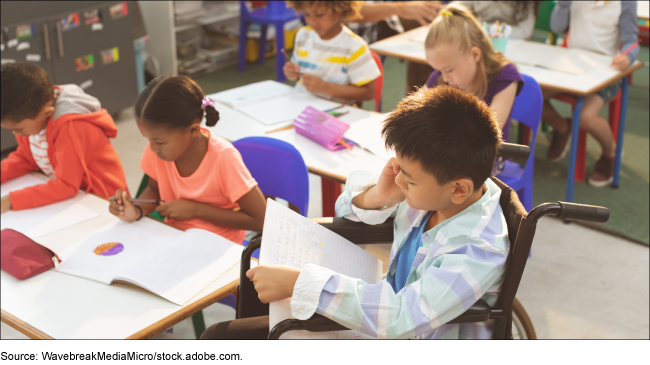
Kids studying in the classroom with one child sitting in a wheelchair reading.
Highlights
What GAO Found
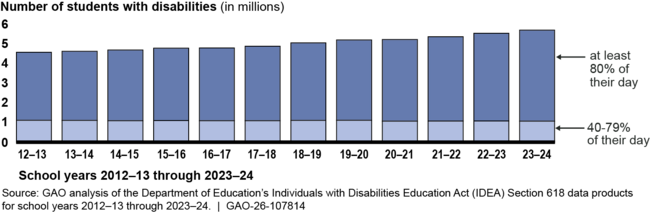
Under federal special education law, students with disabilities are to be educated alongside their peers without disabilities to the maximum extent appropriate. Nationally, the number of students with disabilities in the general education classroom (gen ed) for at least 40 percent of their day increased 25 percent from school year 2012–13 through school year 2023–24 (see figure). The largest increase came from students with disabilities in gen ed for at least 80 percent of their day. The total number of students with disabilities increased 21 percent during this period. GAO also found the share of students with disabilities in gen ed for much of their day increased in 42 of 50 states and the District of Columbia (no data were available for New Mexico for school year 2023–24). However, within states, changes over this period varied widely. For example, the District of Columbia had the largest increase (7.7 percentage points), while in North Dakota the share of students with disabilities in gen ed for at least 40 percent of their day decreased by 3.2 percentage points.
National Enrollment Trends for Students with Disabilities in the General Education Classroom for Much of Their Day (at Least 40 Percent)
For school year 2022–23 (the most recent data available), certain factors related to district resources were associated with higher rates of students with disabilities in gen ed for much of their day, according to GAO’s regression analysis. Specifically, GAO found that for the following types of districts a higher percentage of students with disabilities spent at least 40 percent of their day in gen ed: (1) districts with higher and lower levels of poverty, (2) districts that did not have a standalone special education school, and (3) districts with lower per pupil revenue (i.e., funding per student).
Across the districts and schools GAO visited, officials commonly identified resource availability, parental involvement in educational placement decisions, and school environment (i.e. facilities and school culture) as factors that influenced the educational setting of students with disabilities.
Officials from these schools and districts described challenges and successes creating a sense of belonging in the school community for students with disabilities. For example, officials at one school said funding constraints prevented the school from hiring an additional athletic coach with needed expertise or training to meaningfully include students with disabilities in sports. Officials and educators at a school in another state said they had successfully promoted belonging through small group work where students with disabilities are intentionally grouped with students without disabilities.
Why GAO Did This Study
About 7 million children aged 6 through 21 received special education and related services under Part B of the Individuals with Disabilities Education Act (IDEA) in school year 2023–24. Under IDEA, children with disabilities are to be educated in the “least restrictive environment.” According to Department of Education guidance, inclusive practices can positively shape outcomes for all students. The guidance further notes that all children deserve to feel a sense of belonging in their learning environment.
GAO was asked to review the settings in which students with disabilities are educated. This report addresses: (1) how general education placements for students with disabilities vary nationwide and statewide, (2) factors that influence educational placement for students with disabilities, and (3) how selected districts and schools encourage a sense of belonging in the school community for students with disabilities.
GAO used federal special education data and reviewed federal laws, regulations, guidance, and studies. GAO assessed the number of students who spent much of their day in gen ed by analyzing data on students who spent 40 to 79 percent and 80 percent or more of their time in gen ed. GAO’s regression analysis identified district characteristics associated with the percentage of students with disabilities in gen ed for much of their day. GAO also interviewed Education officials, and officials and educators from 12 districts and eight schools in Connecticut, Illinois, and Washington. GAO selected districts and schools based on factors such as enrollment size and locale.
For more information, contact Jacqueline M. Nowicki at NowickiJ@gao.gov.