
Guam: Considerations for Evaluating Alternative Customs Models and Potential Economic Effects
Fast Facts
Guam, a U.S. territory, administers its own customs operations. It imposes cargo inspection and visitor arrival fees but not tariffs. Guam’s customs agency has reported declining revenues and other challenges to its operations.
We looked at alternatives to Guam’s current customs model, including those used in other U.S. territories. Adopting one of these options could require changes in laws, funding sources, and technology, among other things.
Changing Guam’s customs model could also affect its economy. For instance, imposing U.S. tariffs could make imports more expensive, and raising Guam’s visitor arrival fees could affect tourism.
Guam’s customs agency uses this dog to inspect incoming baggage, cargo, and mail.
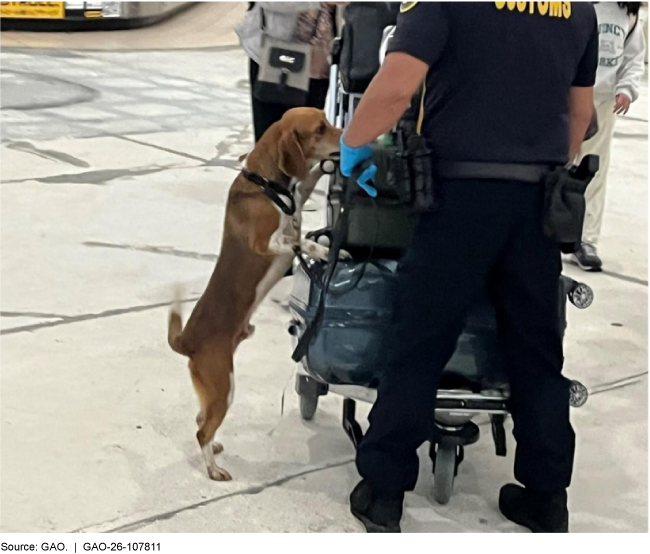
A dog on its hind legs puts its front paws on a luggage trolley being pushed by a customs official. The tip of its tail is blurry from wagging.
Highlights
What GAO Found
Several factors limit the operations of Guam’s Customs and Quarantine Agency (CQA). For example, CQA maintains only paper-based records of customs transactions, which officials said limits efficiency, may compromise data reliability and result in reduced revenue. In August 2025, CQA received funding to implement an automated customs system. Nonfunctional equipment and procurement delays also limit CQA’s operations. For the past 3 years, CQA has had only one working x-ray machine, resulting in time-intensive manual cargo inspections.
GAO identified several considerations for evaluating three selected alternatives to Guam’s current customs model: (1) Guam joins the U.S. customs territory, with U.S. Customs and Border Protection (CBP) administering Guam customs (federalized model); (2) Guam remains outside the U.S. customs territory, with CBP administering Guam customs (hybrid model); or (3) Guam retains its current customs model, with additional funding for CQA from higher fees for incoming passengers or cargo. Considerations include the following:
- Legal changes and funding sources. In the federalized model, federal law would have to be amended for Guam to join the U.S. customs territory. In the federalized or hybrid model, a source of funding for CBP operations in Guam would need to be identified.
- Jurisdiction and security. In the federalized model, CBP would not inspect cargo from the U.S. customs territory. CQA officials said this could increase the risk of illegal drugs entering Guam, as most are smuggled from other parts of the U.S. Also, in the federalized model, Guam’s ports would need to be upgraded to meet all federal security requirements.
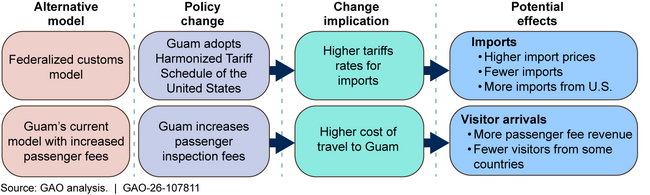
Changes to Guam’s current customs model could also affect Guam’s economy. In the federalized model, imports from foreign countries would be subject to U.S. tariffs, while Guam currently does not impose tariffs. Because manufacturing in Guam is limited, this would likely raise the prices of goods on the island. In Guam’s current model with additional funding for CQA, raising passenger fees to increase CQA funding would likely reduce the number of travellers from some countries to Guam. This, in turn, would likely reduce tourism revenue, which is vital to Guam’s economy.
Potential Economic Effects if Guam Adopts One of Two Selected Alternative Customs Models
Why GAO Did This Study
Guam, a U.S. territory in the Indo-Pacific, serves as a strategic U.S. shipping and military hub. Being outside the U.S. customs territory, Guam is not subject to U.S. federal customs administration and may impose its own tariffs on imports. CQA, which administers Guam’s customs operations, is intended to fund its operations through fees collected from incoming passengers and for cargo imports. However, a drop in tourism since 2020 has reduced its revenue.
GAO was asked to examine CQA’s operations as well as alternatives to Guam’s current customs model. This report describes (1) factors that limit CQA’s operations, (2) considerations for evaluating selected alternative customs models for Guam, and (3) potential economic effects if Guam adopts one of the selected alternative models.
GAO analyzed documents provided by Guam and U.S. agencies. GAO also interviewed agency officials and stakeholders in Washington, D.C.; Guam; Puerto Rico; and the U.S. Virgin Islands (USVI). GAO selected Puerto Rico and USVI to examine customs models used in other U.S. territories. CBP administers customs in Puerto Rico, which is in the U.S. customs territory and therefore uses U.S. tariffs. CBP also administers customs in USVI, which is not in the U.S. customs territory and sets its own tariffs. GAO analyzed these models, as well as Guam’s current model with additional CQA funding, as possible alternatives for Guam customs operations. GAO also conducted economic analyses to estimate the effects of Guam’s adopting one of the selected models. In comments on a draft of this report, the Office of the Governor of Guam and CQA raised concerns about the scope of GAO’s review. GAO believes its scope was appropriate to answer the report’s objectives.
For more information, contact Nagla'a El-Hodiri at elhodirin@gao.gov.