
Low-Earth Orbit: NASA Faces Impending Decisions for Replacing International Space Station with Commercial Stations
Fast Facts
When your car gets old, you have to decide whether to spend money repairing it or replacing it. Similarly, the International Space Station is nearing 30 years old, and NASA is facing decisions about what to do next.
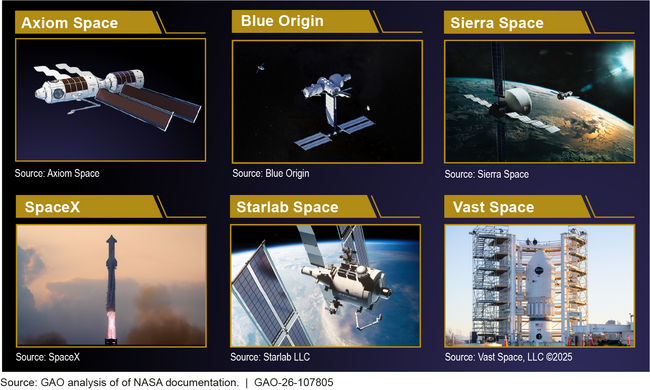
To that end, NASA is working with 6 commercial companies on developing space stations that NASA and other customers could use in low-Earth orbit.
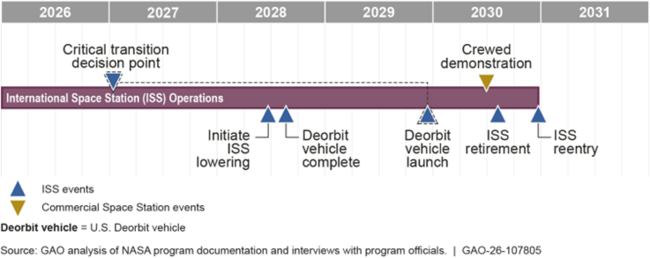
NASA needs to decide by next year whether a commercial station will be ready to replace the ISS before its planned retirement in 2030, or whether it should make other plans like extending the ISS's life.
We recommended that NASA document the factors it'll use to make this decision.
The deorbit vehicle, which will help retire the space station, is docked to the ISS in this artist's rendering.
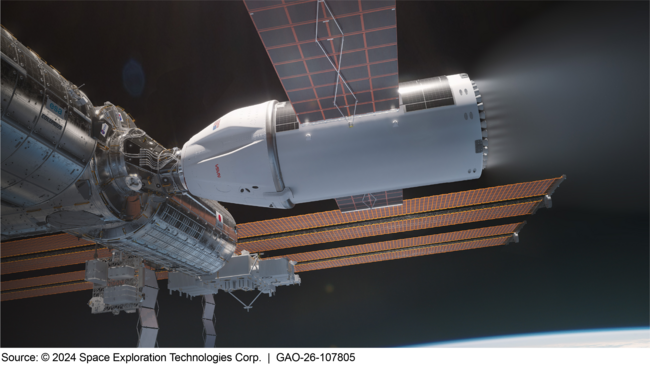
A photorealistic picture of large equipment docked to the International Space Station, on the black background of space
Highlights
What GAO Found
Facing the retirement of the International Space Station (ISS), the National Aeronautics and Space Administration (NASA) is planning to replace it with one or more commercially owned and operated space stations. NASA’s goal is to transition from the ISS, a government-owned platform, to commercial space stations to ensure the U.S. maintains a continuous presence in low-Earth orbit (LEO).
NASA is working with six U.S. companies to develop and certify commercial space stations that NASA and other customers could use in LEO. NASA has been working with the companies to mature their initial space station designs.
NASA’s Commercial Providers’ Space Station Concepts
As of May 2026, NASA has not yet finalized the acquisition approach for this transition. Under the current approach, NASA plans to award one or more Space Act Agreements in 2026 to build stations. Subsequently, NASA anticipates that it will award a contract for certifying that the commercial space stations are safe for NASA crew and for buying mission services.
Timeline of Key Events in the Transition from Using the ISS to Commercial Stations in Low Earth Orbit
In March 2026, NASA also introduced an alternative approach that would include the use of a government-owned core module for a station onto which commercial companies could then attach their modules. As of May 2026, NASA officials were evaluating options for how to proceed.
NASA faces several risks that could lead to a gap in human presence in LEO. For example, there would be a gap if the commercial stations are not available before NASA retires the ISS. NASA historical data suggest that developing the commercial stations might take longer than currently planned.
NASA also faces an overall risk of a potential gap in LEO. However, it has not yet assessed the likelihood or duration of a gap since undergoing several changes such as revising its acquisition approach. Assessing the likelihood of a potential gap would help NASA make more informed decisions on how to mitigate this risk.
NASA is approaching a critical juncture when it must assess readiness and decide whether to pursue the retirement of the ISS and transition to the use of commercial space stations. If the commercial space stations are not assessed to be ready in time, NASA may need to consider other options, such as extending ISS operations beyond 2030, which would have budget implications.
According to NASA officials, the assessment will need to occur in 2027 based on several factors. These factors include sufficient time for NASA to secure funding for additional transportation vehicles to support ongoing ISS operations. Documenting the assessment process and factors—such as key assumptions, risks, and uncertainties—would better position officials to make this decision and improve the transparency of NASA’s assessment.
Why GAO Did This Study
For 25 years, crews aboard the ISS contributed to scientific research and technology development not possible on Earth. U.S. policy calls for an uninterrupted capability for human space flight and operations in LEO to ensure continued U.S. participation and leadership in space. To continue to meet the policy, NASA plans to buy services from companies developing commercially owned and operated space stations. NASA’s ultimate goal is to be one of many customers buying these services. NASA created the Commercial LEO Development Program to work with companies to develop and certify space stations for its crews and to stimulate and foster the development of a commercial space economy in LEO.
GAO was asked to review NASA’s plans for transitioning from the ISS to commercial space stations and plans to retire the ISS. This report identifies upcoming key decision points for NASA leadership related to the transition and examines the implications of a potential gap in human presence in LEO.
To do this work, GAO reviewed NASA, commercial space station development, and ISS documentation and interviewed relevant officials.
Recommendations
GAO recommends that NASA 1) assess the likelihood and duration of a gap in continuous capability or human presence in LEO; and 2) document the assessment process and factors it will use to decide whether NASA will retire the ISS as planned or extend its operations beyond 2030.
Recommendations for Executive Action
| Agency Affected | Recommendation | Status |
|---|---|---|
| National Aeronautics and Space Administration | The NASA Administrator, in coordination with the Space Operations Mission Directorate, should use its risk management process to assess the likelihood and duration of a gap in continuous capability or human presence in LEO, including plans to mitigate the likelihood of a gap, if necessary. (Recommendation 1) |
When we confirm what actions the agency has taken in response to this recommendation, we will provide updated information.
|
| National Aeronautics and Space Administration | The NASA Administrator, in coordination with the Space Operations Mission Directorate, should document the assessment process that NASA will use to make an informed decision on NASA's readiness to retire and deorbit the ISS as planned in 2030. This includes documenting the factors that will be used to make the decision such as the key assumptions, risks, and uncertainties. (Recommendation 2) |
When we confirm what actions the agency has taken in response to this recommendation, we will provide updated information.
|